
AI Automation for E-commerce: Inventory, Support, and Personalization
Last updated: August 16, 2026 · By Joseph Olivas, Founder, MEAN Consultors · 9 min read
E-commerce is the easiest place in business to justify AI automation, because the work is repetitive, high-volume, and already digital. It is also the easiest place to waste money on it, because the vendor landscape is crowded with tools that demo beautifully against clean sample data and fall apart against a real product catalog with inconsistent SKUs and three different names for the same color.
I want to be concrete about where the returns actually are, what each application needs from you before it works, and the order I would build them in. If you are earlier in the process and still deciding whether automation is the right lever at all, start with business process automation 101 and come back.
Where the returns actually are
Adoption in retail is already high. McKinsey’s research on AI in retail and consumer goods finds the large majority of companies actively using or piloting AI, though full implementation across operations remains far less common — most organizations are running pilots rather than production systems. Inventory and demand forecasting consistently ranks as the largest single use case by budget allocation.
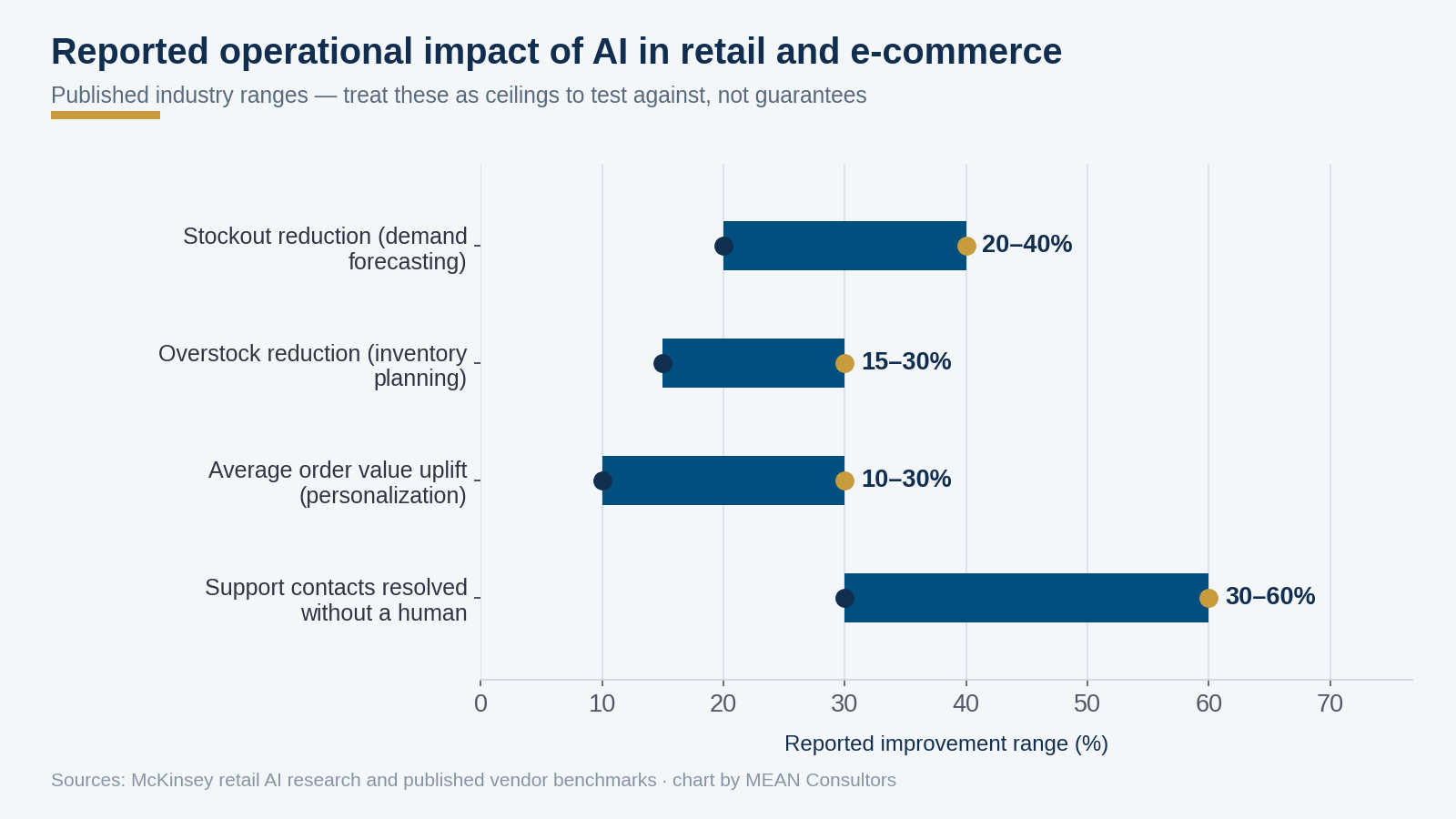
Figure 1: Reported improvement ranges for the main AI applications in retail and e-commerce. Treat the upper bounds as ceilings achieved under good conditions, not as forecasts for your business.
A word about how to read those ranges. They come from published industry research and vendor case studies, which means they reflect organizations that implemented well, on data that was in reasonable shape, and that had a reason to publish the result. Your realistic outcome sits toward the lower bound in year one. That is still a strong return — a 20% reduction in stockouts on a business doing meaningful revenue is a large number — but I would rather you budget against the floor than the ceiling.
- Demand forecasting is the largest AI use case in retail by budget allocation, with reported stockout reductions of 20–40%.
- Personalization delivers 10–30% average order value uplift in published research — but it is the most data-dependent of the three.
- Most retailers are running pilots rather than production systems; the gap between piloting and implementing is where the value is lost.
Inventory and demand forecasting
This is the least glamorous and most valuable of the three. Traditional reorder points are usually a fixed number set by someone two years ago based on a gut feeling about a season. A forecasting model looks at your actual sales history, seasonality, promotional calendar, lead times per supplier, and — where available — external signals like weather or local events, and produces a per-SKU forecast that updates as new data arrives.
The business case works from both directions at once. Stockouts cost you the sale and often the customer. Overstock ties up cash in inventory that may need to be discounted to clear. Every retailer knows this; what they usually lack is a forecast granular enough to act on at the SKU level rather than the category level.
What it needs from you: at least 18 to 24 months of clean sales history, consistent SKU identifiers across your platform and your accounting system, and accurate supplier lead times. That last one is where projects stall. If your lead times are recorded as “about two weeks” in a spreadsheet someone maintains manually, the model has nothing reliable to optimize against.
Where it goes wrong: forecasting new products with no history, and forecasting through a one-off event the model has never seen. Both are handled with human overrides rather than by trying to make the model smarter. Keep a person in the loop for exception cases and let the model handle the 90% that is routine.
Customer support deflection
The support inbox on an e-commerce business is dominated by a small number of question types: where is my order, how do I return this, do you ship to my country, is this back in stock. These are not judgment calls. They are lookups against systems you already have, wrapped in conversational language.
A retrieval-based AI agent connected to your order management system can answer them accurately, because it is reading real order data rather than generating a plausible-sounding guess. That distinction is the entire ballgame — an agent that hallucinates a delivery date is worse than no agent at all. The technical pattern that prevents it is retrieval-augmented generation, which I covered in what RAG is and why businesses need it, and the failure mode it addresses is explained in AI hallucinations: why they happen and how to design around them.
What it needs from you: API access to order status, a returns policy written clearly enough that a machine can apply it, and an escalation path to a human that triggers on low confidence rather than only when the customer asks. Also worth being honest about: the agent needs to be allowed to say “I don’t know, let me get someone.” Agents that are never allowed to fail are the ones that make things up.
Personalization and merchandising
Personalization is the application everyone wants first and should build last. The reason is dependency: recommendations are only as good as your product data. If your catalog has inconsistent categories, missing attributes, and three variants of the same product listed separately, a recommendation engine will confidently recommend the same item the customer is already looking at.
Done properly, it covers more than the “customers also bought” widget. Search relevance is usually the higher-return surface — on-site search users convert at a much higher rate than browsers, and most store search is still keyword matching that fails on synonyms and natural phrasing. Automated product tagging and description generation sit in the same bucket: unglamorous catalog work that makes everything downstream better.
It also connects directly to conversion work you may already be doing. Recommendations shown at the wrong moment increase friction rather than order value — the checkout is generally the wrong place, as the checkout UX principles in reducing cart abandonment with better checkout UX make clear.
The order to build these in
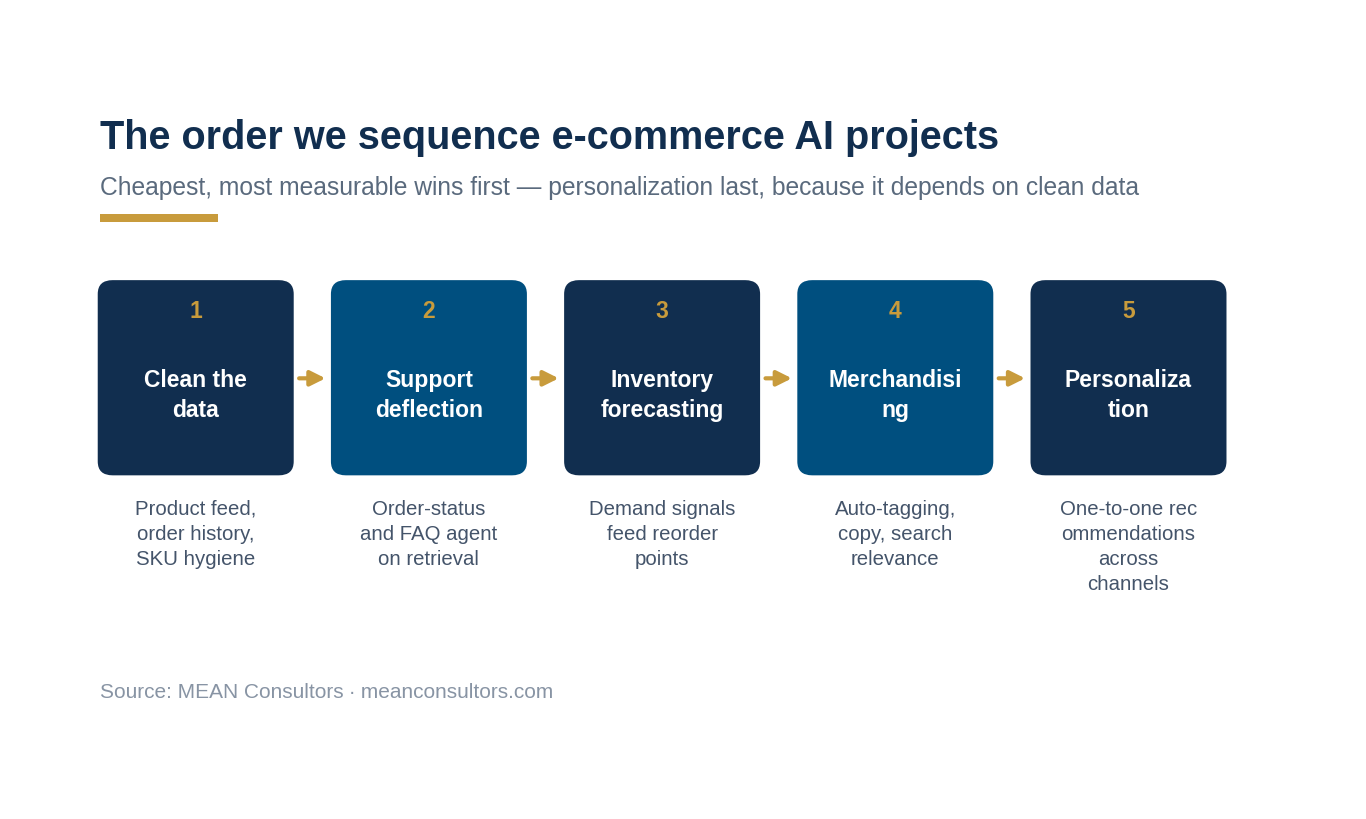
Figure 2: The sequence we use on e-commerce AI engagements. Data hygiene first, then the applications in order of how much clean data they require.
The sequence is not arbitrary. Support deflection comes early because it depends mostly on order data, which is usually the cleanest data a store has — orders either exist or they do not. Forecasting comes next because it needs sales history plus supplier data, which is messier. Personalization comes last because it needs the full product catalog to be consistent, which is the hardest thing on the list to fix and the least likely to already be true.
| Application | Data prerequisite | Time to first measurable result | Primary risk |
|---|---|---|---|
| Support deflection | Order API, written policies | 4–8 weeks | Hallucinated answers without retrieval grounding |
| Demand forecasting | 18–24 months sales history, supplier lead times | 1–2 quarters | Garbage lead-time data; new SKUs with no history |
| Automated merchandising | Consistent product attributes | 6–12 weeks | Tagging errors propagating across the catalog |
| Personalization | Clean catalog plus behavioral data | 2+ quarters | Irrelevant recommendations eroding trust |
- Audit SKU consistency across your storefront, ERP, and accounting system before scoping anything
- Pick one application and one measurable baseline metric — do not run three pilots at once
- Confirm you have API access to the systems involved, not just screen access
- Define what “the model is wrong” looks like and what happens when it is
- Keep a human override path for every automated decision that touches a customer or a purchase order
- Measure against the pre-automation baseline, not against the vendor’s case study
- Budget for ongoing monitoring — models drift as your catalog and customer mix change
If you want to put numbers around the decision before committing, the framework in how to calculate ROI on a business automation project applies directly here, and the integration groundwork usually looks like the work described in connecting your CRM, ERP, and e-commerce platform. Both are the sort of scoping we handle at the front of an AI automation engagement before any model is chosen.
Frequently Asked Questions
What is the best first AI automation project for an online store?
Customer support deflection, in most cases. It has the shortest path to a measurable result, depends on order data that is usually already clean, and produces a metric your team feels immediately. Demand forecasting has a larger financial upside but takes a quarter or more to demonstrate, which makes it a harder first project to sustain internally.
How much data do I need before demand forecasting is worth attempting?
Roughly 18 to 24 months of sales history at the SKU level, so the model can see at least one full seasonal cycle plus enough recent data to detect trend changes. Equally important is accurate supplier lead-time data, which is more often the blocker than the sales history is.
Will an AI support agent give customers wrong information?
It can, if it is generating answers rather than retrieving them. An agent grounded in your actual order and policy data through retrieval is answering from a source of truth. An agent relying on a general model’s knowledge is guessing. Insist on retrieval grounding, a confidence threshold that escalates to a human, and transcript review during the first weeks.
Do I need to replace my e-commerce platform to add AI automation?
Usually not. Most of this work happens through APIs alongside your existing platform rather than inside it. The question is whether your platform exposes the data you need programmatically. If it does not — if inventory only lives in an admin screen with no API — that constraint has to be solved first, and it is a platform question rather than an AI question.
How much does e-commerce AI automation cost?
It varies too widely by scope to quote responsibly, but the cost drivers are consistent: the state of your data, the number of systems that need integrating, and whether you are buying a configured tool or building something custom. Data cleanup is routinely the largest line item and the one most often left out of vendor estimates.
Is personalization worth it for a small catalog?
Less so. Recommendation engines need enough products and enough behavioral data to find meaningful patterns. With a few dozen SKUs, thoughtful manual merchandising usually outperforms an algorithm. Personalization starts to earn its place as catalog size and traffic volume grow.
How do I know whether an AI project is actually working?
Define the baseline before you start and measure the same metric after. For support: resolution rate and repeat-contact rate. For forecasting: stockout frequency and inventory carrying cost. For personalization: average order value and add-to-cart rate on recommended items. If a vendor cannot tell you which number should move and by when, that is the answer.
MEAN Consultors audits your product and order data, tells you honestly what is ready and what is not, and scopes the automation that will show a result this quarter.