
How to Calculate ROI on a Business Automation Project
Last updated: August 4, 2026 · By Joseph Olivas, Founder, MEAN Consultors · 8 min read
Automation vendors love to quote enormous returns, and business owners are right to be skeptical. The truth is that automation ROI is very real — but only when you measure it honestly. Most disappointing projects are not the technology’s fault; they fail because the benefits were overstated, the costs were undercounted, or the wrong process was automated. This guide gives you a framework to run the numbers yourself before you commit a dollar.
The automation ROI formula
At its core, ROI is simple arithmetic. What separates a useful estimate from a fantasy is the completeness of what you plug in.
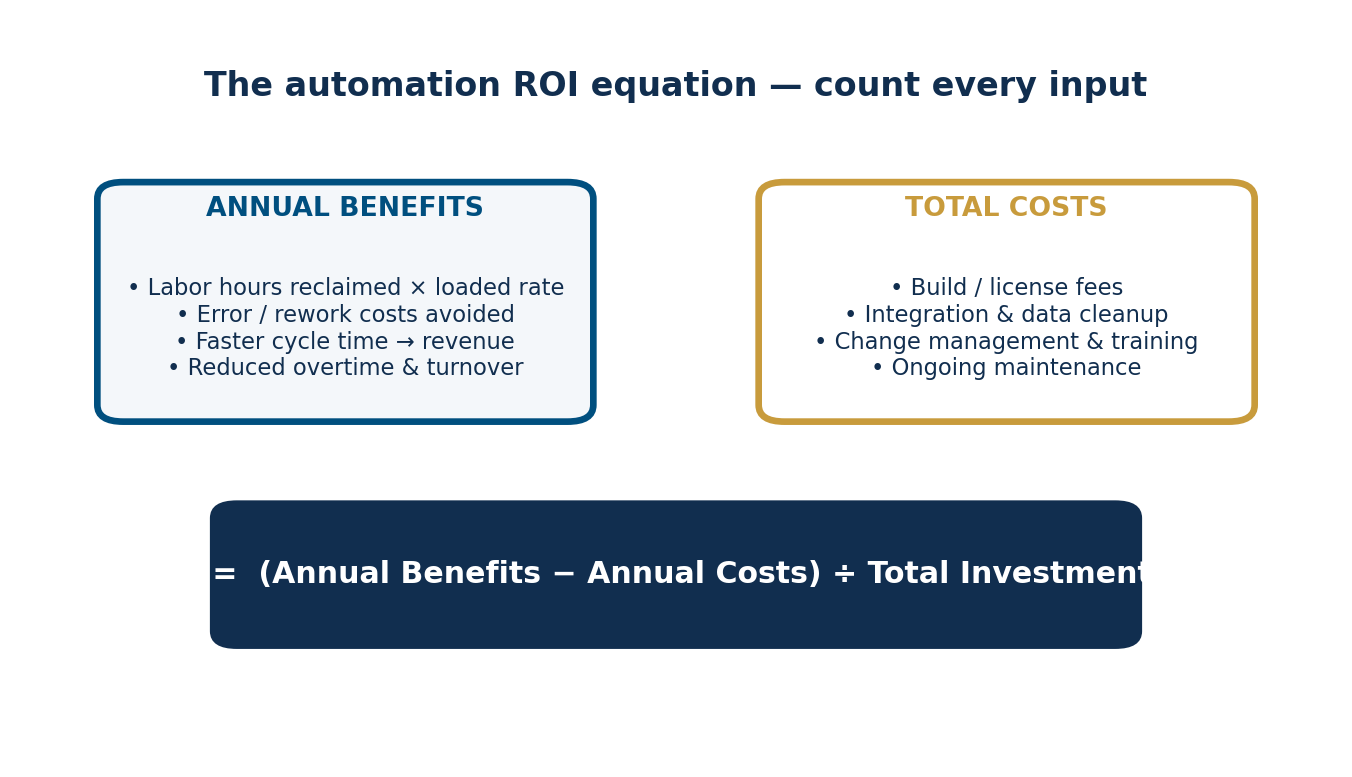
Figure 1: The automation ROI equation — the result is only as honest as the inputs on both sides.
On the benefit side, the biggest driver is usually labor: hours reclaimed multiplied by the fully loaded cost of the people doing the work. Add the cost of errors and rework you avoid, the revenue unlocked by faster turnaround, and reductions in overtime or turnover. On the cost side, go beyond the build or license fee to include integration and data cleanup, change management and training, and the ongoing maintenance every automation needs. This mapping work is exactly why we insist on workflow mapping before automation — you cannot value a process you have not measured.
What returns to actually expect
Realistic benchmarks keep you honest. Industry data puts typical robotic process automation returns at 100–250 percent in the first 12–18 months, with the best implementations reaching 380 percent or more. But payback timing varies dramatically: a 2025 Deloitte survey found only about 6 percent of organizations achieved payback in under a year, while most saw a more realistic two-to-four-year horizon as they moved from simple bots to more capable systems.

Figure 2: Automation returns are strong on average, but payback timelines are spread across a wide range.
The lesson is not to distrust automation — it is to model your own numbers rather than borrowing a vendor’s best-case slide. A conservative estimate that still clears your threshold is far more valuable than an aggressive one that sets you up to feel burned. When we scope work under our AI and automation services, we build the ROI model with the client so the assumptions are theirs, not ours.
A worked example
Say a five-person finance team spends 20 hours a week on manual invoice processing, at a fully loaded rate of $40 per hour. That is 1,040 hours a year, or about $41,600 in labor. Automation reclaims 75 percent of that time and eliminates roughly $8,000 a year in error-related rework — a combined benefit near $39,000 annually. If the project costs $45,000 to build and integrate plus $6,000 a year to maintain, first-year ROI is negative, but by year two the cumulative return turns clearly positive.
| Line item | Year 1 | Year 2 |
|---|---|---|
| Labor + error savings | +$39,000 | +$39,000 |
| Build & integration | –$45,000 | $0 |
| Maintenance | –$6,000 | –$6,000 |
| Net | –$12,000 | +$33,000 |
| Cumulative | –$12,000 | +$21,000 |
This illustrative example shows why timeframe matters: judged on year one alone, the project looks like a loss; judged over two years, it returns strongly. Always model at least a two-to-three-year horizon.
- ROI = (annual benefits – annual costs) ÷ total investment × 100 — but the estimate is only as good as the completeness of both sides.
- Typical automation projects return 100–250 percent over 12–18 months; top efforts exceed 380 percent, but most payback lands in a two-to-four-year window.
- Model a multi-year horizon — year-one figures often understate the true return.
Picking the right process to automate
The single biggest ROI lever is choosing the right process. Research consistently finds that a large share of automation projects underdeliver because of poor process selection, not weak technology. The best candidates are high-volume, repetitive, rule-based tasks with clean digital inputs — exactly the kind we outline in the most automatable business tasks.
- High volume — the task happens often enough that saved time adds up.
- Rule-based — the logic can be described clearly, without constant judgment calls.
- Stable — the process is not about to change, so the automation will not be obsolete.
- Error-prone when manual — automation’s accuracy gain is worth real money.
Beyond cost savings
The hard-dollar savings are only part of the story. Automation also delivers benefits that are harder to put on a spreadsheet but often matter more over time: fewer errors reaching customers, faster response times, employees freed from drudgery to do higher-value work, and the ability to scale without proportionally growing headcount. Capture these as secondary benefits in your model so a project that looks marginal on labor savings alone gets full credit for the value it creates.
Frequently Asked Questions
What is a good ROI for an automation project?
Typical robotic process automation projects return 100–250 percent within 12–18 months, and strong implementations exceed 380 percent. A “good” ROI ultimately depends on your own cost of capital and alternatives, but a well-chosen process should clearly clear your internal threshold within two to three years.
How long until an automation project pays for itself?
Payback varies widely. Some projects break even in months, but a 2025 Deloitte survey found only about 6 percent of firms achieve payback in under a year, with most landing in a two-to-four-year range. Model your specific numbers rather than assuming a fast payback.
What costs do people forget when calculating automation ROI?
The most commonly missed costs are integration and data cleanup, change management and training, and ongoing maintenance. The upfront build or license fee is usually only part of the total, so leaving these out inflates your ROI estimate.
Why do some automation projects fail to deliver ROI?
The most common reasons are poor process selection, change management gaps, and integration complexity — not the technology itself. Automating the wrong process, or one that keeps changing, is the fastest way to a disappointing return.
Should I include soft benefits in my ROI calculation?
Yes, but label them clearly. Benefits like improved accuracy, faster response, and freeing staff for higher-value work are real and often substantial. Keep them separate from hard-dollar savings so decision-makers can see both the conservative and the full picture.
MEAN Consultors builds the numbers with you before we build the automation — so you know the payback before you commit.