
AI Automation for Healthcare Administration: Use Cases and Limits
Last updated: August 14, 2026 · By Joseph Olivas, Founder, MEAN Consultors · 9 min read
Healthcare administration is an unusually good fit for automation, and an unusually easy place to over-promise. The same practice can have a genuinely transformative use case in eligibility verification and a genuinely dangerous one in clinical documentation, and the difference is not obvious from the vendor demo.
What follows is how I scope AI and automation work in healthcare administrative settings: where the returns are real and measurable, where the technology is capable but needs guardrails, and where the honest answer is that a human still has to do it.
The case for automating administrative transactions
The economics here are not speculative. CAQH tracks the cost of administrative transactions across the U.S. healthcare system, and the gap between manual and electronic processing is stark. For a single prior authorization request, the 2024 CAQH Index puts the manual cost at $3.41 per transaction against $0.05 when fully electronic — and the staff time at 24 minutes by phone, fax or email.
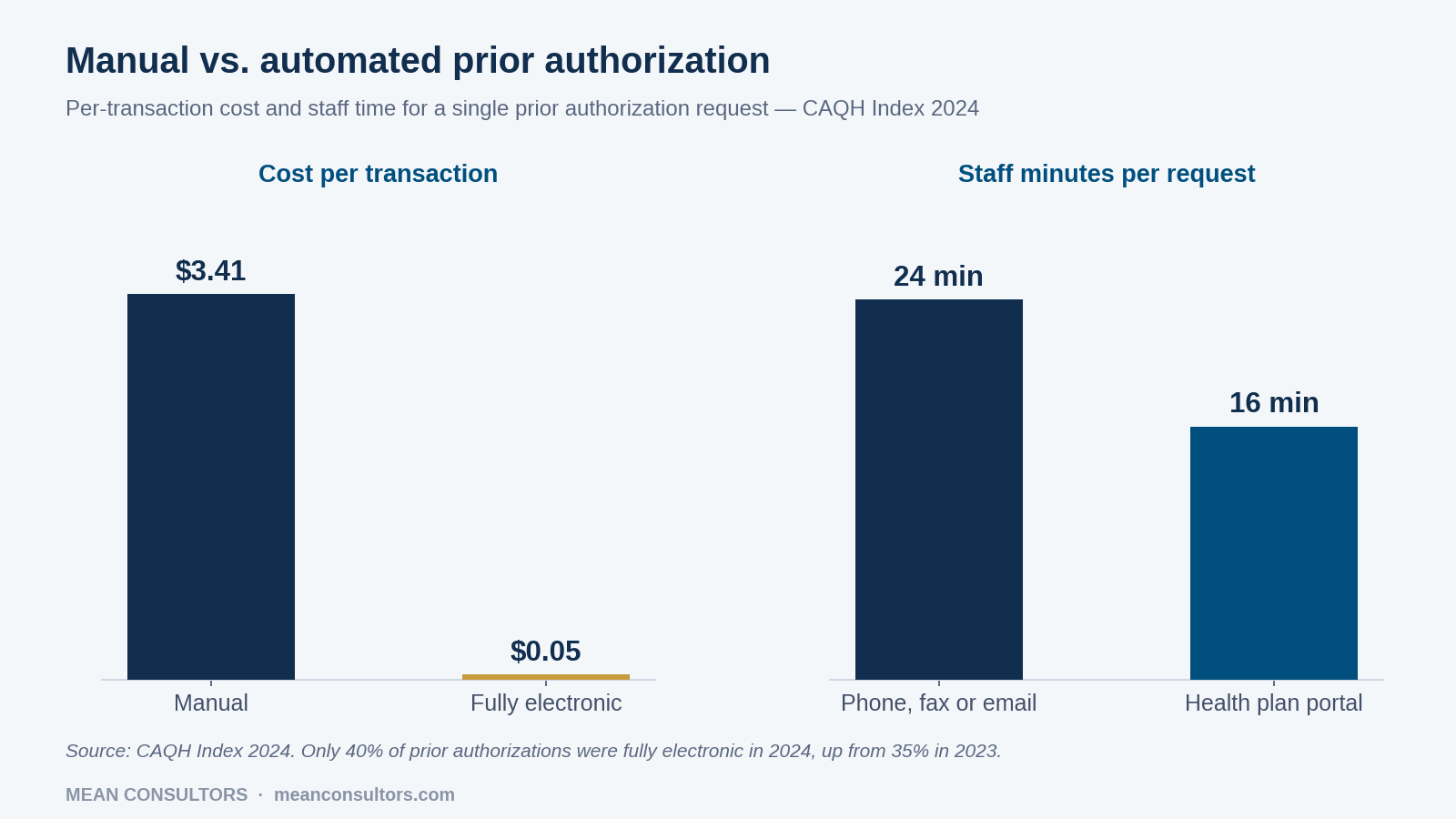
Figure 1: Cost and staff time for a single prior authorization request, CAQH Index 2024.
Two things follow from those numbers. First, the saving is per transaction, which means volume determines whether a project is worth doing at all — identical implementation effort pays back very differently at 50 versus 500 transactions a week. Second, adoption is still low: only 40% of prior authorizations were fully electronic in 2024, up from 35% the year before. The opportunity is not exotic; it is unfinished.
- A manual prior authorization costs $3.41 and 24 staff minutes; the fully electronic equivalent costs $0.05 (CAQH Index 2024).
- Even through a health plan portal, a prior authorization still consumes 16 staff minutes — portals reduce cost, not effort.
- Only 40% of prior authorizations were fully electronic in 2024, so most practices still have the easy gains available.
Where AI automation genuinely works
The pattern in every strong case below is the same: structured input, a defined correct answer, high volume, and a visible failure mode. Those four properties, not the sophistication of the model, are what make an automation safe to run.
- Eligibility and benefit verification. The clearest win. High volume, an existing electronic standard, and a failure that surfaces immediately. This is usually where I start, because it produces a measurable staff-time reduction that makes the next project easier to fund.
- Claim status inquiries. Deterministic lookups against a known payer response. Automating these removes a large share of the hold-music hours in a billing operation.
- Prior authorization intake. Assembling documentation, checking payer-specific requirements, populating and submitting. The clinical justification stays with the clinician; everything around it is document handling.
- Patient scheduling, reminders and intake forms. Repetitive, low clinical risk, easy to audit, and it reduces no-shows — which is a revenue effect, not just an efficiency one.
- Claim denial triage. Classifying denials by reason code and routing them is rules work. Deciding how to argue an appeal is not.
- Records requests and referral coordination. Tracking, chasing and routing are exactly what workflow automation is for, and they are among the most commonly dropped tasks in a busy front office.
Where the limits are real
The failure mode that matters in healthcare is not an automation that breaks. It is one that produces a confident, plausible, wrong answer that nobody catches, in a domain where wrong answers have clinical and financial consequences.
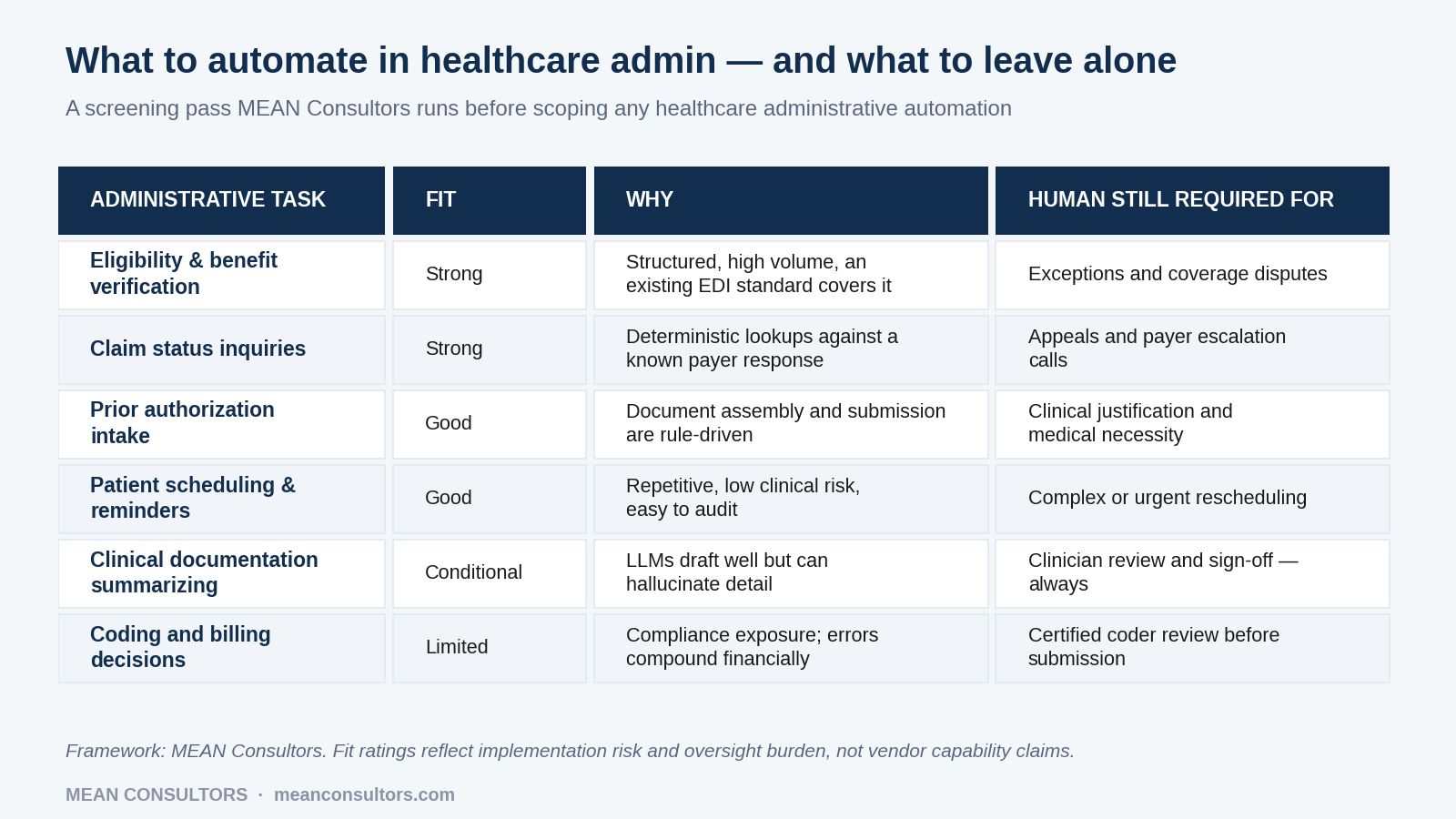
Figure 2: The screening pass we run before scoping any healthcare administrative automation.
Clinical documentation summarizing is the sharpest example. Large language models draft well, and the output reads convincingly — which is precisely the risk, because a fabricated detail in a clinical summary looks exactly like a real one. That is not an argument against using it. It is an argument for designing the workflow so a clinician reviews and signs off, always, and for building the system to retrieve from verified records rather than recall from training. Our explainer on why AI hallucinations happen and how to design around them covers the architectural patterns; retrieval-augmented generation is the usual answer.
Coding and billing decisions sit in a similar place for a different reason: the compliance exposure is asymmetric. An automation that is 97% accurate at coding sounds excellent until you consider what the other 3% represents across a year of claims.
Compliance is an architecture decision, not a checkbox
Every AI automation touching protected health information inherits HIPAA obligations, and the details are decided when the system is designed rather than when it is reviewed.
| Requirement | What it means in practice | Decide it |
|---|---|---|
| Business associate agreement | Any vendor processing PHI must sign one — many general AI services will not | First vendor conversation |
| Data residency and retention | Where PHI is processed, how long prompts and outputs are stored | Architecture, before build |
| Training-data exclusion | Explicit contractual guarantee your data is not used to train models | Contract stage |
| Minimum necessary | Send the model only the fields the task requires, not the whole record | Integration design |
| Audit logging | Every automated action attributable and reconstructable after the fact | Build |
| Human approval gates | Which actions can never execute without a person confirming | Workflow design |
How to start without betting the practice on it
The mistake I see most often is starting with the most painful process. Painful usually means complex, poorly documented and full of exceptions — the worst possible first automation. Start with the highest-volume process that is well understood, prove the pattern, then use what you learned on the harder one.
- Map the process before you automate it. Automating a broken workflow produces a faster broken workflow. Our guide to workflow mapping before automation covers the pass to run first.
- Measure the baseline. Transactions per week, minutes per transaction, error rate. Without these you cannot tell whether it worked, and you cannot justify the next project.
- Run parallel before you cut over. Automation and existing process side by side for a few weeks. Expensive, and worth it — this is where you find the exceptions nobody mentioned.
- Instrument the exceptions. What the automation could not handle is the most valuable data you will get, and it tells you where phase two goes.
- Calculate payback honestly. Include implementation, integration, training and ongoing oversight, not just licence cost. Our framework for calculating ROI on a business automation project covers what to include.
None of this is unique to healthcare, incidentally — the sequencing is the same discipline any operations team needs, and the fundamentals are covered in our business process automation primer. What healthcare adds is a lower tolerance for confident errors and a regulatory floor beneath every design decision. Both are manageable. Neither is optional.
Frequently Asked Questions
Is it HIPAA-compliant to use AI on healthcare administrative data?
It can be, but compliance is a property of the implementation rather than of the technology. You need a business associate agreement with any vendor that touches protected health information, controls on where data is processed and retained, audit logging, and a clear answer to whether your data is used for model training. Many general-purpose AI services will not sign a BAA on standard terms — that question should be asked in the first vendor conversation, not the last.
What is the highest-return administrative task to automate first?
Eligibility and benefit verification, in most practices. It is high volume, highly structured, has an established electronic standard, and the failure mode is visible and cheap to correct. It also produces an immediate, measurable staff-time reduction, which makes the next automation easier to fund internally.
Can AI handle prior authorization end to end?
Not responsibly. AI handles the intake side well — assembling documentation, checking payer-specific requirements, populating and submitting the request. The clinical justification of medical necessity is not an administrative task wearing a disguise; it is a clinical judgment. The realistic target is compressing the 24 minutes CAQH attributes to a manual request, not eliminating the clinician from the loop.
Will automating administrative work mean cutting staff?
In the small and mid-size practices I have worked with, it usually does not, because these teams are already behind rather than idle. What changes is what the same people spend their day on: fewer hold-music hours on eligibility calls, more time on the exceptions, appeals and patient issues that were being deferred. If you are building the business case on headcount reduction, be honest about that up front rather than discovering it during rollout.
How do we stop an AI system from hallucinating clinical information?
Constrain it. Retrieve answers from your own verified data rather than asking a model to recall them, require citations back to a source record, and design the interface so an unanswerable question produces “I do not know” instead of a confident guess. Then keep a human in the approval path for anything that touches a clinical record. Design around the failure mode; do not try to eliminate it with prompt wording.
How long does a healthcare administrative automation project take to pay back?
It depends far more on transaction volume than on build complexity, because the saving is per transaction. A practice running hundreds of eligibility checks a week reaches payback much faster than one running dozens, on identical implementation cost. Measure your current per-transaction time and volume before scoping — that pair of numbers determines whether the project is worth doing at all.
MEAN Consultors scopes AI and workflow automation for U.S. businesses, starting with the process map and the baseline numbers.