
SEO for B2B Distribution Companies and Logistics Providers
Last updated: August 26, 2026 · By Joseph Olivas, Founder, MEAN Consultors · 10 min read
Distribution is a large, quiet market. The U.S. Census Bureau put merchant wholesaler sales at $11.38 trillion in 2022, up 17.4% from $9.69 trillion the year before. Yet the typical distributor website is a brochure with a phone number, and the typical logistics provider site is three pages of stock photography and a quote form. The gap between the size of the market and the sophistication of the average site is exactly where the opportunity sits.
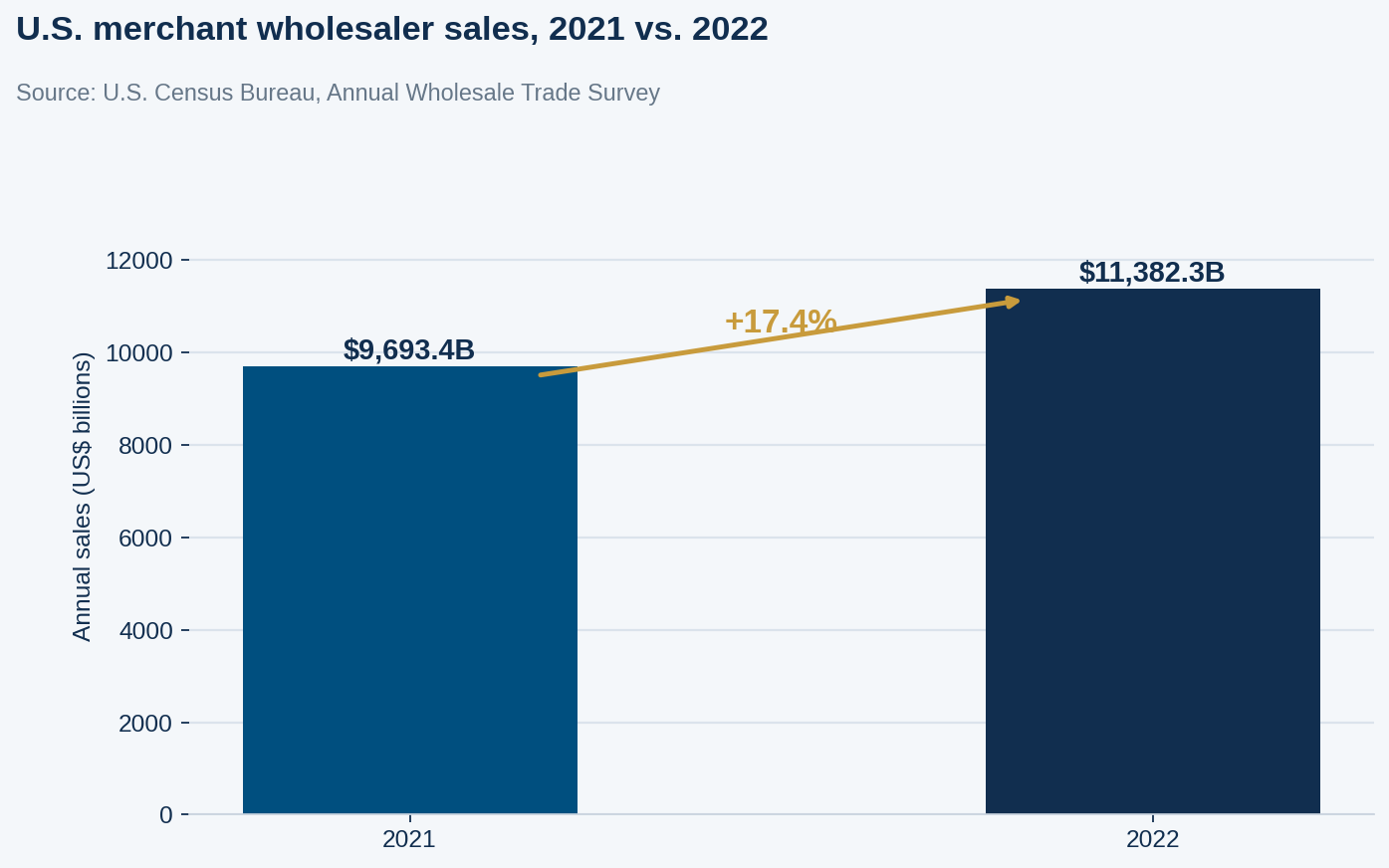
Figure 1: U.S. merchant wholesaler sales, 2021 vs. 2022. Source: U.S. Census Bureau, Annual Wholesale Trade Survey.
I want to be precise about what makes this vertical different, because the generic advice does real damage here. Distributors get told to publish twice a week and chase keyword volume, and they end up with a blog nobody reads while ten thousand SKUs sit invisible behind a search widget.
How buyers in this industry actually search
Three things distinguish distribution and logistics search behaviour, and each one has a direct structural consequence.
The queries are specific and low-volume. A maintenance manager does not search “industrial fasteners.” They search a part number, a manufacturer code, a spec string, or a discontinued item plus “replacement.” Individually these terms show almost no volume in keyword tools. Collectively they are the majority of qualified demand. If you filter your keyword list by search volume, you will delete your best opportunities.
Intent is late-stage by default. Somebody searching a part number has already decided what they need. Their remaining questions are availability, lead time, minimum order quantity, and whether you will pick up the phone. A page that answers those wins; a page that says “contact us for pricing” and nothing else loses to the competitor who published a lead time.
The buying committee is plural. The engineer specifies, procurement approves, finance signs, and compliance may veto. Each of those people searches differently. That is why capability pages, certification pages, and spec comparisons matter as much as product pages — they serve the people who never search a part number at all.
Where to spend your effort first
Given limited hours, this is the order I work in on a distribution or logistics site. The scores below are my own prioritisation model, weighted by how reliably each page type has produced qualified enquiries relative to the effort it takes to build.
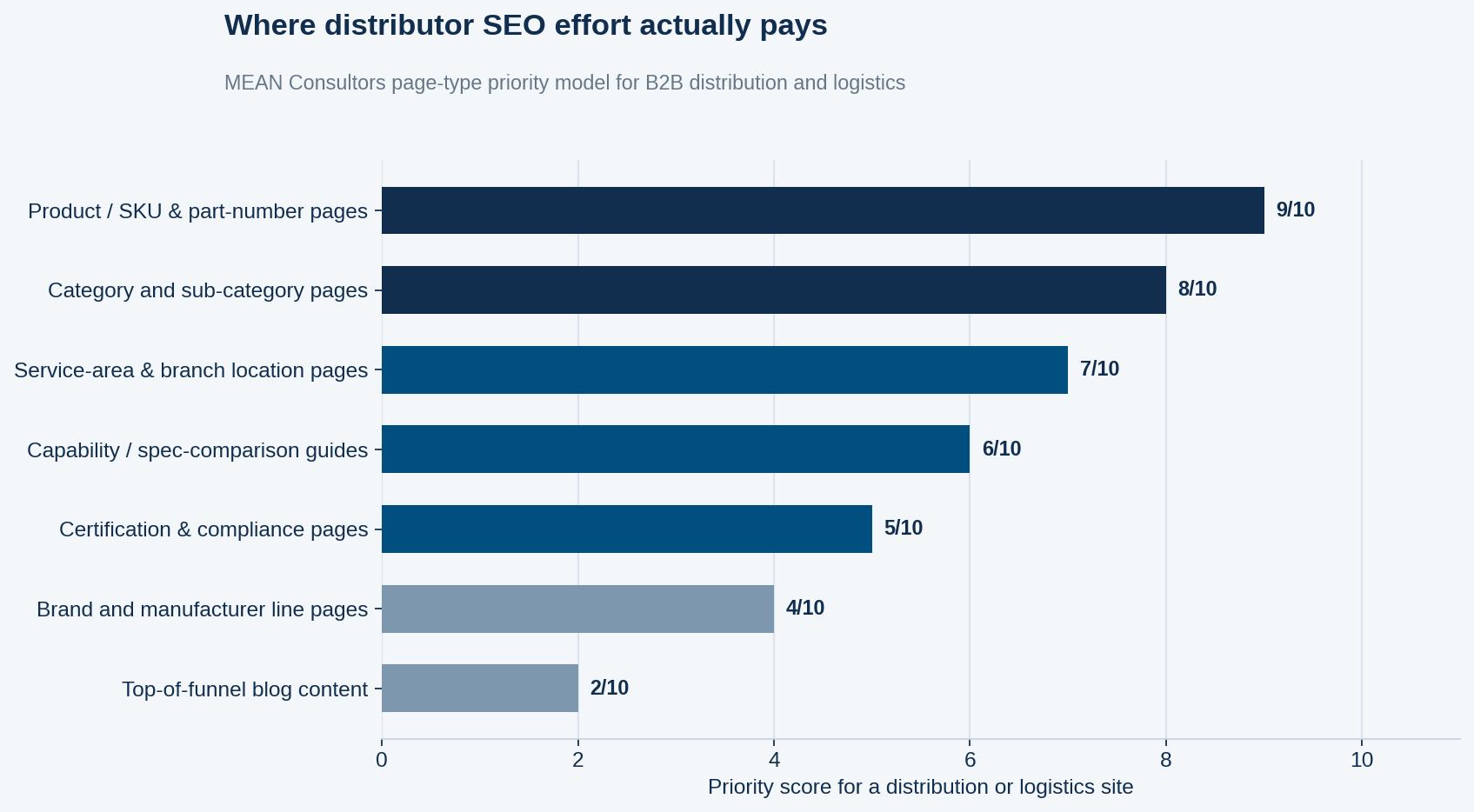
Figure 2: MEAN Consultors page-type priority model for B2B distribution and logistics websites.
- Merchant wholesaler sales reached $11.38 trillion in 2022 — a market whose online presence is far less competitive than its size suggests.
- Part-number and SKU-level pages outrank blog content as a priority because they capture buyers who have already decided what they need.
- Low keyword volume is not low value in this vertical; filtering by volume deletes the highest-intent demand.
- Availability, lead time, and minimum order quantity are ranking content, not just sales information — they are what the query is actually asking for.
Fix the catalogue before you write anything
The most common failure I find on distributor sites is a catalogue that search engines cannot see. It usually takes one of four forms: the product search is a client-side widget with no crawlable URLs; the catalogue lives behind a customer login; every product resolves to the same URL with a query string; or the entire catalogue is a downloadable PDF.
Each of those makes your inventory invisible. The fix is unglamorous and it is the highest-return work available to you: give every product a stable, indexable URL with a descriptive path, a unique title containing the manufacturer name and part number, the specifications rendered as text rather than an image, and internal links from the relevant category page. Our guide to site architecture for SEO covers how to structure that hierarchy so it scales past a few thousand items, and the e-commerce SEO checklist applies almost entirely to catalogue pages even when you do not transact online.
Branch and service-area pages that are worth publishing
Distributors with multiple warehouses and logistics providers with regional coverage both need location pages, and both usually build them the same wrong way: one template, one paragraph, the city name swapped. Google’s guidance on people-first content asks whether a page provides substantial value compared with other pages in results. A page whose only unique element is a city name does not.
A branch page earns its place when it carries information that is only true at that location: the actual address and hours, which product lines are stocked there, the local delivery radius and cut-off times, the will-call process, the branch manager’s name, and the certifications held by that facility. That content is genuinely difficult for a competitor to copy, which is exactly why it works. We go deeper on the mechanics in multi-location SEO without duplicate content and on the local fundamentals in the 2026 local SEO checklist.
The four content types that actually produce enquiries
Once the catalogue is indexable, editorial content earns its keep — but only four kinds do the heavy lifting in this vertical.
| Content type | Who it serves | Why it ranks | Example angle |
|---|---|---|---|
| Cross-reference and replacement guides | Engineers and maintenance | Captures discontinued and competitor part numbers | “Equivalents for a superseded fitting series” |
| Spec and compatibility comparisons | Specifiers | Answers a decision no manufacturer page will answer neutrally | “Choosing between two material grades for wash-down environments” |
| Compliance and certification explainers | Procurement, quality, compliance | Demonstrates the trust signals a buying committee screens for | “What our certifications mean for your audit” |
| Lead time and logistics transparency | Operations and planners | Directly answers the highest-frequency pre-purchase question | “Current lead times by product family, updated monthly” |
Notice what is missing: general industry trend posts, holiday content, and anything a competitor could publish without changing a word. If a page would read identically on a rival’s site, it is not going to earn a ranking worth having. A structured search engine optimization programme for a distributor should be roughly seventy percent catalogue and structure work, thirty percent editorial — the inverse of what most agencies propose.
The technical issues specific to large catalogues
Distribution sites break in characteristic ways once the catalogue passes a few thousand items. These are the ones I check first.
- Faceted navigation generating millions of crawlable filter combinations and burning crawl budget on near-duplicate pages.
- Out-of-stock or discontinued items returning a 404 instead of remaining live with alternatives, destroying accumulated equity.
- Product variants each getting their own thin page when they should be consolidated, or consolidated when the specs genuinely differ.
- Specifications rendered inside images or PDFs, invisible as text.
- Pagination that search engines cannot follow, stranding deep catalogue pages.
- No product structured data, so rich results and AI summaries have nothing reliable to quote.
- Internal search result pages being indexed and competing with real category pages.
Work through the technical SEO audit checklist before commissioning content; on a large catalogue, the technical layer usually returns more than the editorial layer for the first two quarters.
Being quotable in AI search results
An increasing share of B2B research now starts in an AI assistant rather than a results page, and Google has published its own guidance on optimizing for generative AI features. The practical implication for distributors is narrow and useful: language models quote specific, structured, unambiguous facts. A page that states a part number, its dimensions, its compatible assemblies, and a current lead time in plain text is quotable. A page that says “we offer a wide range of solutions” is not.
That is the same discipline that makes a page useful to a human buyer, which is the point. The businesses that already publish real specifications instead of marketing adjectives are the ones being cited — and specifications, unlike opinions, are something a distributor already owns.
Where SEO meets your operations data
The last piece is the one most distributors have not considered. The information that makes these pages rank — stock status, lead times, specifications, alternatives — already exists in your ERP or inventory system. If it is being retyped into the website by hand, it will go stale, and stale availability data is worse than none.
Connecting the catalogue to the system of record is a development problem rather than a marketing one, but it determines whether your SEO investment holds its value. We cover the pattern in automating order management for distribution businesses, and the platform-level considerations in building a B2B e-commerce platform.
Frequently Asked Questions
Does SEO work for B2B distributors with low search volume?
Yes, and low volume is often the reason it works well. Part-number and specification queries have small individual volumes but very high intent and very little competition, so a modest number of visits converts at a rate general traffic never reaches.
Should distributors publish pricing to rank?
You do not need to publish pricing. You do need to publish the product page. Keep contract pricing behind a login if that is your model, but make specifications, compatibility, part numbers, and lead times publicly crawlable — those are what the search is actually looking for.
How many product pages should be indexable?
Every product you actively sell and can describe accurately. Where you carry tens of thousands of items, start with the lines that drive the most revenue and the most repeat orders, get those templates right, then expand. Thin, auto-generated pages across an entire catalogue create more problems than they solve.
What should happen to discontinued or out-of-stock items?
Keep the page live. Mark the status clearly, explain whether it is temporary or permanent, and link to current alternatives. Deleting the page throws away the rankings and links it accumulated and sends a buyer to a competitor’s replacement guide instead of yours.
Do logistics providers need the same approach as distributors?
The structure differs but the principle holds. Instead of SKU pages, a logistics provider builds service-and-lane pages: mode, origin and destination regions, commodity types handled, certifications, and equipment. The common thread is specificity — publish what is uniquely true about your operation.
How long before a distribution SEO programme shows results?
Technical and catalogue fixes on an established domain often show movement within one to three months because you are surfacing pages that already existed. New content clusters and branch pages typically take longer. Anyone promising rankings on a fixed schedule is guessing.
Is a blog worth it for a distributor?
Only if it answers questions your buyers actually ask — cross-references, specification decisions, compliance, lead times. General industry commentary is not worth the hours. Publish less, make each piece something only your business could write.
We audit distribution and logistics sites catalogue-first, so the fixes land where the qualified demand actually is.