
SEO for Healthcare Providers: Navigating YMYL and E-E-A-T Requirements
Last updated: August 25, 2026 · By Joseph Olivas, Founder, MEAN Consultors · 9 min read
Healthcare SEO frustrates good marketers because the usual playbook underperforms. You publish more, you build links, you optimise titles — and you still lose the symptom queries to Mayo Clinic and the “dentist near me” queries to the practice down the street with 400 reviews. The reason is structural, not tactical. Google applies a different standard to pages that can affect somebody’s health, and if your site cannot demonstrate who wrote something and why they are qualified, no amount of on-page tuning closes the gap.
Here is how I explain the landscape to the medical practices and healthcare software clients we work with at MEAN Consultors, and the order I would tackle it in.
What YMYL actually means for your site
YMYL is the shorthand Google’s search quality raters use for topics that can significantly impact a person’s health, financial stability, safety, or the welfare of society. Health and medical information is the canonical example. Google’s published position is that for clear YMYL topics it holds pages to very high page quality standards, because low-quality content in those categories can do real harm — and that its systems give more weight to content demonstrating strong E-E-A-T on exactly those topics.
E-E-A-T — Experience, Expertise, Authoritativeness, and Trust — is not a score you can look up, and Google is careful to say raters do not directly influence rankings. What it is, practically, is a description of the evidence Google’s systems try to approximate. So the useful question is not “how do I raise my E-E-A-T?” but “if a stranger landed on this page, could they tell within five seconds who is responsible for this claim and why they should believe it?”
That reframing changes your priorities. Below is how we weight the trust signals when we take on a provider site that is underperforming, and therefore the order in which we fix them.

Figure 1: How we prioritise YMYL trust signals on healthcare sites. This is our editorial weighting model for sequencing work, not a list of confirmed Google ranking factors.
- Authorship and clinical review together carry nearly 40% of our priority score — they are the cheapest high-impact fix on most provider sites.
- Entity consistency (accurate practice data everywhere) matters more than content volume for local patient acquisition.
- Page experience and privacy hygiene are table stakes: they rarely win you anything on their own, but a failure there caps everything above it.
Build the trust stack from the bottom up
Healthcare sites tend to get built in the wrong order — content first, credibility later. Reversing that is most of the job. Think of it as five layers, each of which is undermined by a failure in the one below it.
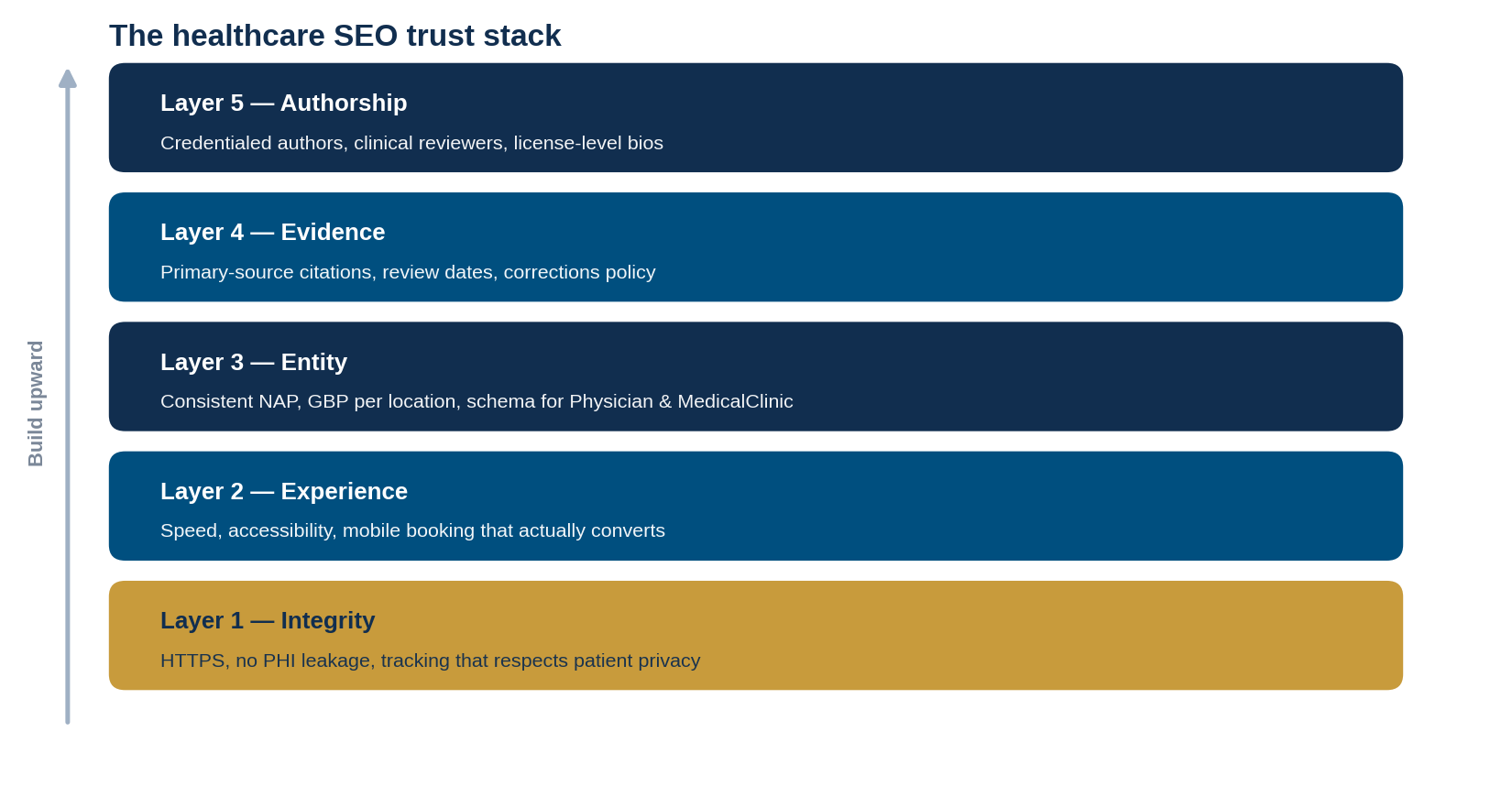
Figure 2: The healthcare SEO trust stack — each layer only pays off if the one beneath it is solid.
Layer 1 — Integrity
HTTPS everywhere, no protected health information anywhere it should not be, and analytics configured so that patient identifiers never travel to third-party tools. This last one is a genuine compliance exposure, not just an SEO nicety: tracking pixels on patient portals and appointment flows have generated real regulatory attention, and a practice that ships PHI to an ad platform has a much bigger problem than rankings.
Layer 2 — Experience
Speed, accessibility, and a booking flow that works on a phone. Accessibility deserves specific attention in healthcare because a meaningful share of your patients rely on assistive technology — and because the legal expectations are firmer than most industries assume. We covered the practical baseline in our guide to ADA and WCAG website compliance.
Layer 3 — Entity
Google needs to resolve “your practice” into a single, confident entity. That means identical name, address, and phone data across your site, your Google Business Profile, and the major health directories; a properly filled profile for every physical location; and Physician, MedicalClinic, or MedicalBusiness schema on the pages that describe them. Our Google Business Profile optimisation guide covers the profile side in detail.
Layer 4 — Evidence
Every clinical claim should trace to a primary source — a peer-reviewed study, a professional society guideline, or a government health agency — and the citation should be visible to the reader, not buried in a references page nobody clicks. Add a review date and a corrections policy. This is the layer that separates a practice blog from a resource a physician would forward to a patient.
Layer 5 — Authorship
A named, credentialed human on every clinical page. Not “Admin”, not “Our Team”. Full name, credentials, license state, specialty, and a bio page that links to their professional profiles. Where the writer is a marketer rather than a clinician, add a separate clinical reviewer byline with a review date. This single change is the highest-leverage edit available on most provider sites, and it costs you a template modification plus an afternoon of sign-offs.
Two different games: local intent and informational intent
Healthcare SEO is really two campaigns that share a domain, and conflating them is why a lot of provider sites feel stuck.
| Dimension | Local intent (“dentist in Jacksonville”) | Informational intent (“is a root canal painful”) |
|---|---|---|
| What you are competing for | Map pack and localised organic results | Standard organic and AI-generated answers |
| Who you compete with | Other practices within a few miles | National health publishers and hospital systems |
| What decides it | Proximity, profile completeness, review volume and recency, NAP consistency | Depth, credentialed authorship, citations, topical coverage |
| Realistic timeline | Weeks to a few months | Six to eighteen months of consistent publishing |
| Commercial value | High — these people are booking | Indirect — builds trust and captures earlier-stage demand |
If you have limited budget, win the local game first. It converts faster, the competitive set is smaller, and the work is finite. Informational content is a compounding asset worth building, but it should be funded out of a longer horizon and it will not rescue a quarter. Our 2026 local SEO checklist is the sequence I would work through for the local side.
Reviews, patient stories, and the PHI trap
Reviews and testimonials are among the strongest trust signals you can accumulate, and healthcare is the industry where collecting them is most legally constrained. A few rules I would treat as non-negotiable:
- Never publish a patient testimonial, photo, or case detail without documented written authorisation — and never assume a public review gives you licence to discuss that person’s care.
- Never confirm or deny in a public review reply that someone is a patient. Respond generically and move the conversation to a private channel.
- Do not incentivise reviews. Beyond the platform policy problem, in healthcare it invites a much more serious regulatory reading.
- Do ask, systematically, at the moment of highest satisfaction — usually right after a successful visit — using a process the front desk actually follows.
- Do reply to negative reviews promptly and without defensiveness. Prospective patients read the reply more closely than the complaint.
What changes now that AI engines answer health questions
Generative results have made the trust layer more important, not less. When an AI engine assembles an answer about a medical topic, it is looking for content it can safely attribute — clearly authored, clearly dated, clearly sourced, and structured so a specific claim can be lifted cleanly. In practice that means the same things that satisfy a careful human reader: a direct answer near the top of the page, unambiguous headings, a real FAQ section, and citations a machine can follow.
It also means being conservative. Content that overstates certainty on a medical question is a liability in an environment where your page may be summarised without your caveats. Write the caveats into the sentence, not into a disclaimer at the bottom.
A realistic first 90 days
- Weeks 1–2: Audit for PHI leakage in analytics and ad tags. Fix HTTPS and accessibility blockers. Baseline your Search Console and Google Business Profile metrics.
- Weeks 3–4: Add credentialed author bylines and bio pages. Add clinical reviewer bylines and review dates to existing clinical content.
- Weeks 5–6: Normalise NAP data everywhere. Complete every location profile. Ship
PhysicianandMedicalClinicschema. - Weeks 7–9: Rebuild location and service pages with genuinely distinct content. Stand up the review request process at the front desk.
- Weeks 10–12: Start the informational content programme — one deeply sourced, clinically reviewed piece per week beats four thin ones.
If any of that outruns your in-house capacity, that is the sort of scope our SEO team takes on directly, and the template and schema work usually runs alongside our web development engagements.
Frequently Asked Questions
Is healthcare SEO really different, or is that just agency positioning?
It is genuinely different in one specific way: Google explicitly holds YMYL topics — health among them — to a higher page quality standard, and states that its systems weight strong E-E-A-T more heavily for content that could affect health, financial stability, or safety. The mechanics of crawling, indexing, and links are the same as any other industry. The evidentiary bar for the content is not.
Do I need a doctor to write our blog posts?
Not necessarily to write them, but you do need one to stand behind them. The pattern that works is a competent writer producing the draft and a named, credentialed clinician reviewing and signing it with a visible review date. What does not work is anonymous or “Admin”-bylined clinical content, which gives a reader no basis for trust and gives Google nothing to evaluate.
How long does healthcare SEO take to show results?
Local visibility work — profile completeness, NAP consistency, reviews, location pages — often moves within four to twelve weeks because the competitive set is small and geographically bounded. Informational content competing against national health publishers is a six-to-eighteen-month programme. Budget and expectations should be set separately for the two.
Can we use patient testimonials on the website?
Only with documented written authorisation from the patient, and even then be deliberate about what identifying detail you include. Treat every testimonial, before-and-after photo, and case story as a disclosure decision rather than a marketing asset. When in doubt, run it past whoever owns compliance at your practice.
What schema markup should a medical practice use?
Start with MedicalClinic or MedicalBusiness for the organisation and each location, Physician for provider pages, and FAQPage on pages with a genuine question-and-answer section. Mark up services, accepted insurance, and hours where they exist as real content on the page. Schema describes what is visibly there — it does not substitute for it.
Are AI-generated health articles a bad idea?
Unreviewed, yes — the risk is not that Google detects the tool, it is that a plausible-sounding inaccuracy on a medical topic can genuinely harm someone and will destroy the trust you are trying to build. Using AI to draft, outline, or research while a credentialed clinician verifies and signs the output is a reasonable workflow. Publishing unreviewed generated clinical content is not.
Should we build separate pages for every condition we treat?
Only where you can say something substantive and specific about how your practice treats that condition. A thin page per condition is duplicate-adjacent filler that dilutes your site. A well-built hub covering the condition, linked to the specific service pages and the providers who handle it, outperforms twenty stubs — the pillar-and-cluster approach rather than the long tail of thin pages.
We build the trust layer — authorship, schema, entity data, and privacy-safe tracking — before we touch keyword strategy.