
Automation Platform Total Cost: Subscription Fatigue vs. Custom Builds
Last updated: August 29, 2026 · By Joseph Olivas, Founder, MEAN Consultors · 10 min read
Almost every automation conversation I have starts the same way: someone discovered what their company is actually spending. Not on the one tool they think of as “the automation tool” — on all of it, once you add the database tier the workflows write to, the AI credits, the document parser, the e-signature product, the overage charges from a busy quarter, and the two seats added last spring. That total is usually a genuine surprise, and it is the honest starting point for this comparison.
What follows is a cost model, not a sales pitch. Subscriptions are the right answer for a large share of the businesses that ask me this, and I will show you where the line is rather than argue that everyone should build something.
What the automation stack actually costs
Nobody buys an expensive automation platform. They buy six affordable ones over three years.
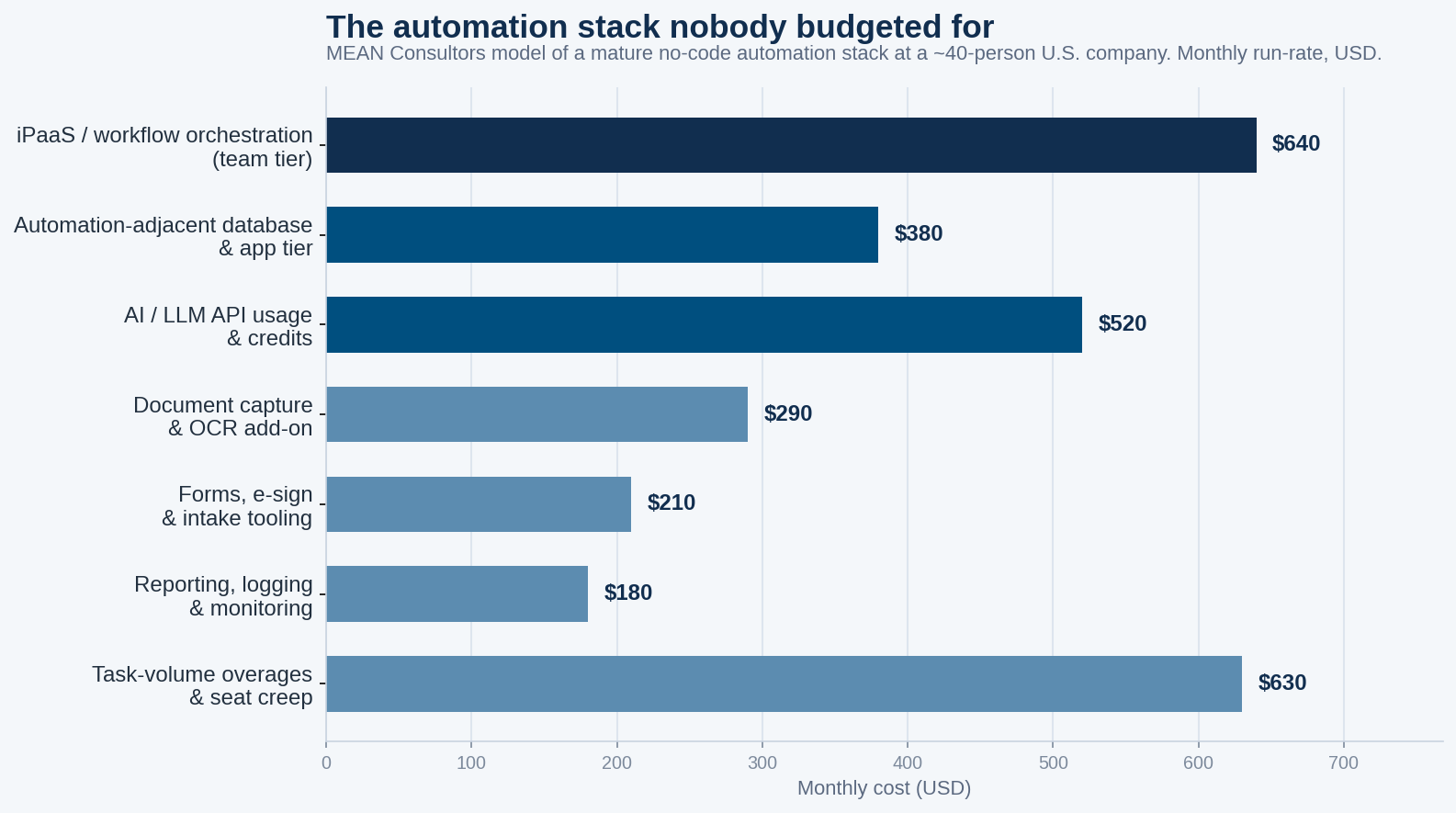
Figure 1: MEAN Consultors’ model of a mature no-code automation stack at a roughly 40-person U.S. company — $2,850 per month, or $34,200 a year.
Two line items in Figure 1 deserve attention because they are the ones nobody forecasts. The first is AI and LLM API usage, which barely existed as a budget line three years ago and is now frequently the second-largest item in the stack. The second is overages and seat creep at $630 a month — more than the orchestration platform itself. That figure is not a penalty for doing something wrong. It is what happens when metered pricing meets a business that grew.
The structural point is this: on a metered platform, your automation bill is a function of your transaction volume. Succeed and it rises. That is a perfectly reasonable pricing model, and it is exactly why the cost curve behaves the way it does over five years.
- A mature no-code stack at a 40-person company models to $2,850 per month — roughly $34,200 a year across seven line items.
- Overages and seat creep ($630/mo) exceed the cost of the orchestration platform itself ($640/mo) in our model.
- Metered pricing means the bill scales with business volume; a custom build’s running cost stays broadly flat.
Where the two curves cross
Put the subscription stack on the same chart as a custom build and the shape of the decision becomes obvious.
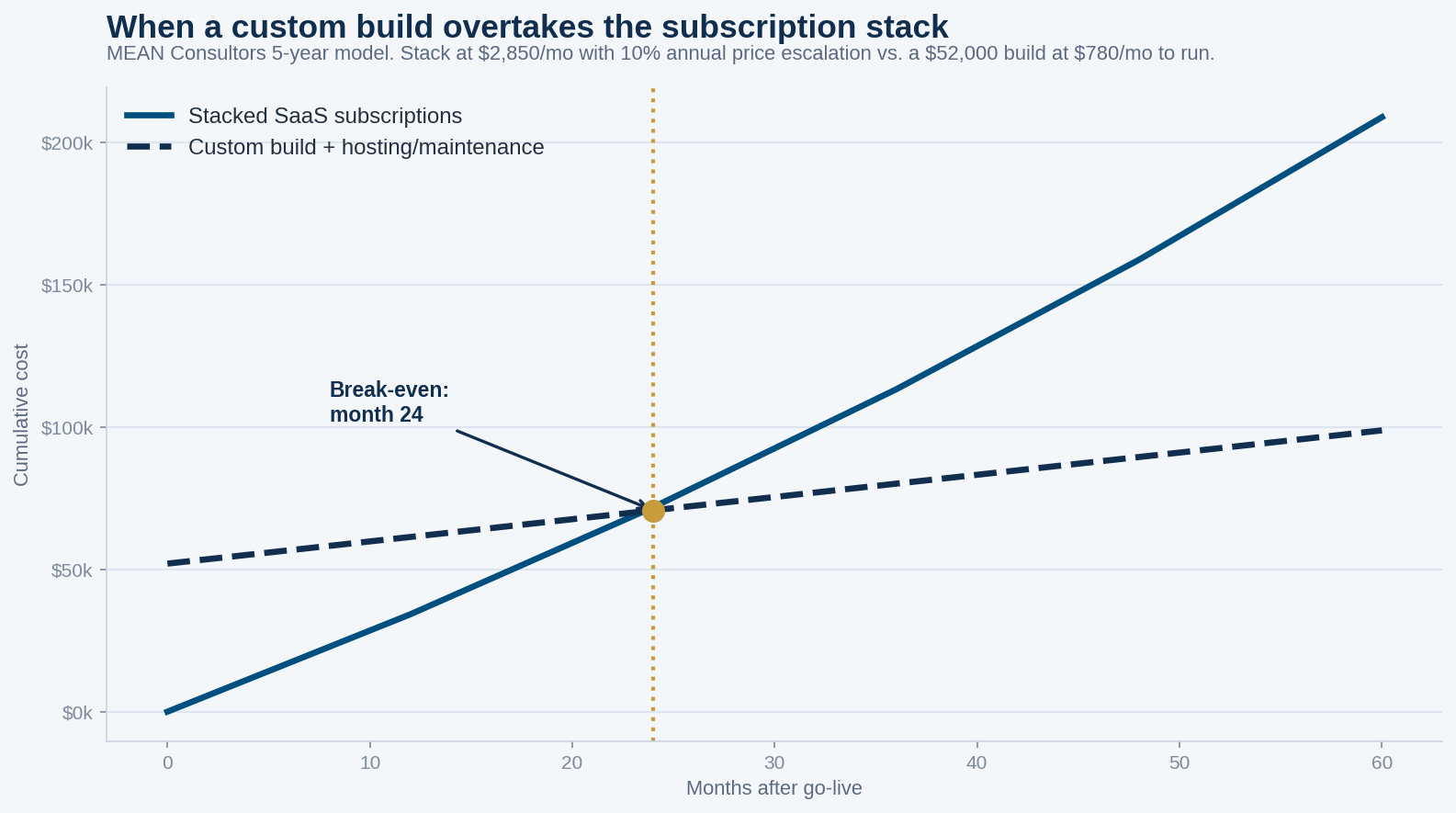
Figure 2: Cumulative cost over five years. The stack starts at zero and climbs; the build starts high and flattens. They cross at month 24.
The model behind Figure 2 assumes the $2,850 monthly stack from Figure 1 with 10% annual price escalation, against a $52,000 custom build carrying $780 a month in hosting, monitoring, and maintenance. Break-even is month 24. At the end of year three the subscription path has cost about $113,200 against $80,100 for the build; by month 60 it is roughly $208,800 against $98,800.
Two things about this chart matter more than the specific numbers. First, the subscription line is convex — it bends upward, because escalation and volume compound. Second, the build line is nearly straight. Whatever your inputs, that difference in shape is what drives every conclusion here, and it is why the break-even point moves so dramatically with volume.
| Profile | Monthly stack | Custom build + run | Break-even | Verdict |
|---|---|---|---|---|
| Small — 10 people, 2–3 workflows | $480 | $22,000 + $300/mo | ~71 months | Keep subscribing |
| Growing — 25 people, 6–8 workflows | $1,150 | $38,000 + $520/mo | ~47 months | Hybrid; build the top two |
| Mid-market — 40 people, 15+ workflows | $2,850 | $52,000 + $780/mo | ~24 months | Build the core |
| Volume-heavy — per-task pricing at scale | $6,400 | $85,000 + $1,100/mo | ~16 months | Build, and soon |
Read that table honestly and it says something a consultancy is not supposed to say: for the first profile, buying wins and it is not close. A five-year payback on software is not a payback, because the business will have changed twice before you get there. The interesting rows are the last two, where metered pricing has decoupled the bill from the value delivered.
The costs on both sides of the ledger that people forget
A fair comparison has to include the items that never appear on the invoice.
On the subscription side, start with switching cost. Workflow logic built in a hosted platform is generally not portable in any meaningful sense — you can export something, but only the same vendor can read it. Add the internal labor of maintaining those workflows, which for a fifteen-workflow stack is realistically a few hours a week of someone competent. Add the ceiling: the workflows you did not build because the platform could not express them, a limitation I wrote about in the limits of no-code automation. And add data residency and compliance constraints, since every platform in the chain is another processor holding your customer data.
On the custom side, be equally unsentimental. You inherit responsibility for security patching and uptime — the shared-responsibility boundary the NIST definition of cloud computing formalizes shifts toward you as you move from SaaS to infrastructure you manage, and application-layer risks like those in the OWASP Top 10 become your problem rather than a vendor’s. You inherit a knowledge concentration risk if one person or one agency understands the system. And you have to run genuine cost discipline on your own infrastructure — the practices in the AWS Well-Architected cost optimization pillar exist because self-hosted does not automatically mean cheap.
This is why I put running cost at 15–22% of build cost per year rather than treating a build as a one-time expense. The claim is not that custom is free after launch. It is that custom is roughly flat while subscription is not.
The hybrid answer, which is usually the right one
Framing this as build-or-buy is the mistake. Automation spend is never evenly distributed — in nearly every stack I audit, two or three workflows generate the large majority of metered cost, while a dozen others run a few hundred tasks a month and cost almost nothing.
So split them. Build the heavy ones: the order-processing pipeline, the document intake flow, the nightly reconciliation. Keep subscriptions for the light ones at the edges, where per-task pricing is genuinely cheap and the flexibility is worth more than the fee. In practice this removes 60–70% of the monthly bill for 30–40% of what a full replacement would cost, and it leaves you able to wire up something new on a Tuesday afternoon without a development ticket.
- Tag twelve months of spend across every tool that touches automation, including overages
- Rank workflows by metered cost, not by how important they feel
- Check whether the top workflows are stable — only build what has stopped changing weekly
- Model break-even at your real volume, with escalation, over five years
- Price the exit: what could you actually take with you from each platform today
- Build the top two or three; leave the long tail on subscriptions
- Contract for source code, documentation, and infrastructure you can hand to another firm
One more filter before anyone builds anything: a workflow has to be stable. Automating a process that is still changing every month produces expensive software that is wrong by the time it ships. If the top-cost workflow is also the one being redesigned, subscribe for another two quarters and revisit. Our automation payback period framework covers how to time that, and the broader ownership economics are in custom software vs. SaaS total cost of ownership. When you are ready to model your own numbers, that is the work our AI and automation practice starts with — and if the answer is that you should keep subscribing, we will tell you so.
Frequently Asked Questions
At what point does a custom automation build become cheaper than subscriptions?
In our five-year model it depends almost entirely on volume and seat count, not on company size. A small operation running two or three workflows at roughly $480 a month does not break even on a custom build inside five years — keep subscribing. A mid-market company running a $2,850-per-month stack breaks even at about month 24. A volume-heavy operation on per-task pricing at $6,400 a month breaks even near month 16. The honest answer for most small businesses is that subscriptions win, and the honest answer for anyone whose bill scales with transactions is that they usually do not.
Why does the automation bill keep rising when we have not added workflows?
Three mechanisms, all of them working as designed. Task and operation metering means the bill grows with your business volume even at a fixed workflow count. Seat creep adds licenses as more people touch a workflow. And annual list-price increases compound — a 10% yearly rise turns a $2,850 monthly stack into roughly $4,170 by year five without a single new automation.
Is a custom build really a one-time cost?
No, and any quote that implies it is should worry you. A custom automation platform carries hosting, monitoring, dependency and security patching, and a change budget for when the business shifts. Budget 15–22% of the build cost annually as a running figure. The distinction is not one-time versus recurring — it is that the recurring cost is roughly flat while subscription cost scales with your success.
What is the risk of building instead of buying?
Concentration and responsibility. You own uptime, security patching, and the knowledge of how the system works, and if that knowledge sits with one person or one agency, you have swapped vendor lock-in for people lock-in. Mitigate it with documentation, standard frameworks rather than exotic ones, source code in your own repository, and infrastructure you can hand to another firm. Ask for those in the contract, not after.
Can we use a hybrid approach?
That is what I recommend most often, and it usually costs the least. Keep subscription tools for the low-volume, rarely-changing connections at the edges — form to CRM, notification routing — where per-task pricing is trivial. Build the two or three high-volume workflows that are consuming most of your metered spend. This typically removes 60–70% of the bill for 30–40% of a full build’s cost.
How do we work out what our automation stack actually costs today?
Pull twelve months of card and ACH statements and tag every line that touches automation — including the database tier, AI API credits, document tooling, and overage charges, which are the items people forget. Then add the internal labor spent maintaining the workflows. Most companies I do this with find the true figure is 30–50% above what they would have guessed, mostly because the spend is spread across several departments and nobody sees the total.
What happens to our automations if we stop paying?
They stop, and in most platforms your workflow logic is not portable — you can export a configuration file that only the same vendor can read. That switching cost is a real part of total cost of ownership even though it never appears on an invoice. Before you scale a workflow to business-critical volume on a hosted platform, ask what specifically you would be able to take with you.
MEAN Consultors will model your break-even against your actual volume and tell you plainly whether to build, buy, or run a hybrid.