
API Security Best Practices Every Business Should Require
Last updated: July 31, 2026 · By Joseph Olivas, Founder, MEAN Consultors · 9 min read
APIs are how your business systems talk to each other — your website to your payment processor, your CRM to your accounting tool, your mobile app to your database. That also makes them one of the most attacked parts of modern software. When an API is exposed without the right controls, it hands attackers a direct line to your data. This checklist covers the API security best practices I require on every project, in plain language, with the reasoning a business owner needs to hold a vendor accountable.
Start with the controls that reduce the most risk
Not every security control carries equal weight. Based on the vulnerabilities we see most often and the industry-standard OWASP API Security Top 10, the biggest risk reductions come from getting authentication and authorization right — verifying who is calling and strictly limiting what each caller can access. Everything else builds on that foundation.
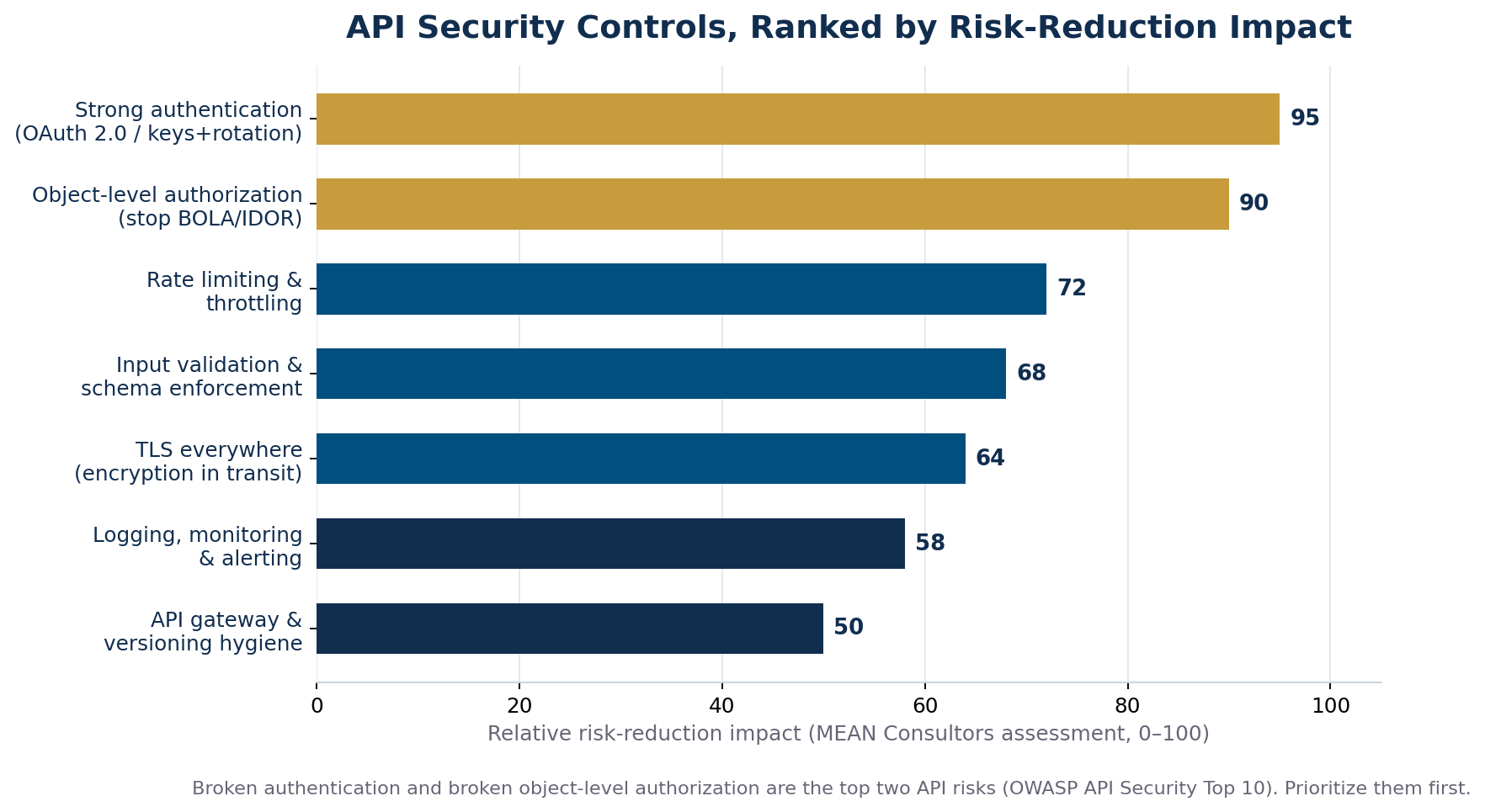
Figure 1: API security controls ranked by risk-reduction impact — authentication and authorization lead.
The reason authorization ranks so high is that the most common serious API flaw is “broken object-level authorization,” where an API correctly checks that you are logged in but fails to check that the specific record you requested actually belongs to you. Change an ID in the request from 1001 to 1002 and you see someone else’s invoice. It is simple to exploit and devastating in impact, which is why it tops OWASP’s list. If APIs are new to your team, our primer on API integration for business systems is the foundation this article builds on.
- Authentication and authorization deliver the largest risk reduction — fix them first.
- Broken object-level authorization is the most common serious API flaw and is trivial to exploit.
- Security is layered: no single control is enough, so require defense in depth.
The API security checklist to require from any vendor
Whether you are building in-house or hiring a firm, these are the controls that should be non-negotiable. Use this as a checklist when you scope or review any software project:
- Authenticate every request with strong credentials — OAuth 2.0, signed tokens, or API keys with rotation. Never ship a public, unauthenticated write endpoint.
- Enforce authorization on every object, not just at login — confirm the caller owns or may access each specific record.
- Require TLS 1.2 or higher on all traffic so data is encrypted in transit and cannot be intercepted.
- Validate and sanitize all input against a strict schema to block injection and malformed-payload attacks.
- Apply rate limiting and quotas to stop brute-force, scraping, and denial-of-service abuse.
- Log every request and monitor for anomalies, with alerts on unusual patterns and failed-auth spikes.
- Version your API and retire old versions so you are not maintaining insecure legacy endpoints.
Notice that none of these are exotic. They are disciplined engineering habits — the same ones we bake into our custom software development work from the first line of code rather than bolting on before launch.
Layer your defenses: how a secure request should flow
Good API security is not one wall; it is a series of checkpoints, each catching what the last might miss. The diagram below shows the layers a request should pass through before it ever touches your data. A request that fails any layer is rejected early, which limits the blast radius if one control is misconfigured.
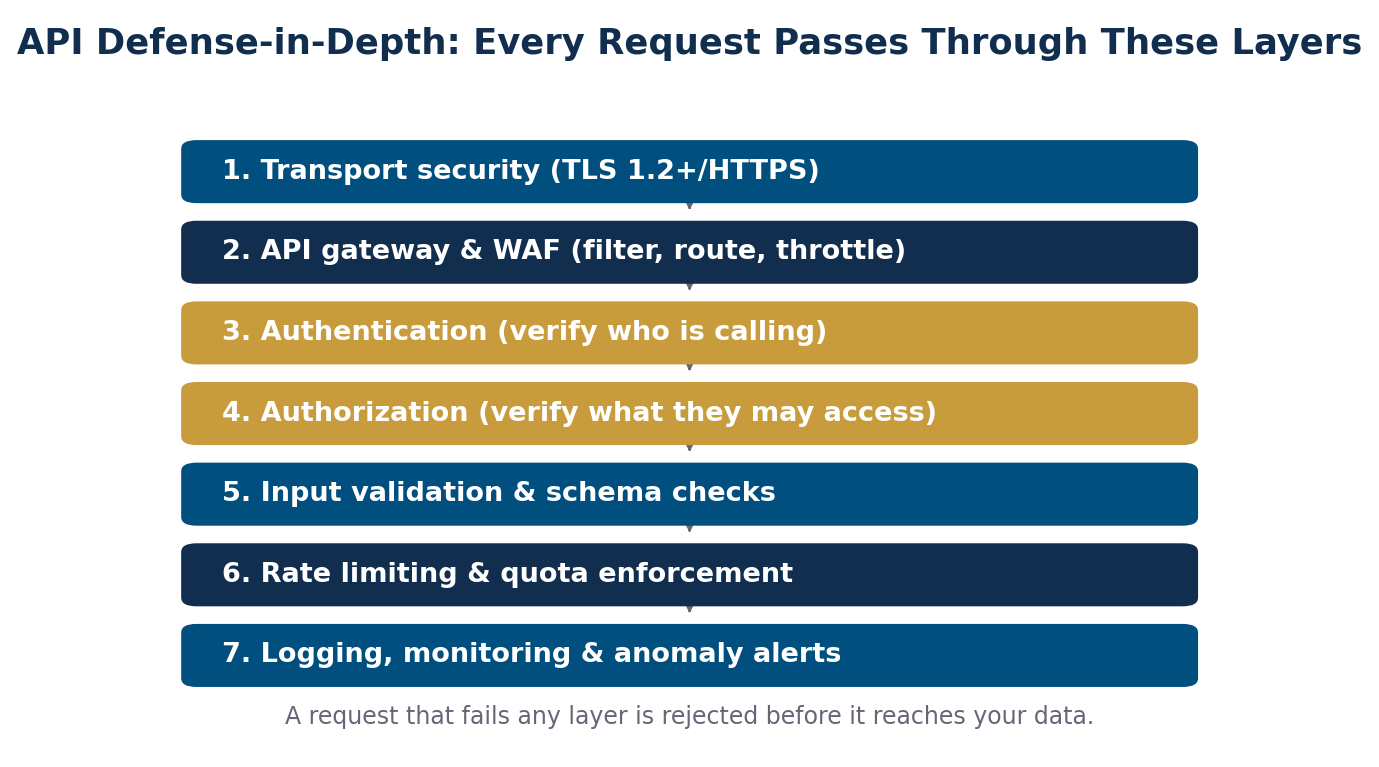
Figure 2: Defense in depth — every request passes through layered checks before reaching your data.
The same layered thinking should extend to how your systems connect to one another. When your CRM, ERP, and store all share data through APIs, a weak link anywhere exposes everything — a risk we design around in our CRM, ERP, and e-commerce integration blueprint.
Does your API architecture change the security picture?
Whether you use REST or GraphQL, the core principles hold, but the specifics differ. GraphQL’s flexibility, for instance, means you must guard against overly complex or deeply nested queries that can exhaust your server, while REST endpoints need careful per-resource authorization. Choosing the right architecture up front makes securing it far easier — we compare the trade-offs in our guide to REST vs. GraphQL API design. Whatever the style, insist that security is designed in from the start, because retrofitting it onto a live API is slower, riskier, and more expensive than doing it right the first time.
Frequently Asked Questions
What is the most important API security best practice?
Proper authorization — specifically object-level authorization — is the single most impactful control. Broken object-level authorization is the most common serious API vulnerability, so verifying that each caller may access each specific record they request prevents the majority of damaging breaches.
What is the difference between authentication and authorization?
Authentication verifies who is making the request (are you a valid user?). Authorization verifies what that verified user is allowed to do or see (may you access this specific record?). Both are required; passing authentication alone does not mean a caller should reach every resource.
Do small businesses really need API security, or is it just for big companies?
Every business with an API needs it. Automated bots scan the internet for exposed and misconfigured APIs regardless of company size, and small businesses are often targeted precisely because their defenses are assumed to be weaker. The controls in this checklist apply at any scale.
How do I know if my current API is secure?
Have it reviewed against the OWASP API Security Top 10 and this checklist. Key red flags include endpoints without authentication, no rate limiting, unencrypted traffic, and no logging. A professional security review will surface gaps you cannot see from the outside.
Is HTTPS enough to secure an API?
No. HTTPS (TLS) encrypts data in transit, which is essential, but it does nothing to control who can call your API or what they can access. You still need authentication, authorization, input validation, rate limiting, and monitoring on top of encryption.
MEAN Consultors develops and reviews APIs with security built in from day one — not bolted on before launch.