
REST vs. GraphQL: Choosing the Right API Architecture
Last updated: July 29, 2026 · By Joseph Olivas, Founder, MEAN Consultors · 8 min read
REST and GraphQL are both proven ways to build an API, and the “which is better” framing misses the point. The right choice depends on your data, your clients, and your team. In this comparison I break down how each works, where each shines, and the practical questions I ask before recommending one for a client project.
REST and GraphQL in plain terms
REST exposes your data as a set of URLs (endpoints), each returning a fixed shape of data — /users, /users/1/orders, and so on. GraphQL exposes a single endpoint and lets the client ask for exactly the fields it needs in one query. REST is the established default; GraphQL is the flexible challenger built to solve over-fetching and under-fetching. Both are central to how modern systems connect, a topic we cover more broadly in API integration for business systems, and both are part of our software development service.

Figure 1: REST is still near-universal, while GraphQL has become a mainstream option.
The market reflects this. In Postman’s 2025 State of the API Report, 93% of developers reported using REST, while GraphQL adoption reached 33% (respondents could select multiple styles). REST is not going anywhere — but GraphQL is now common enough that it deserves genuine consideration rather than reflexive dismissal.
Part of the reason REST endures is that its constraints are also its strengths. Every resource has a predictable URL, every operation maps to a familiar HTTP verb, and the response you get from an endpoint today looks like the one you got last year. That predictability makes REST easy to document, easy to test, and easy for a new developer to pick up in an afternoon. GraphQL asks more of a team up front — you design a schema, write resolvers, and think carefully about how clients might combine your data — but in return it gives front-end developers the freedom to build screens without waiting on a back-end change for every new data requirement. Which of those trade-offs is worth making is exactly the judgment call this article is meant to help you make.
The problem GraphQL was built to solve
The clearest advantage of GraphQL is eliminating over-fetching and under-fetching. With REST, a screen that needs a user’s name, their last three orders, and their cart might require three separate requests — and each may return more data than the screen uses. GraphQL collapses that into one request that returns precisely the requested fields.
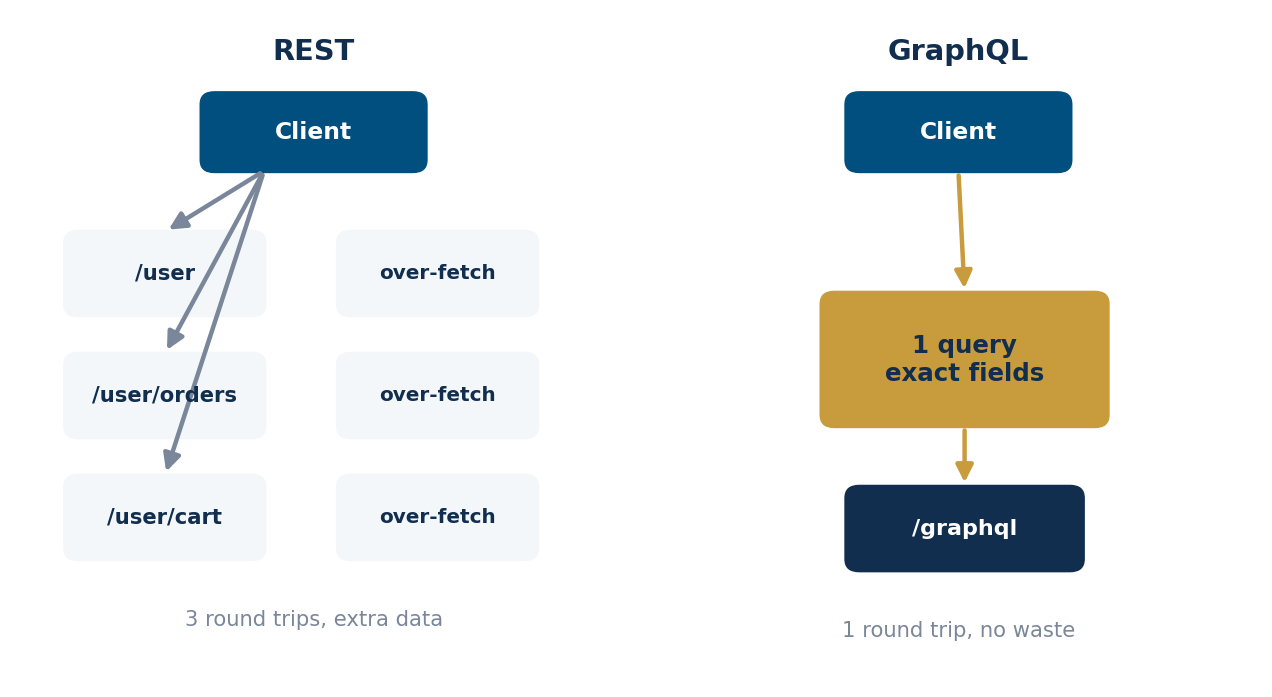
Figure 2: REST often needs several round trips; GraphQL fetches exactly what a screen needs in one.
That efficiency matters most for complex, data-hungry front ends — think mobile apps on slow networks or dashboards that assemble data from many sources. For simpler applications, the difference is often negligible, and REST’s simplicity wins.
It is worth being honest about the flip side, though. The same flexibility that lets a GraphQL client fetch exactly what it needs also lets a poorly written query pull far more than it should, and because everything flows through one endpoint, a spike in expensive queries is harder to spot and rate-limit than traffic to a specific REST route. Over-fetching does not vanish with GraphQL; it moves from the server’s response shape to the client’s query discipline. That is manageable with good tooling and sensible limits, but it means GraphQL rewards teams that invest in monitoring and conventions, whereas REST is more forgiving of a lighter-touch approach.
REST vs. GraphQL: a side-by-side comparison
| Factor | REST | GraphQL |
|---|---|---|
| Data fetching | Multiple endpoints, fixed shapes | Single endpoint, client-specified fields |
| Over/under-fetching | Common | Largely eliminated |
| Caching | Simple — uses standard HTTP caching | More complex — needs client/tooling support |
| Learning curve | Low; ubiquitous tooling | Higher; schema and resolvers to learn |
| Versioning | Often versioned (/v1, /v2) | Evolve schema; deprecate fields |
| Best fit | Public APIs, simple CRUD, file handling | Complex UIs, many data sources, mobile clients |
- REST is used by 93% of developers and remains the safe default for most APIs (Postman 2025).
- GraphQL (33% adoption) shines when clients need flexible, precise data from many sources.
- REST keeps caching and tooling simple; GraphQL trades some complexity for front-end efficiency.
How I decide which to use
Rather than picking a favorite, I answer a few practical questions with the client.
- Who consumes the API — a single web app, many mobile clients, or third-party developers?
- How varied are the data needs across screens? High variety favors GraphQL.
- How important is simple HTTP caching and CDN behavior? That favors REST.
- What does the team already know? Momentum and maintainability matter more than novelty.
- Is this a public API? REST’s conventions and tooling make it the friendlier choice for outside developers.
Choosing an API style is one instance of a broader engineering habit: matching the tool to the requirement instead of the trend. That same discipline drives decisions like build vs. buy — the goal is always the option your team can ship and maintain, not the one that sounds most impressive.
Caching, security, and the operational trade-offs
The comparison table captures the headline differences, but two operational realities deserve more attention because they surprise teams after launch. The first is caching. REST rides on top of standard HTTP, which means browsers, proxies, and content delivery networks can cache responses out of the box using well-understood headers. GraphQL typically sends every query as a POST to a single endpoint, so that free HTTP-level caching largely disappears; you regain it through client libraries and specialized tooling, but that is additional complexity you are choosing to take on. For read-heavy public APIs, REST’s caching story alone is often the deciding factor.
The second is security and predictability. Because a GraphQL client can request deeply nested or unusually large queries, you have to guard against expensive requests with query depth limits, complexity analysis, and timeouts — safeguards a fixed REST endpoint gives you almost for free. None of this makes GraphQL unsafe; it simply shifts responsibility onto your team. The teams that succeed with GraphQL treat these controls as part of the initial build, not an afterthought.
Finally, remember that adopting one style does not mean abandoning the other. A pragmatic path for an existing system is to keep your stable REST endpoints exactly as they are and introduce GraphQL only for the new, data-intensive screens that actually benefit from it. Migrations rarely need to be all-or-nothing, and the lowest-risk architecture is usually the one that lets each part of your product use the approach that fits it best.
Frequently Asked Questions
Is GraphQL replacing REST?
No. REST remains the dominant API style — 93% of developers report using it in Postman’s 2025 survey, compared with 33% for GraphQL. GraphQL is growing and excellent for specific use cases, but it complements REST far more than it replaces it.
Is GraphQL faster than REST?
Not inherently. GraphQL can reduce the number of round trips and the amount of over-fetched data, which speeds up complex front ends on slow networks. But for simple requests a well-built REST endpoint is just as fast, and REST’s standard HTTP caching can make it faster for repeat reads.
When should I choose REST over GraphQL?
Choose REST for public APIs, straightforward CRUD operations, file uploads and downloads, and any project where simple HTTP caching and broad tooling matter. It has a lower learning curve and is the safer default when data needs are predictable.
When is GraphQL the better choice?
GraphQL is worth it when you have complex or highly variable data needs across many screens, multiple client types (especially mobile), or data spread across several services that a single query can assemble. Those are exactly the situations where REST’s over-fetching becomes painful.
Can I use both REST and GraphQL in the same product?
Yes, and many teams do. A common pattern is REST for public and CRUD-style endpoints plus GraphQL for internal, data-intensive front ends. The right architecture is the one that best serves your product and team, not a single style applied everywhere.
MEAN Consultors designs and builds REST and GraphQL APIs matched to your data, clients, and team — not to a trend.