
Choosing an LLM Provider: OpenAI vs. Anthropic vs. Open-Source Models
Last updated: July 31, 2026 · By Joseph Olivas, Founder, MEAN Consultors · 9 min read
Once you decide to add AI to your product or operations, the next question is which model to build on. The choice shapes your cost, your data privacy, your latency, and how quickly you can ship. There is no single “best” provider — only the best fit for your use case. In this comparison I will lay out how OpenAI, Anthropic, and open-source models actually differ, and give you a simple framework for deciding, drawn from the AI projects we deliver.
Weigh the decision before you compare vendors
The mistake I see most often is teams comparing models on price or benchmark scores alone. In practice, the right choice depends on how you weight several factors together. For most business use cases, task accuracy and data control matter more than shaving a few cents per request — a cheap model that gets answers wrong or leaks data is the most expensive option of all.
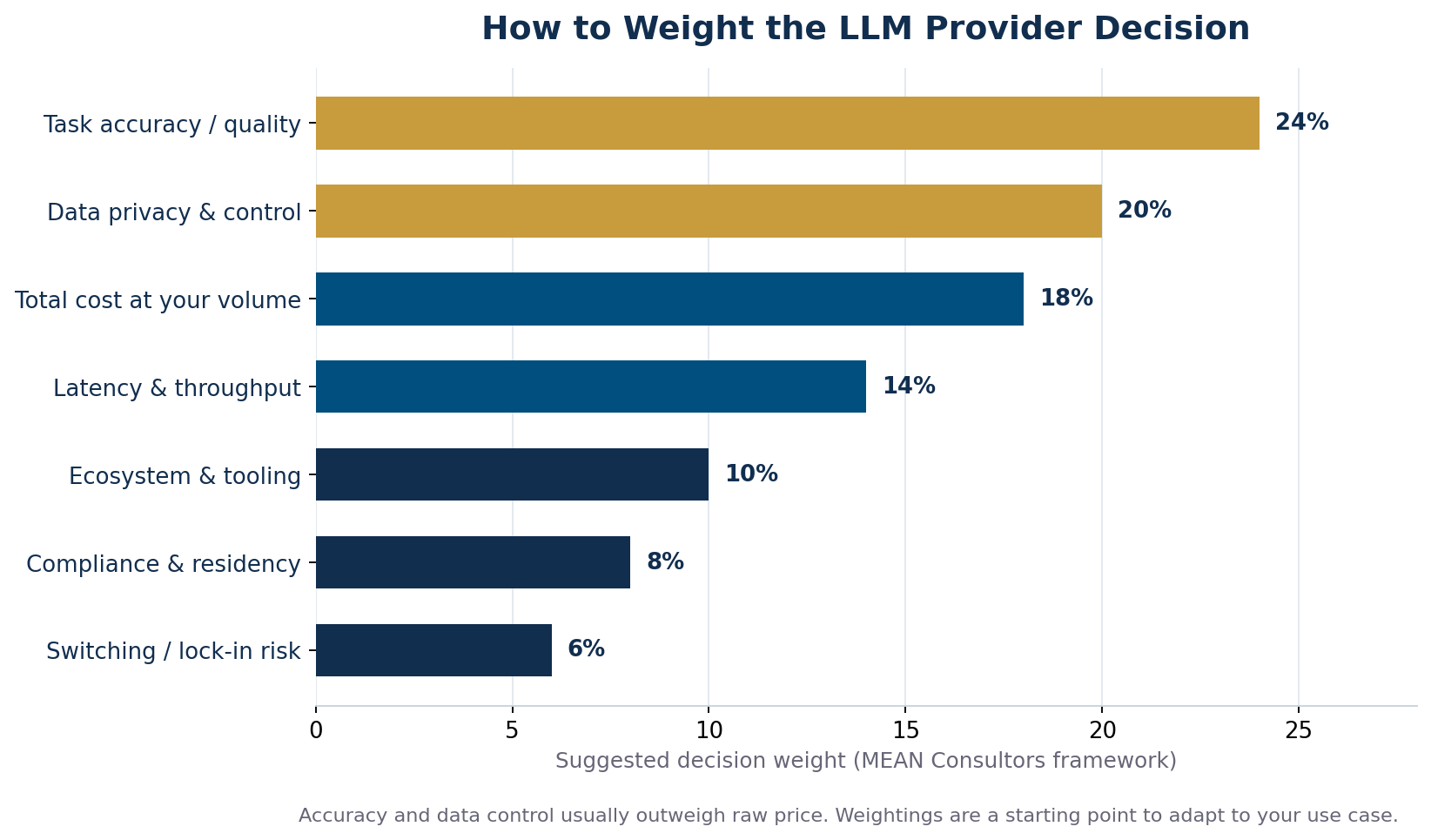
Figure 1: A suggested weighting for the LLM decision — accuracy and data control usually outweigh raw price.
Use the weighting above as a starting point and adjust it to your reality. A healthcare or legal application will push data control and compliance far higher; a high-volume consumer chatbot will care more about cost and latency. The point is to decide what matters before you look at any vendor, so you are choosing on your criteria rather than their marketing. This is exactly the scoping conversation that opens every one of our AI and automation engagements.
- Decide how you weight accuracy, data control, cost, and latency before comparing any provider.
- Proprietary APIs win on quality and speed-to-launch; open-source wins on control and high-volume cost.
- Most teams should start managed and migrate to open-source only when the numbers justify it.
OpenAI vs. Anthropic vs. open-source, side by side
Here is how the three options compare across the factors that usually decide the call. Treat this as a map of trade-offs rather than a scoreboard — the “winner” depends entirely on which row matters most to you.
| Factor | Proprietary APIs (OpenAI, Anthropic) | Open-source (Llama-class, self-hosted) |
|---|---|---|
| Quality / reasoning | Consistently top-tier on hard tasks | Strong and closing the gap; varies by model |
| Data control | Data leaves your environment (with API terms) | Full control; can run in your own VPC |
| Cost model | Pay per token; simple but scales with usage | Infrastructure cost; cheaper at high volume |
| Time to launch | Fastest — an API key and you are building | Slower — you provision and maintain hosting |
| Operational overhead | Minimal; the provider runs it | You own scaling, uptime, and updates |
| Lock-in risk | Some; mitigated with an abstraction layer | Low; you own the weights and stack |
OpenAI and Anthropic both sit in the proprietary-API camp and are often close on quality; teams tend to choose between them on specific strengths, pricing at their volume, and how each model behaves on their particular tasks. The honest answer is to prototype your real workload on both and measure — benchmarks rarely predict how a model performs on your data.
A simple decision path
When a client asks me to just tell them what to pick, I walk them through the path below. It starts with the question that most constrains the choice — whether your data can leave your environment — and narrows from there.
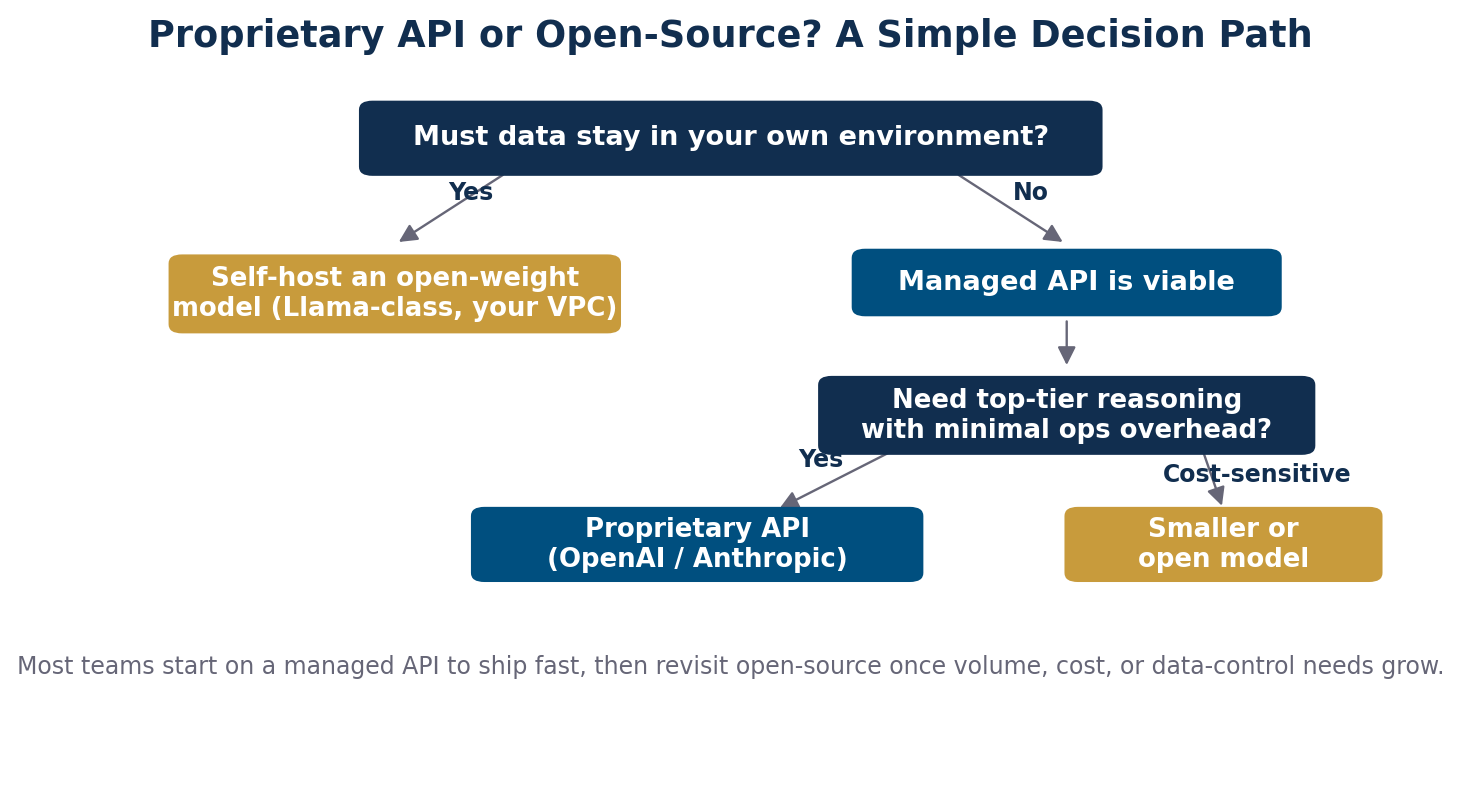
Figure 2: A simple decision path for proprietary API versus open-source, starting from your data-control needs.
The provider is only part of the architecture
Choosing a model is not the whole job. Most business AI value comes from connecting the model to your own knowledge and systems — which is where retrieval-augmented generation comes in. Rather than fine-tuning, you give the model access to your documents and data at query time, which improves accuracy and reduces made-up answers regardless of which provider you use. We explain the pattern in our guide to retrieval-augmented generation for businesses, and how it fits into your stack in integrating an LLM into your existing software.
A practical tip: build a thin abstraction layer between your application and the model provider from day one. That way, switching from one API to another — or from a proprietary API to an open-source model — is a configuration change, not a rewrite. It is the cheapest insurance against lock-in and against the fast-moving pace of the AI market. If you are also weighing what a full build costs, our breakdown of the cost to build a custom AI chatbot puts real ranges around it.
Frequently Asked Questions
Is OpenAI or Anthropic better for business applications?
Both are excellent and often close in quality. The better choice depends on your specific tasks, your pricing at your volume, and how each model behaves on your data. The reliable way to decide is to prototype your real workload on both and measure the results rather than relying on general benchmarks.
When should a business use an open-source LLM instead of an API?
Consider open-source when you have strict data-residency or privacy requirements, when your request volume is high enough that per-token API costs exceed hosting costs, or when you want full control over the model and stack. It requires infrastructure and expertise, so it pays off most at scale.
Is open-source AI less capable than proprietary models?
The gap has narrowed considerably. Top open-weight models are strong for many business tasks, though the leading proprietary models still tend to edge ahead on the hardest reasoning. For most practical applications, the difference is often smaller than the difference RAG and good prompting make.
How do I avoid getting locked into one LLM provider?
Build a thin abstraction layer between your application and the model so the provider is a configuration choice, not hard-coded throughout your codebase. This lets you switch APIs or move to a self-hosted model with minimal rework as pricing and capabilities change.
Does my data stay private if I use OpenAI or Anthropic?
Both offer business and API terms that address data handling, and typically state that API data is not used to train their models by default. Review the current terms for your plan, and if you have hard data-residency requirements, a self-hosted open-source model in your own environment gives you the most control.
MEAN Consultors helps U.S. businesses choose the right LLM and integrate it securely into real workflows — without vendor lock-in.