
WordPress vs. Custom-Coded Website: Cost, Speed, and Scalability Compared
Last updated: July 13, 2026 · By Joseph Olivas, Founder, MEAN Consultors · 8 min read
Almost every website project I scope starts with the same question: should we build this on WordPress, or should we custom-code it? It is a fair question, and the honest answer is that both are excellent tools that solve different problems. Below I break down how the two approaches really compare on cost, speed, and scalability so you can make the call with clear eyes instead of marketing hype.
How WordPress and custom-coded websites actually differ
A WordPress site is built on a mature open-source content management system, extended with a theme and plugins. You get a proven foundation, a huge ecosystem, and a dashboard your team can update without a developer. A custom-coded website is built from the ground up in a framework your developers choose, with only the code your project actually needs. When we handle a build through our web development services, the platform recommendation always follows the requirements, never the other way around.
The clearest way to see the trade-off is to score each approach on the factors that actually drive project decisions. Neither wins across the board.
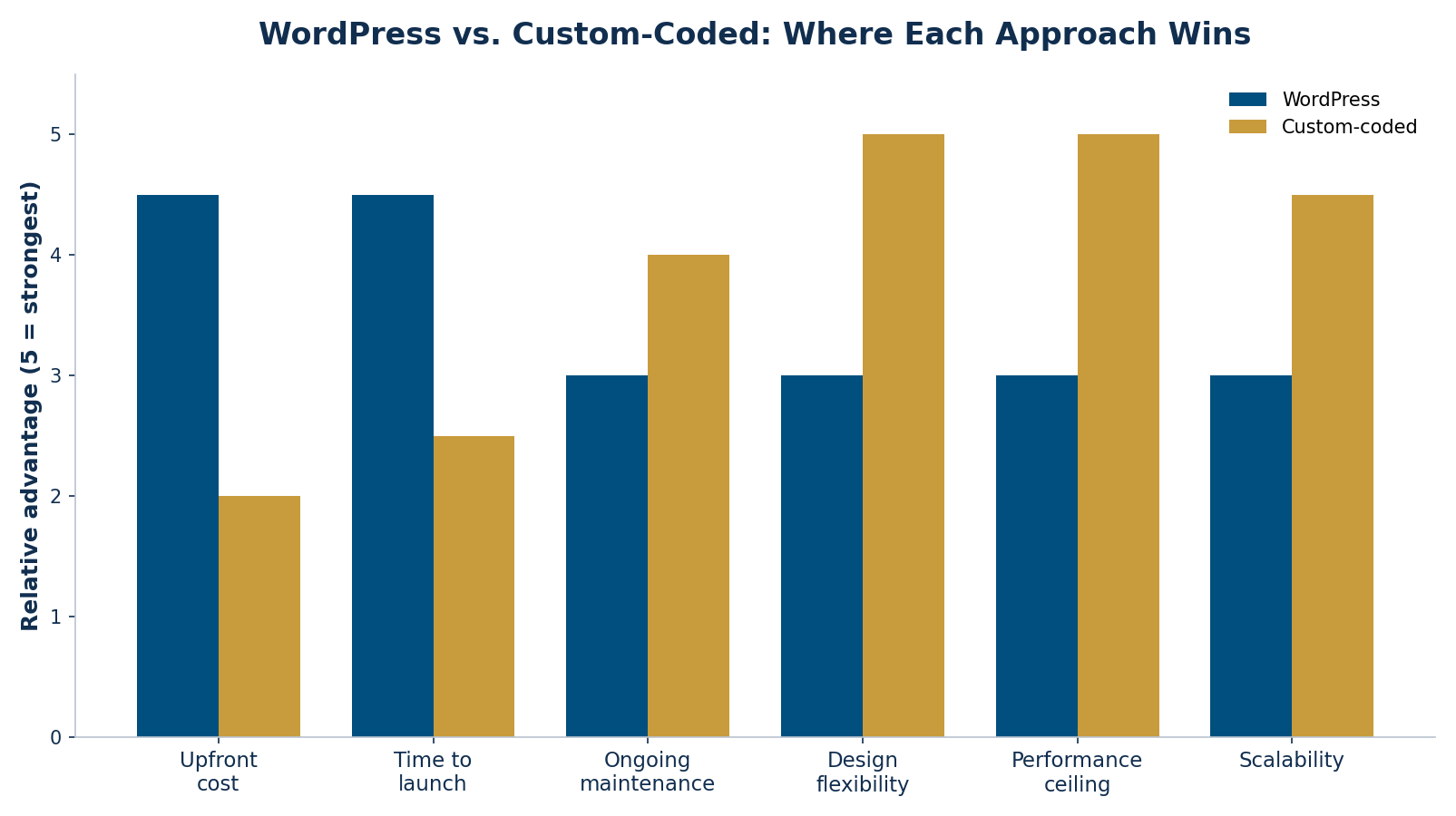
Figure 1: WordPress leads on cost and speed-to-launch; custom-coded pulls ahead on flexibility, performance ceiling, and scalability.
| Factor | WordPress | Custom-coded |
|---|---|---|
| Upfront cost | Lower | Higher |
| Time to launch | Weeks | Months |
| Design freedom | Theme-bound | Unlimited |
| Performance ceiling | Good with tuning | Highest |
| Ongoing maintenance | Plugin/core updates | Developer-dependent |
| Scalability | Strong to a point | Engineered to fit |
- WordPress powers about 43% of all websites, so hosting, plugins, and talent are abundant and inexpensive.
- Custom-coded sites carry higher upfront cost and longer timelines but remove the constraints of themes and plugins.
- The decision hinges on complexity and growth expectations, not on one platform being universally superior.
Cost and time: what you really pay for each
WordPress is cheaper to launch because so much of the work is already done. You are configuring and customizing a proven system rather than writing everything from scratch, and you can find a developer for it in almost any market. That is also why a typical WordPress project measures its timeline in weeks rather than months. If you want a deeper look at real budget ranges, my breakdown of how much a custom website costs in 2026 walks through the line items in detail.
Custom-coded websites cost more because you are paying for engineering time to build exactly what you need. That premium buys you something real: no bloat from features you will never use, no licensing fees stacking up plugin by plugin, and no compromise between what the theme allows and what your business actually requires. For a brochure site the premium rarely pays off. For a product that is the business, it usually does.
Speed and performance: why milliseconds cost you customers
Speed is where this debate gets expensive. Google’s own mobile benchmark research found that as page load time climbs from one second to three seconds, the probability that a visitor bounces jumps 32%. Push load time to five seconds and bounce probability rises 90%; at ten seconds it more than doubles. Every second of delay is quietly costing you conversions.

Figure 2: Google mobile data — the slower a page loads, the more likely a visitor leaves before it finishes.
Here is the nuance most comparisons miss: a well-built WordPress site with quality hosting, caching, and disciplined plugin use can be genuinely fast. The problem is that WordPress makes it easy to slow yourself down by piling on plugins, heavy page builders, and unoptimized images. A custom-coded site has a higher performance ceiling because you ship only the code the page needs, with nothing extra to load. If your audience is largely on mobile and every conversion matters, that ceiling is worth paying for.
Scalability: which one grows with you
Scalability is not just about surviving a traffic spike. It is about whether the platform can keep absorbing new features, integrations, and users without turning into a maintenance nightmare. WordPress scales impressively far, and plenty of high-traffic publishers run on it. But as your logic gets more custom, you start bolting complexity onto a system that was not designed for your specific case.
Custom-coded applications are engineered to fit, which is exactly why they scale cleanly when your needs are unusual. If you are heading toward heavy custom workflows, deep third-party integrations, or app-like functionality, that is often a sign you are outgrowing the CMS model, which is a conversation I cover in our software development practice. Before you commit either way, sanity-check your project against these questions:
- Do you need functionality that no reputable plugin already provides?
- Will non-technical staff need to update content daily without a developer?
- Are page speed and Core Web Vitals mission-critical to your revenue?
- Do you expect deep integrations with other internal systems?
- How fast do you realistically expect traffic and features to grow?
So which should you choose?
Choose WordPress when you want to launch quickly, keep costs down, and let your own team manage content, and when your requirements fit comfortably inside a good theme and trusted plugins. That describes the majority of small-business websites, and there is no shame in the practical choice. Choose custom-coded when performance is a competitive advantage, when your functionality is genuinely unique, or when you are building something closer to a web application than a website. Many businesses even start on WordPress and graduate to custom later, once the requirements and the budget both justify it.
Frequently Asked Questions
Is WordPress cheaper than a custom-coded website?
Yes, in almost every case WordPress is cheaper to build and launch because you are configuring a proven system rather than writing everything from scratch, and skilled WordPress developers are widely available. Custom code costs more up front but can be more economical over time if you would otherwise be paying for plugins and workarounds you constantly have to fight.
Is a custom-coded website faster than WordPress?
It has a higher performance ceiling because it loads only the code a page actually needs. That said, a well-hosted, well-optimized WordPress site can be very fast. WordPress usually gets slow when it is loaded with too many plugins, heavy page builders, and unoptimized images rather than because of the platform itself.
Can WordPress handle a large, high-traffic website?
Yes. WordPress powers roughly 43% of the web, including many high-traffic publishers, and it scales well with proper hosting, caching, and architecture. The limits show up less around raw traffic and more when your custom logic and integrations grow beyond what the CMS model handles gracefully.
When does a custom-coded website make more sense?
When you need functionality no plugin provides, when page speed is a direct competitive advantage, when you require deep integrations with internal systems, or when you are really building a web application rather than a content site. In those cases the engineering premium buys performance and flexibility you cannot get off the shelf.
Can I start on WordPress and move to a custom build later?
Absolutely, and many businesses do. Launching on WordPress lets you get to market fast and validate demand cheaply. Once your requirements and revenue justify it, you can migrate to a custom build for the parts of the experience that have outgrown the platform.
MEAN Consultors scopes web development projects on the platform that actually fits your goals, budget, and growth plans — not the one that is easiest to sell.