
Secure Software Development Lifecycle (SSDLC): A Practical Overview
Last updated: August 30, 2026 · By Joseph Olivas, Founder, MEAN Consultors · 9 min read
Most teams I work with are not indifferent to security. They are sequencing it wrong. Security shows up as a phase near the end — a scan, a pen test, a checklist someone runs the week before launch — and by then the expensive decisions were made months earlier by people who were not thinking about attackers.
An SSDLC is the correction. It is less a methodology than a scheduling discipline: put the security question at the moment in the project when answering it is still cheap. Here is what that looks like phase by phase, and what our own numbers say about the cost of not doing it.
Why Timing Dominates the Economics
The strongest argument for an SSDLC is not moral, it is arithmetic. We went back through forty-one security findings across our own client projects and recorded the median engineer-hours required to fully remediate each one, grouped by the phase in which it was discovered.
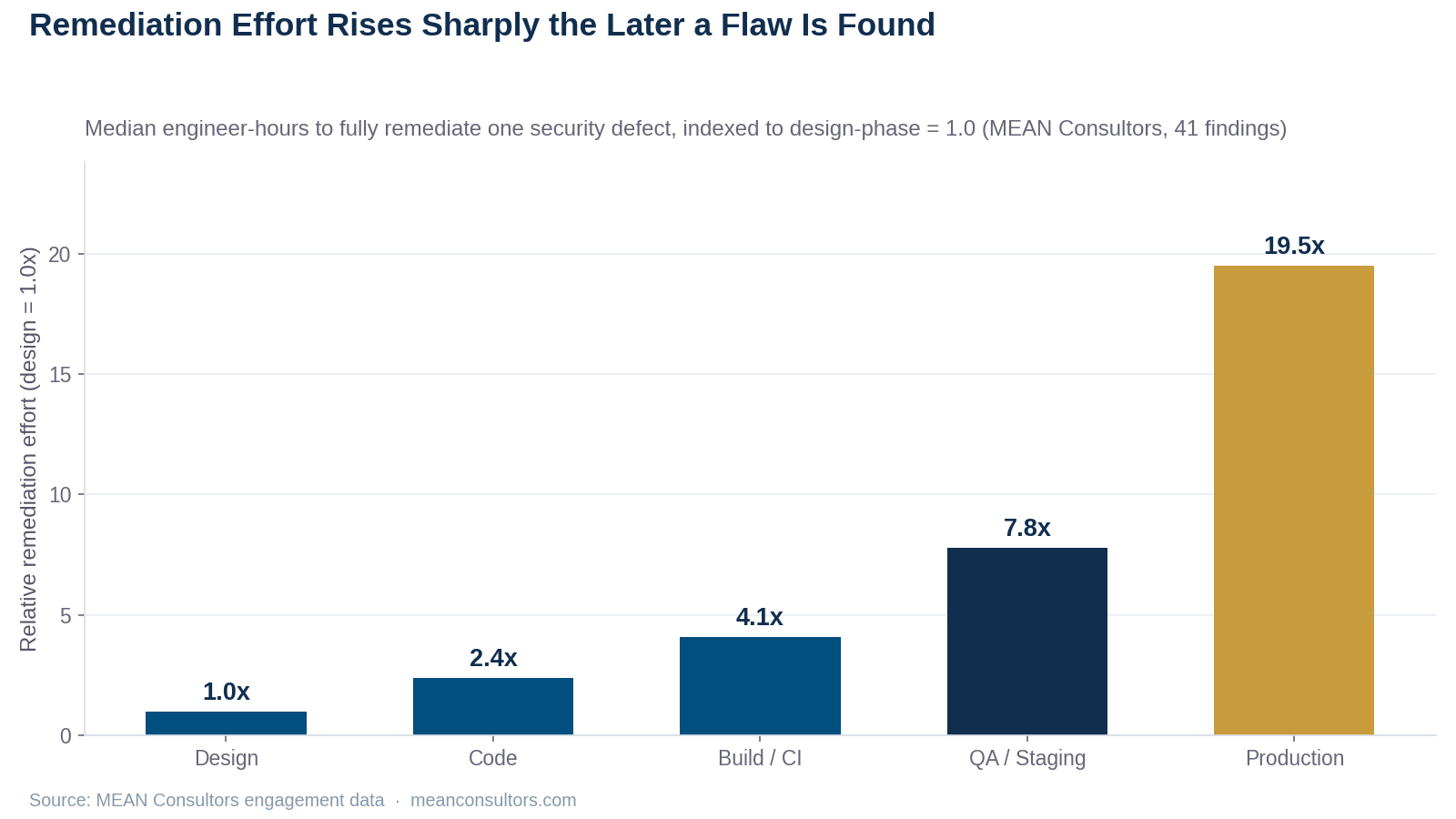
Figure 1: Median remediation effort per security defect by discovery phase, indexed to design phase = 1.0. MEAN Consultors project data, 41 findings.
The shape is what matters more than the exact multiples. Cost is roughly flat while the defect exists only as a decision or a few lines of code, then rises steeply once the defect has dependents — other code that assumes the flawed behavior, test suites written around it, data already stored in the wrong shape, and eventually customers depending on it.
Production is worse still because remediation there is not just engineering. It is coordination, communication, possibly disclosure, and always a scheduling emergency that displaces planned work. The nineteen-times figure understates it if you count the roadmap cost.
- A defect caught at design costs roughly one-twentieth of the same defect caught in production, in median engineer-hours across 41 of our own findings.
- The cost curve inflects sharply at QA and staging — once other code depends on flawed behavior, remediation stops being local.
- An SSDLC adds an estimated 8–12% to initial build effort in our projects, concentrated in requirements and verification.
- The most expensive findings in our sample were architectural — authorization models and trust-boundary errors — not coding mistakes.
That last point deserves emphasis. The findings that hurt were almost never a missed input validation. They were decisions about who is allowed to do what, made early, encoded everywhere, and expensive to unwind. Those are design-phase questions, and no amount of late-stage scanning surfaces them cheaply.
The Six Phases and What Each Should Produce
Here is the shape of the lifecycle we implement on custom software development engagements. Each phase has one primary security deliverable — something you can point at, not a state of mind.

Figure 2: Security activities mapped to each phase of the secure software development lifecycle.
Requirements. Threat modeling and abuse cases, written alongside the functional spec. The question is not “what should this do” but “what would someone try to make this do.” It is the highest-leverage hour in the entire project, and it requires no tooling. If your requirements document has no adversarial section, that is the first gap to close — and it is worth building into the software requirements document itself rather than keeping it separate.
Design. Explicit trust boundaries, an authentication and authorization model, and a data classification scheme. Which data is sensitive, where does it cross a boundary, and who is permitted at each crossing. Write it down. Architectural findings are the expensive ones precisely because they are usually undocumented assumptions.
Implementation. Secure coding standards the team has actually read, secrets managed outside the repository, and dependency choices made with maintenance status in mind. An abandoned library is a scheduled future vulnerability.
Verification. Static analysis, dependency and container scanning, and code review with a security dimension — all wired into the pipeline so they run without anyone remembering to. If it is a manual step, it will be skipped under deadline. This is one of the strongest practical arguments for a proper CI/CD pipeline.
Release. Signed builds, least-privilege deployment credentials, configuration reviewed separately from code, and a rollback path that has actually been exercised. An untested rollback plan is a hypothesis.
Operations. Patch service levels, logging sufficient to reconstruct an incident, and a rehearsed response path. Most of a system’s life is spent in this phase, and it receives the least design attention of the six.
Starting Without a Security Team
The objection I hear most is that this is enterprise process for enterprise budgets. It does not have to be. Here is the minimum viable version for a small team, in the order I would adopt it.
- Turn on dependency scanning in your repository host. It is often free, takes minutes, and catches the most common class of real-world exposure.
- Move every secret out of the codebase into environment configuration or a managed secrets store. Then rotate the ones that were committed.
- Add one adversarial paragraph to every feature spec: who would abuse this, and how.
- Add a security prompt to your code review template so the question gets asked on every pull request.
- Write down your patch commitment — critical within days, high within weeks — and hold to it.
- Enforce least privilege on deployment credentials and production database access. Most teams over-grant here by habit.
- Rehearse one incident, badly, on a quiet afternoon. The gaps you find will be organizational, not technical.
That list is roughly two days of setup. It will not satisfy an enterprise security questionnaire, but it addresses the majority of what we find in practice, and it establishes the habit that formal maturity later builds on.
When Regulation Raises the Floor
If your software touches health data, payment data, or federal contracts, the SSDLC stops being optional practice and becomes evidence. Auditors and enterprise security reviewers ask for artifacts: the threat model, the scanning results, the change records, the access reviews. A team that has been doing the work informally but producing nothing durable will struggle in that conversation despite being reasonably secure.
This is where the documentation burden earns its keep. The same is true when you sell into larger companies — the security questionnaire is now a routine part of B2B procurement, and answering it credibly requires that the artifacts already exist. Building software for regulated environments raises specific obligations we cover in our guides to HIPAA-compliant healthcare software and API security best practices.
| Phase | Primary artifact | Who typically owns it |
|---|---|---|
| Requirements | Threat model and abuse cases | Technical lead with product |
| Design | Trust boundary and authorization model | Architect or technical lead |
| Implementation | Coding standard; secrets inventory | Whole engineering team |
| Verification | Pipeline scan results and review records | CI owner |
| Release | Deployment checklist and rollback record | Release manager |
| Operations | Patch log and incident response plan | Operations or on-call owner |
Frequently Asked Questions
What is a secure software development lifecycle?
A secure software development lifecycle is a development process with a defined security activity attached to every phase — threat modeling during requirements, a documented trust model during design, secure coding standards during implementation, automated scanning during verification, hardened deployment at release, and patch and incident discipline in operations. The distinguishing feature is that no phase ends without its security work being done, so security stops being a gate at the end and becomes a property of the process.
How is SSDLC different from just running a penetration test?
A penetration test is a point-in-time measurement of what you built. An SSDLC is the process that determines what you build. The test tells you what went wrong; the lifecycle reduces how much goes wrong in the first place. Both belong in a mature program, but a practice that only pen-tests is paying to discover late-stage defects at their most expensive, and re-discovering the same classes of defect on every release.
Does a small business really need a formal SSDLC?
It needs the substance, not the ceremony. A five-person team does not need a governance committee, but it does need a threat model it can point to, dependency scanning wired into CI, code review that includes a security question, secrets kept out of the repository, and a patch commitment. That is perhaps two days of setup and a modest ongoing habit. The formal artifacts matter more as headcount, regulatory scope, and customer security reviews grow.
Which SSDLC framework should we follow?
For most U.S. businesses the NIST Secure Software Development Framework is the sensible reference, partly because it is practice-oriented rather than prescriptive about tooling, and partly because it increasingly shows up in customer and federal procurement expectations. OWASP’s SAMM is useful when you want a maturity model to measure progress against. Pick one, map your existing practices onto it honestly, and close the largest gaps first rather than trying to adopt everything at once.
What does an SSDLC add to project cost and timeline?
In our project experience it adds roughly eight to twelve percent to initial build effort, concentrated in the requirements and verification phases. That is the honest sticker price. It is offset by the remediation curve — defects caught during design cost a fraction of the same defect caught in production, and the difference compounds across every release. The projects where the math does not work are throwaway prototypes that will never hold real data.
Who owns security in a small development team?
Ownership should sit with a named person even when it is not a full-time role — usually the technical lead. What fails reliably is diffuse ownership, where security is everyone’s responsibility and therefore nobody’s. The named owner does not need to perform every activity; they need to be accountable for the gates existing, running, and being enforced when a release is under deadline pressure.
MEAN Consultors develops custom applications with security built into every phase — from threat modeling through operations — for U.S. businesses in regulated and high-trust industries.