
What Is Generative Engine Optimization? A Practical GEO Guide for 2026
Last updated: August 30, 2026 · By Joseph Olivas, Founder, MEAN Consultors · 9 min read
I get asked some version of “is GEO real or is it consultant vocabulary” about once a week now. Fair question. My honest answer is that the underlying shift is real, the acronym is doing more work than it deserves, and the practical checklist is shorter than the discourse suggests.
What follows is what we actually change on a client site when GEO is the goal, what we found when we audited a batch of business websites against those criteria, and where the whole thing is genuinely uncertain.
How a Generative Engine Decides What to Cite
To optimize for something, it helps to know what it does. A generative answer is assembled in stages, and your content has to survive each one.
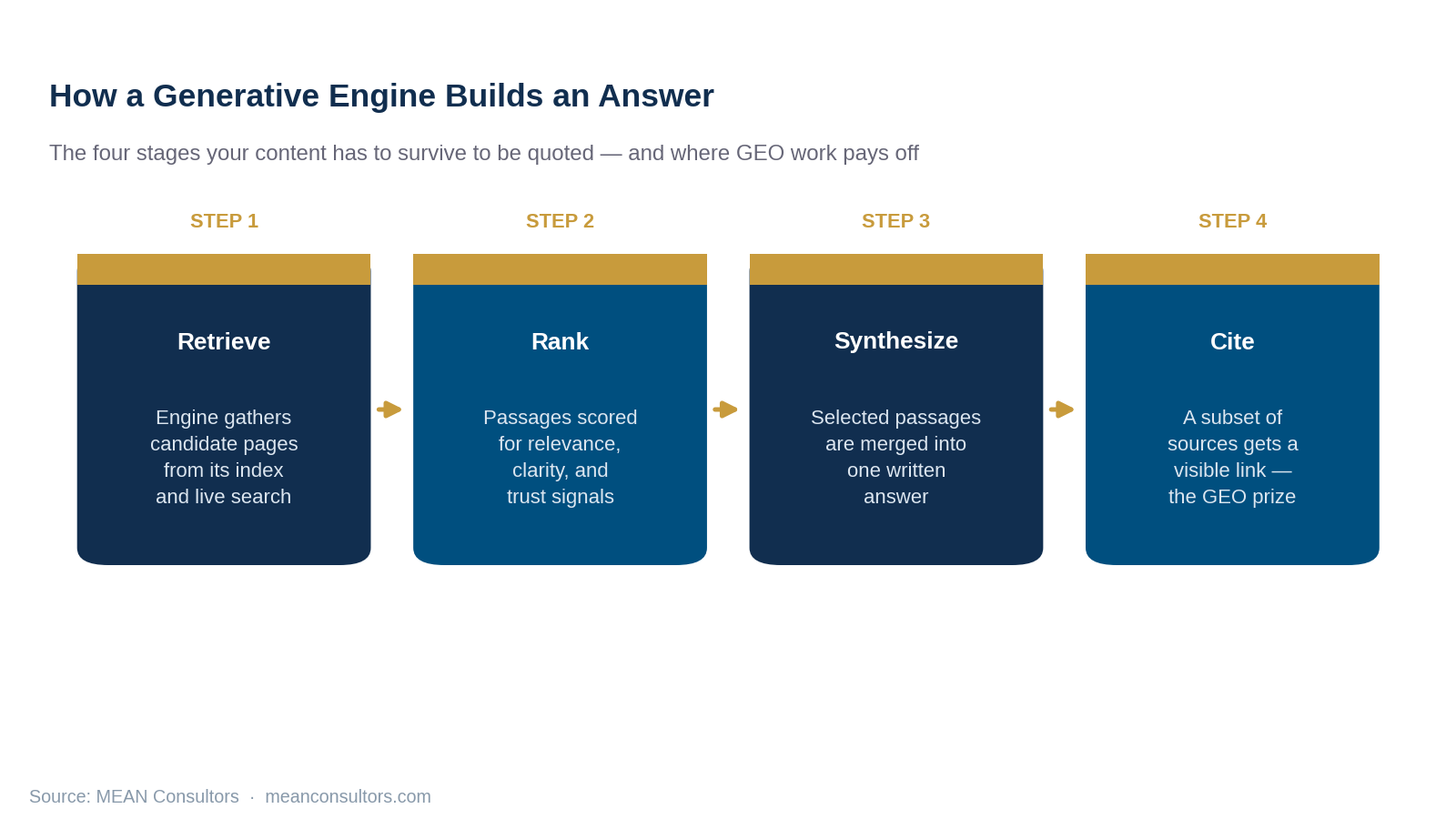
Figure 1: The four stages a page must pass through to be cited in a generative answer.
The retrieval stage is ordinary search infrastructure — if you are not indexed and findable, nothing downstream matters. That is why GEO cannot precede basic technical SEO. The ranking stage scores individual passages rather than whole pages, which is the first meaningful difference: a page can rank poorly overall while containing one passage that is perfect for a specific question.
Synthesis is where most content quietly loses. The model needs a passage that stands on its own — one that still makes sense when lifted away from the surrounding page. Content that depends on the previous three paragraphs for context is hard to lift cleanly, so it gets passed over in favor of something more self-contained.
The citation stage is the prize, and it is not automatic. Engines cite selectively, and they lean toward sources that are easy to attribute: a named author, a clear publication date, a specific claim traceable to that page. Anonymous, undated content gets synthesized without credit.
What Business Sites Are Actually Missing
We audited thirty-two U.S. small and mid-size business websites against a six-point GEO checklist during the first half of 2026. The chart shows how often each element was absent.
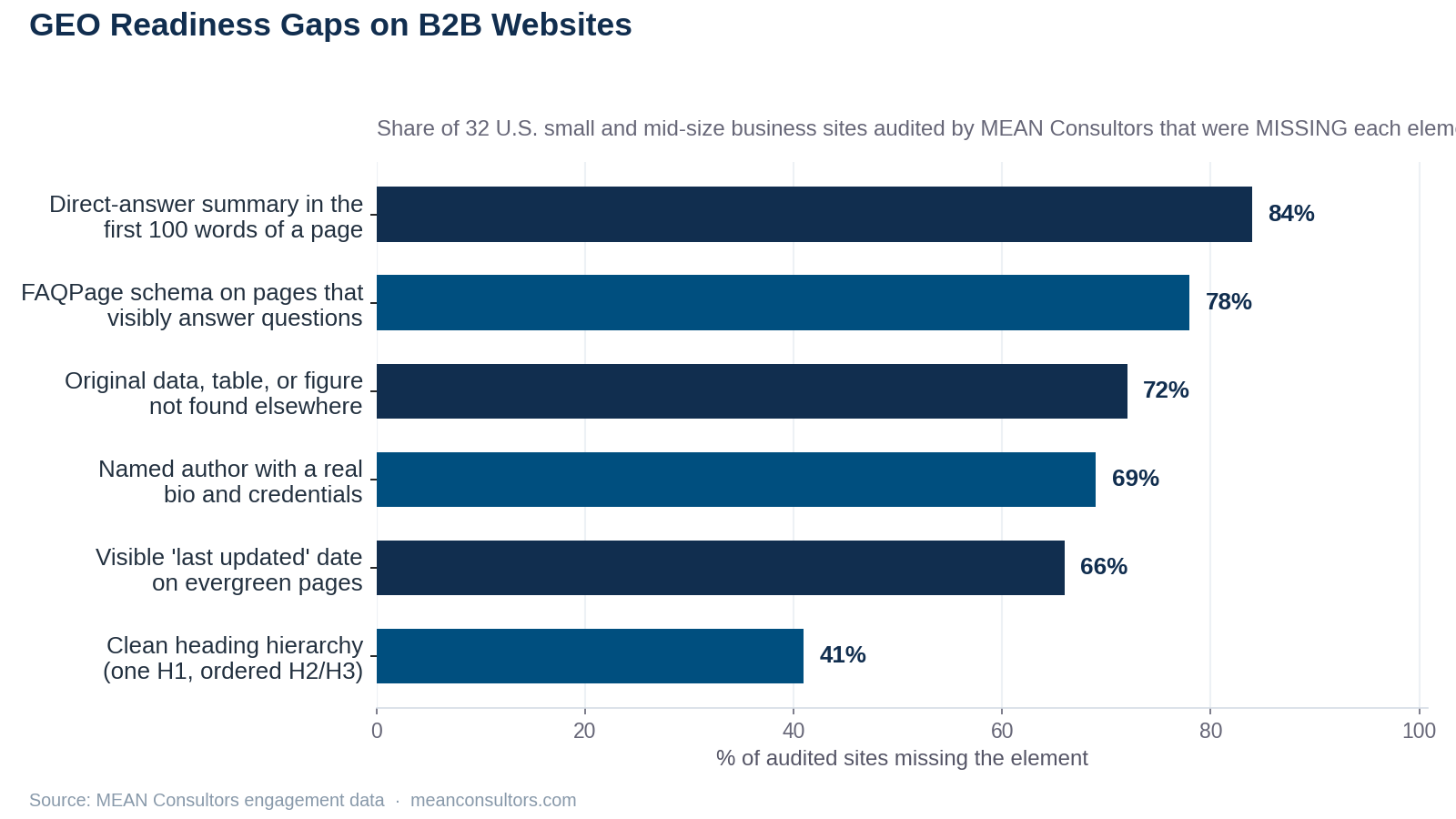
Figure 2: GEO readiness gaps across 32 U.S. small and mid-size business websites audited by MEAN Consultors, 2026.
Two findings stood out. The first is that the direct-answer summary — the cheapest fix on the list, roughly twenty minutes of writing per page — was missing from eighty-four percent of sites. Most business content opens with throat-clearing: context, background, a paragraph about why the topic matters. The answer shows up around paragraph six, and by then the extraction opportunity is gone.
The second is that original data was missing from seventy-two percent. Nearly every page we reviewed cited the same handful of widely-circulated industry statistics as everyone else. A model has no reason to cite your page for a number it can source from two hundred other pages. It has a strong reason to cite the only page that reports a particular figure.
- 84% of audited sites had no direct-answer summary in the first 100 words — the single cheapest GEO fix available.
- 72% published no original data, table, or figure, leaving nothing a model could uniquely attribute to them.
- 69% had no named author with a real bio, which weakens attribution at exactly the stage where citation is decided.
- Clean heading hierarchy was the strongest area at 59% compliant — largely a side effect of good SEO habits already in place.
The Six Changes That Do the Most Work
This is the list we work through on a page-by-page basis. It is deliberately short.
- Answer first. Put a two-to-four sentence direct answer inside the first 100 words, phrased so it survives being quoted alone. Then write the rest of the article.
- One question per heading. Structure H2s and H3s as the questions a buyer would actually type, and answer each one immediately below in a self-contained passage.
- FAQPage schema that matches the page. Every question in the markup must be visibly on the page with the same answer. One-to-one, no exceptions.
- Publish something only you have. Your own engagement data, a benchmark from your own book of work, a comparison table you built — anything the model cannot source elsewhere.
- Make the author real. Named byline, credentials, a linked bio page, and an organization the engine can resolve to a real entity.
- Date everything and keep it current. A visible “last updated” date plus genuine revisions. Undated content is treated as stale by default.
Note how much of this is just good editorial practice with the structure made explicit. That is the honest shape of GEO: it rewards clarity and penalizes vagueness, which was already true, but the penalty is now sharper.
Where GEO and SEO Diverge — and Where They Do Not
The overlap is larger than the marketing suggests. Here is how we split the two in practice.
| Element | Classic SEO priority | GEO priority |
|---|---|---|
| Crawlability and indexation | Essential | Essential — identical requirement |
| Keyword targeting | High — phrase-level matching | Moderate — question and intent matching |
| Title and meta description | High — drives click-through | Low — not usually what gets quoted |
| Passage-level self-containment | Moderate | Critical — determines extractability |
| Original data and figures | Helpful for links | Critical — the main reason to cite you |
| Named authorship and credentials | Matters for YMYL topics | Matters broadly — attribution depends on it |
| Internal linking and topical depth | High | High — establishes subject authority |
The row worth dwelling on is internal linking. Generative engines assess topical authority much the way search engines do, and a well-built cluster of related pages signals depth on a subject far better than an isolated article does. If you have not organized your content that way yet, our framework for topic clusters and pillar pages is the place to start, and the fundamentals in our on-page SEO checklist still apply unchanged.
What I would not do is treat GEO as a reason to abandon conventional search engine optimization. Every generative engine currently relies on a search index to find candidate content. Optimizing for the answer layer while neglecting the retrieval layer is optimizing for a stage you will never reach.
What Is Genuinely Uncertain
Worth saying plainly: this field is young, the platforms change their behavior without notice, and nobody has stable longitudinal data. Citation patterns we observed in the spring shifted by summer. Attribution formats differ between assistants and change between releases. Anyone selling GEO certainty is selling something else.
What I am confident about is narrower: clear answers, verifiable authorship, accurate structured data, and information that exists nowhere else have been rewarded by every retrieval system I have worked with for a decade, and there is no plausible version of the future where they stop being rewarded. That is a durable bet regardless of which acronym wins.
Frequently Asked Questions
What is generative engine optimization in simple terms?
Generative engine optimization is the work of making your content easy for an AI answer engine to extract, verify, and attribute. Traditional SEO competes for a ranked position on a results page. GEO competes to be the passage a model actually quotes inside a written answer. The underlying content still has to be genuinely good; GEO is about removing the structural obstacles that keep good content from being usable as a citation.
Is GEO different from SEO, or just a rebrand?
It is a genuine extension rather than a replacement, and the overlap is large — roughly two-thirds of the work is standard technical and content SEO you should already be doing. The distinct part is optimizing for extraction rather than for clicks: writing self-contained answers, marking up questions with schema, publishing data that exists nowhere else, and making authorship verifiable. If you do no SEO, GEO will not save you. If you do good SEO, GEO is an incremental layer.
Do I need special schema markup for GEO?
You do not need a new vocabulary — schema.org already covers what matters. FAQPage, Article or BlogPosting with a real author, Organization, and Product or Service markup do the heavy lifting. What changes is the discipline: the markup has to describe content that is visibly on the page, one-to-one. Schema that promises answers the page does not display is worse than no schema, and Google’s structured data guidelines are explicit about that.
How do I measure whether GEO is working?
Direct rank tracking does not exist the way it does for blue links, so measurement is indirect. We track four things: referral sessions from AI assistant domains in analytics, branded search volume trend, manual citation checks by running a fixed set of buyer questions through the major assistants each month, and assisted conversions from those referral sources. It is coarser than classic rank tracking, and anyone promising precise GEO rank data should be treated skeptically.
Does GEO reduce traffic to my website?
It can. If a generative answer fully satisfies a question, some users will not click through, and informational top-of-funnel pages feel that first. The strategic response is to shift emphasis toward content where the answer creates a need for you — pricing realities, scoping decisions, comparisons, local service specifics — and to treat citation itself as brand exposure. A cited mention in front of a buyer researching a purchase has value even without the session.
How long does GEO take to show results?
In our engagements, structural changes such as answer summaries and FAQ schema tend to show up in assistant citations somewhere between four and ten weeks after publication, which is generally faster than the equivalent organic ranking timeline. Authority-dependent gains — being cited for competitive commercial questions — run on the same slow clock as SEO, because the models lean heavily on the same trust signals.
MEAN Consultors builds SEO and GEO programs for U.S. businesses — starting with a structural audit of what is keeping your best pages out of AI answers.