
RPA vs. AI Automation: What’s the Difference?
Last updated: July 17, 2026 · By Joseph Olivas, Founder, MEAN Consultors · 8 min read
“Should we use RPA or AI?” is one of the most common questions I get from business owners exploring AI and automation services. The terms get used interchangeably in marketing, but they solve different problems — and picking the wrong one wastes money and erodes trust in automation across your team. This guide draws a clear line between the two, shows where each shines, and gives you a simple way to decide.
RPA vs. AI automation: the core difference
Robotic process automation is a rules engine. You define the exact steps — open this file, copy this field, paste it there, click submit — and a software bot repeats them tirelessly, exactly, and fast. RPA doesn’t “understand” anything; it mimics the clicks and keystrokes a person would make. That’s its strength and its ceiling: perfect for predictable tasks, helpless the moment something unexpected appears.
AI automation is a decision engine. Instead of fixed rules, it uses machine learning models trained on data to interpret inputs — reading an invoice in any layout, classifying a support email by intent, predicting which lead is worth calling. It handles ambiguity, learns from new examples, and makes probabilistic judgments. RPA follows a script; AI writes part of the script on the fly.
A side-by-side capability comparison
The fastest way to internalize the difference is to score each technology against the kinds of work businesses actually automate. The chart below reflects how RPA and AI automation compare across six common dimensions.
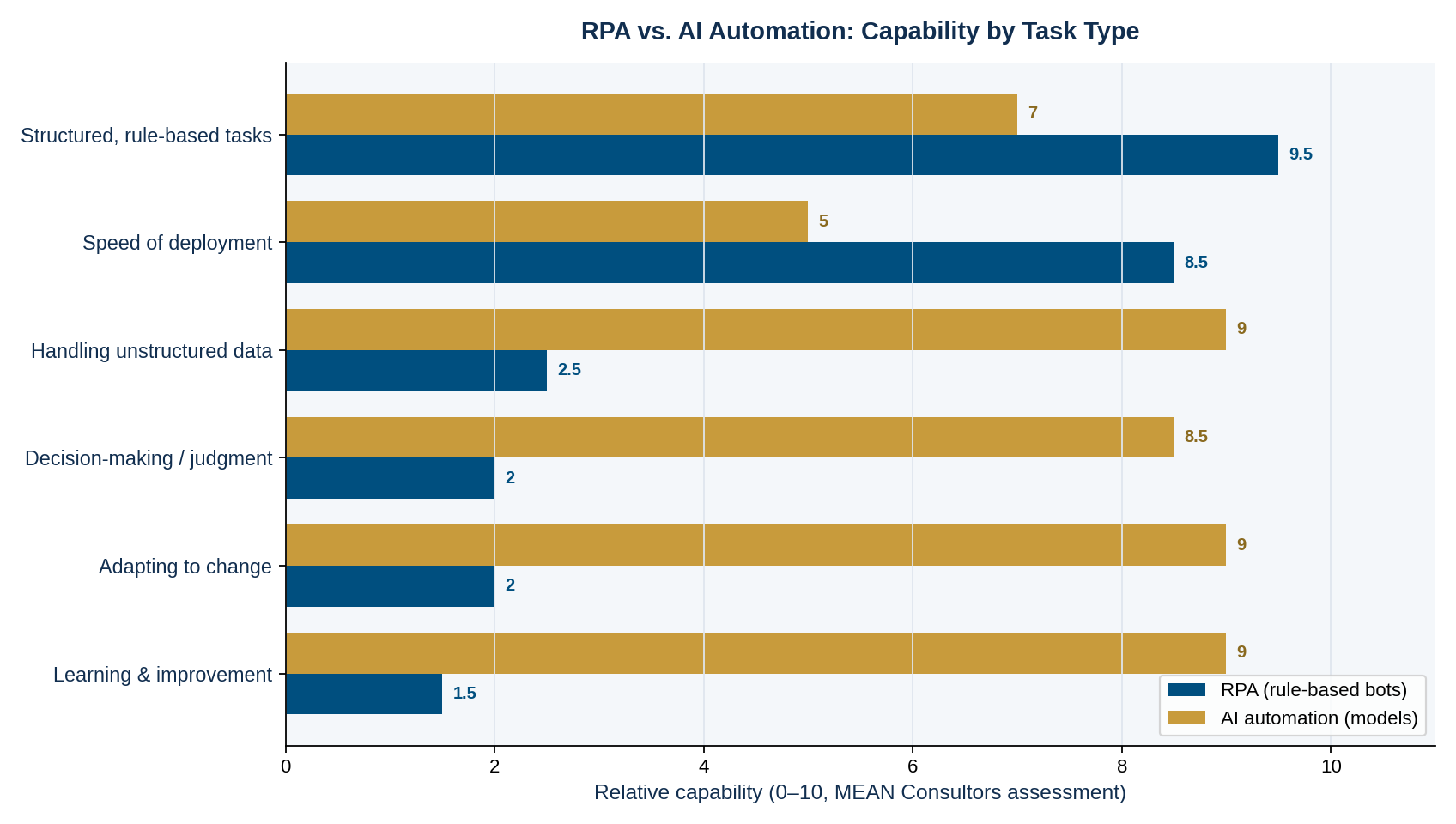
Figure 1: RPA excels at structured, rule-based speed; AI automation excels at unstructured data, judgment, and adaptability.
| Capability | RPA (rule-based bots) | AI automation (models) |
|---|---|---|
| Structured, repetitive tasks | Excellent | Good |
| Speed of deployment | Fast | Slower (needs data/training) |
| Unstructured data (documents, email, images) | Weak | Excellent |
| Decision-making & judgment | Very limited | Strong |
| Adapting to change | Breaks on change | Adapts |
| Learning & improvement | None | Improves with data |
- RPA wins on speed and reliability for structured, high-volume tasks — you can often deploy in days.
- AI automation wins whenever the work involves unstructured data or judgment that rules can’t capture.
- The two are complementary, not competing — the best results usually come from pairing them.
What RPA does well — and where it breaks
RPA is the right tool when a process is stable, high-volume, and rule-based. Think moving data between two systems that don’t integrate, generating the same report every morning, or reconciling records across spreadsheets. Gartner has projected that around 90% of large organizations would adopt RPA in some form, precisely because so much office work is this kind of repetitive shuffling.
Where RPA breaks is change and ambiguity. If a vendor redesigns a screen, the bot clicks the wrong place and fails. If an invoice arrives in an unfamiliar format, RPA can’t read it. Bots are brittle by nature — they do exactly what they were told, which is a problem the moment reality stops matching the script.
What AI automation adds
AI automation earns its place wherever human judgment used to be the bottleneck. Intelligent document processing reads invoices, contracts, and forms regardless of layout. Natural language models route and even draft responses to customer emails. Predictive models score leads or flag anomalies. These are things no rulebook can fully specify, because the inputs are messy and the “right” answer depends on context.
The trade-off is that AI needs data and setup. It has to be trained or configured, validated for accuracy, and monitored over time. That’s why it’s slower to deploy than RPA and why it deserves a clear business case before you start. When the payoff is handling work that genuinely requires interpretation, though, it’s transformative.
Which should you use? A simple decision path
You rarely have to choose in the abstract — you choose per process. Run each candidate workflow through this logic:
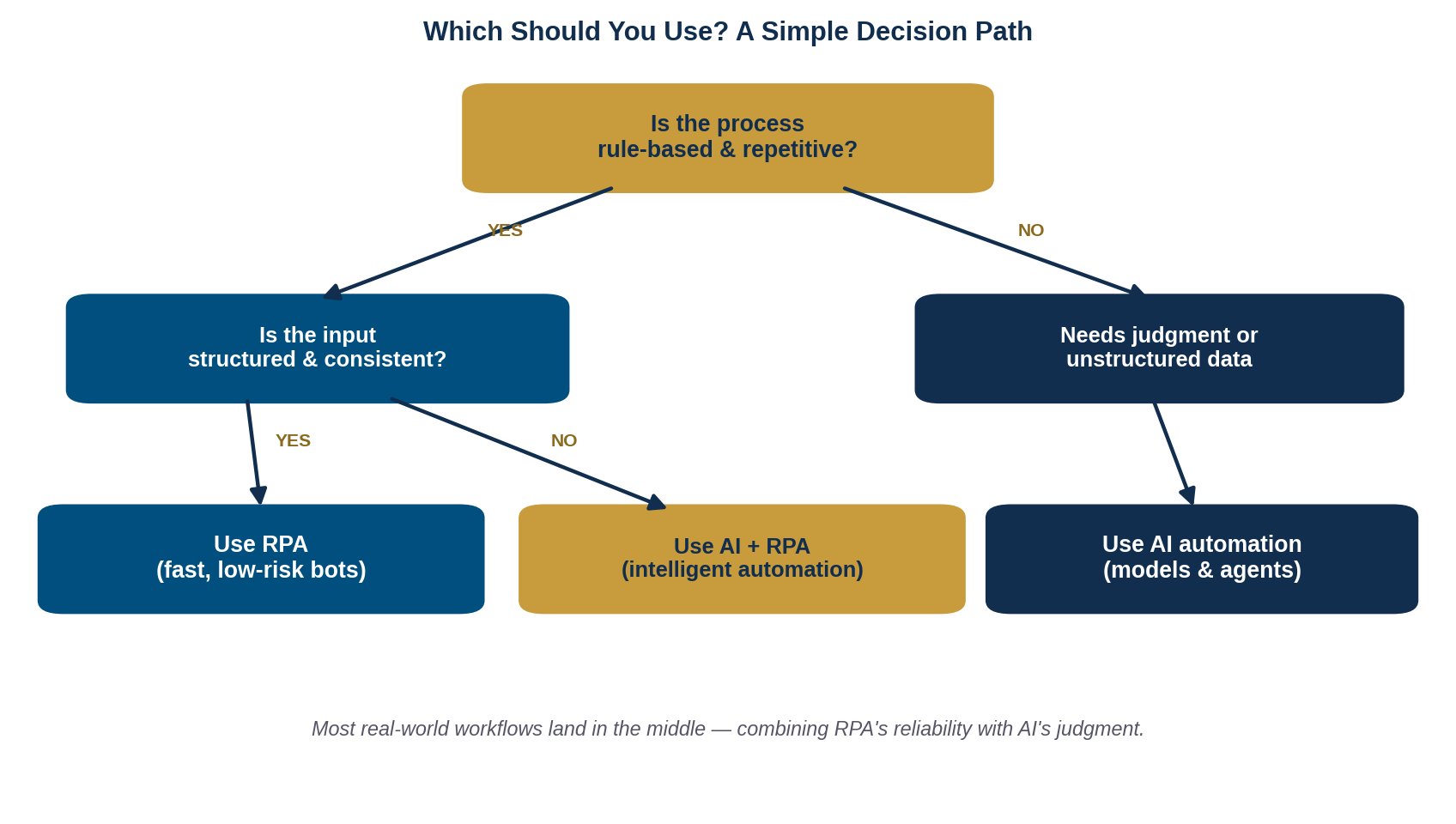
Figure 2: A simple decision path. Rule-based and structured points to RPA; judgment or unstructured data points to AI; the middle blends both.
- Rule-based and structured input? Use RPA — it’s fast and low-risk.
- Rule-based process but messy input? Use AI to read the input, then RPA to act on it.
- Needs judgment or unstructured data? Lead with AI automation.
- High volume plus high variability? Combine both into intelligent automation.
How RPA and AI work together (hyperautomation)
The real story in 2026 isn’t RPA or AI — it’s RPA and AI. When you layer AI’s interpretation onto RPA’s execution, you get what IBM and others call intelligent automation and Gartner calls hyperautomation: AI reads and decides, bots do the repetitive work, and orchestration ties the workflow together end to end. A classic example: AI extracts data from an unstructured invoice, applies business rules to validate it, and an RPA bot enters it into your accounting system — no human touch required.
This is why I tell clients not to frame it as a competition. Start with the process, not the technology. Map the workflow, find where rules suffice and where judgment is needed, and apply each tool to the part it’s best at. If you’re just getting started, our primer on business process automation is a good next step before choosing tools.
Frequently Asked Questions
Is RPA a type of AI?
No. RPA follows predefined rules and does not learn or make judgments — it mimics human clicks and keystrokes. AI automation uses machine learning to interpret data and make decisions. They’re often combined, but RPA on its own is not artificial intelligence.
Which is cheaper to implement, RPA or AI automation?
RPA is usually cheaper and faster to deploy for structured, rule-based tasks — often live in days to weeks. AI automation typically costs more upfront because it requires data, training, and validation, but it solves problems RPA simply can’t. Match the spend to the problem rather than defaulting to the cheaper tool.
Can RPA and AI be used together?
Yes — that’s the most common and most powerful pattern. AI interprets unstructured inputs and makes decisions, then RPA bots execute the repetitive steps. Combining them across a whole workflow is what Gartner terms hyperautomation and IBM calls intelligent automation.
What is a good first process to automate?
Start with a task that is high-volume, repetitive, rule-based, and stable — data entry between systems, recurring reports, or reconciliations. These deliver quick wins with RPA and low risk. Save the judgment-heavy, unstructured work for AI once you’ve proven value.
Will RPA bots break when our software changes?
They can. Because RPA follows fixed steps tied to specific screens and fields, an interface change can cause a bot to fail. This brittleness is a key reason to add AI for processes that change often, and to budget for ongoing bot maintenance.
How do I know if I need AI or just RPA?
Ask whether the process needs judgment or has to handle unstructured, variable input. If it’s purely rule-based on consistent data, RPA is enough. If it requires interpreting documents, language, or context — or making decisions that depend on the situation — you need AI, often alongside RPA.
MEAN Consultors maps your processes first, then applies RPA, AI, or both to the parts each does best.