
Product Page SEO Best Practices: How to Structure Pages That Rank and Convert
Last updated: August 7, 2026 · By Joseph Olivas, Founder, MEAN Consultors · 9 min read
Most e-commerce sites treat product pages as an afterthought: a manufacturer description pasted in, a photo, a price, and a buy button. Then they wonder why category pages get all the organic traffic while the pages closest to the sale get none. In my work building and rebuilding e-commerce stores at MEAN Consultors, product pages are consistently the highest-ROI place to invest SEO effort — because a visitor landing on one is often a search away from buying.
What product page SEO actually means in 2026
Product page SEO is the practice of structuring individual product pages so search engines understand exactly what you sell — the product, price, availability, and reputation — and so shoppers who land on the page have every reason to buy. It sits at the intersection of technical SEO, content, and conversion design, which is why it is so often done badly: the SEO team owns keywords, the dev team owns templates, and nobody owns the page as a whole.
The stakes are higher than they used to be. Google Shopping results, AI Overviews, and product grids now pull directly from structured data and page content. A product page with clean markup can appear in organic results, image results, Shopping tabs, and AI-generated answers simultaneously. A page without it is invisible in most of those surfaces. When we build stores as part of our web development service, the product page template is where we spend the most design and engineering time, because it multiplies across every SKU in the catalog.
One template decision, repeated across 50 or 5,000 products, is the difference between a store that compounds organic traffic and one that depends on ads forever. That’s also why platform choice matters — as I covered in my comparison of Shopify vs. WooCommerce vs. custom e-commerce, how much control you have over the product template varies enormously by platform.
The eight structural elements of a product page that ranks
Here is the exact structure we implement on client product pages, in order from the top of the page down.
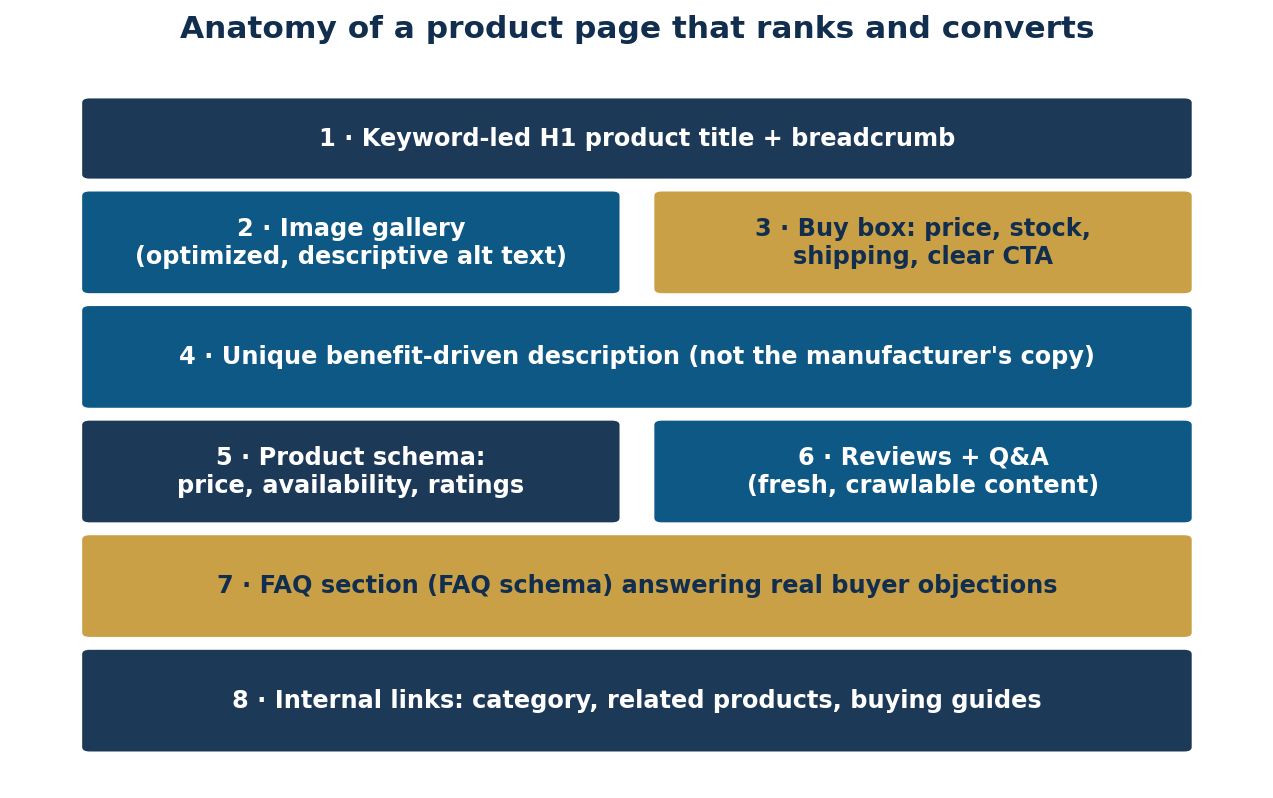
Figure 1: The eight-element product page structure MEAN Consultors implements on e-commerce builds.
- Keyword-led H1 product title. Lead with what people search for — brand, product name, and the defining attribute (size, material, model number). One H1 per page, matching the title tag closely.
- Breadcrumb navigation. Breadcrumbs give Google your category hierarchy and give shoppers an escape route that isn’t the back button.
- Optimized image gallery. Compressed, next-gen formats, descriptive file names, and alt text that describes the actual product variant shown.
- A clear buy box. Price, availability, shipping expectations, and the add-to-cart button visible without scrolling on mobile.
- A unique, benefit-driven description. Never the manufacturer’s copy — more on this below.
- Product structured data. Price, availability, ratings, and review count marked up in JSON-LD so Google can show rich results.
- Reviews and Q&A rendered in crawlable HTML. Reviews are free, fresh, keyword-rich content written in your customers’ own vocabulary.
- Internal links. Links to the parent category, related products, and buying guides keep authority flowing and shoppers moving.
None of these elements is exotic. What’s rare is a page that has all eight, because most templates were designed for visual appeal first and retrofitted for SEO later.
Structured data: the highest-leverage 30 minutes in e-commerce SEO
If you implement only one thing from this article, make it Product structured data. Google’s Search Central documentation is explicit that Product markup makes pages eligible for rich results — the listings that show price, star ratings, and stock status directly in search results. Those enhanced listings consistently outperform plain blue links, and Google has published the case studies to prove it.
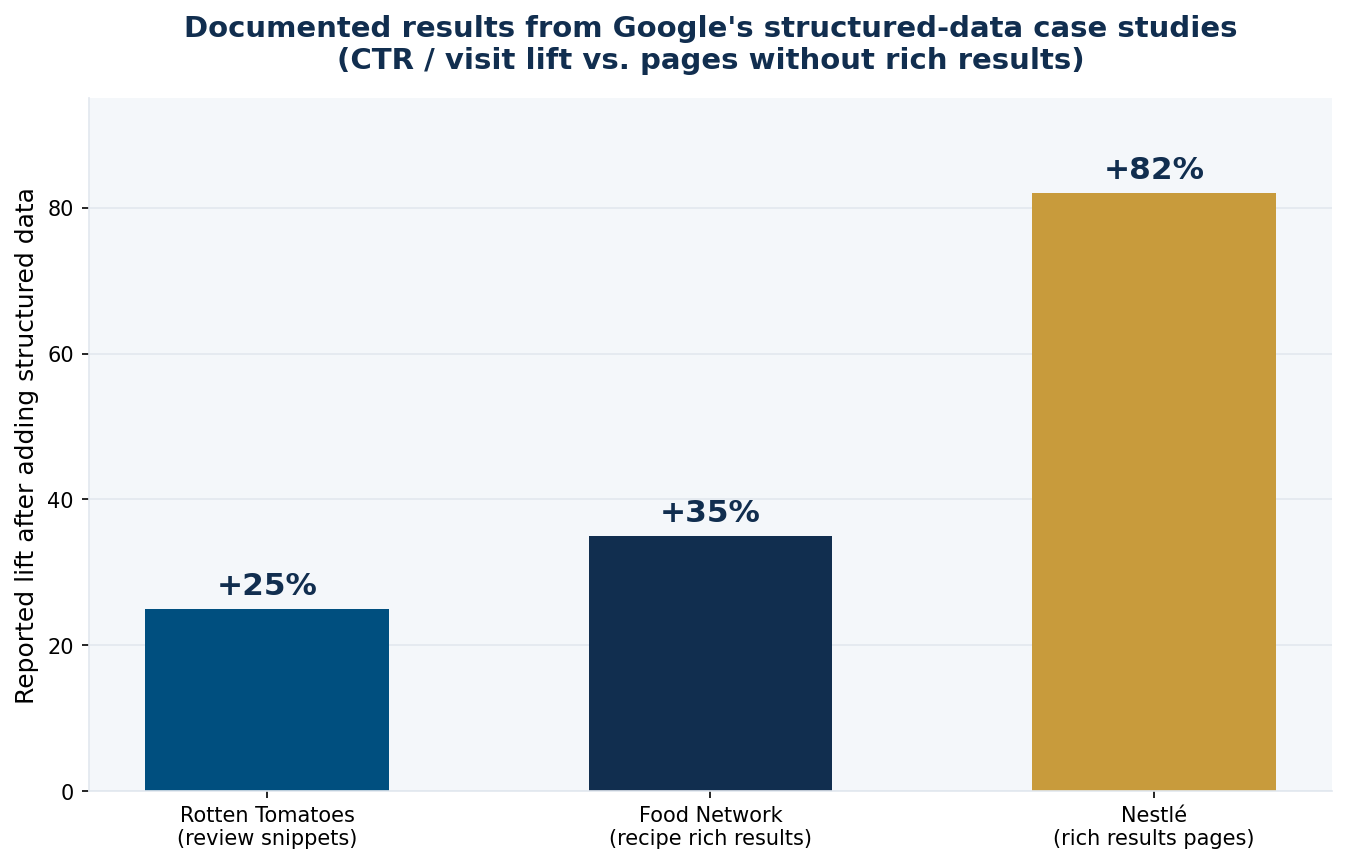
Figure 2: Documented lifts from Google’s own structured-data case studies: Rotten Tomatoes (+25% CTR), Food Network (+35% visits), Nestlé (+82% CTR on rich-result pages).
The minimum viable Product schema includes the fields in this table:
| Schema field | What it powers | Common mistake |
|---|---|---|
| name | Product identification in all surfaces | Doesn’t match the visible H1 |
| offers.price + priceCurrency | Price shown in search results | Stale price after a promotion ends |
| offers.availability | “In stock” label in rich results | Never updated when items sell out |
| aggregateRating + reviewCount | Star ratings in the listing | Markup present but reviews not visible on page |
| image | Image in Shopping and rich results | Low-resolution or watermarked images |
| gtin / mpn / sku | Matching to Google’s product graph | Omitted entirely |
- Google’s published case studies show rich results lifting CTR between 25% and 82% — structured data is the cheapest traffic multiplier on a product page.
- Schema values must match what’s visible on the page; mismatched price or rating markup risks a manual action rather than a rich result.
- Structured data is a template-level fix: implement it once and every SKU in the catalog benefits.
Writing product descriptions that rank (without copying the manufacturer)
The single most common product page problem I see in audits is duplicated manufacturer copy. If 400 other retailers paste the same paragraph, Google has no reason to rank your version — you’re competing on domain authority alone, and you’ll lose to Amazon every time. Duplicate descriptions also waste the one place on the page where you can actually answer a shopper’s real questions.
A strong description does three jobs. First, it leads with the specific benefit that differentiates this product — not “high quality materials” but the concrete thing a buyer gets. Second, it answers the questions that block purchase: sizing, compatibility, shipping time, returns. Third, it uses the vocabulary buyers actually search, which you can mine from your own site search logs, customer reviews, and the People Also Ask results for your target keyword. The same on-page fundamentals from my on-page SEO checklist apply here — title tags, headers, and internal anchors all still matter on product pages.
For stores with hundreds of SKUs, write unique descriptions for your top 20% of products first — the ones with meaningful search volume or margin — and use structured templates with variable attributes for the long tail. Prioritization beats perfectionism.
Ranking is half the job: conversion structure
Traffic that doesn’t convert is a vanity metric, and page structure drives conversion as much as it drives rankings. The Baymard Institute’s long-running research puts average cart abandonment at roughly 70%, with unexpected costs, forced account creation, and unclear delivery times among the top reasons shoppers walk. Most of those objections can be answered on the product page, before the cart: show shipping costs and delivery estimates in the buy box, surface the returns policy, and keep the primary CTA visible on mobile.
This is also where reviews earn their keep twice: they add fresh crawlable content for rankings and social proof for conversion. Pages with visible, recent reviews outperform on both metrics. If checkout friction is your bigger problem, I’ve written a full breakdown on reducing cart abandonment with better checkout UX.
Five product page mistakes that quietly kill rankings
- Thin variant pages. Separate URLs for every color and size, each with near-identical content, dilute authority. Consolidate variants on one URL with a canonical tag unless variants have distinct search demand.
- Discontinued products returning 404s. Retired products with backlinks and rankings should 301 to the closest replacement or parent category, not vanish.
- Reviews rendered only in JavaScript widgets. If review text isn’t in the served HTML, you may be losing your freshest content. Verify with the URL Inspection tool in Search Console.
- Out-of-stock pages stripped from the site. Keep the URL live, mark availability accurately in schema, and offer alternatives — restocking a page that lost its rankings is expensive.
- Slow templates. Product pages carry galleries, scripts, and widgets; unoptimized, they fail Core Web Vitals exactly where purchase intent is highest.
Frequently Asked Questions
How long should a product description be for SEO?
Long enough to answer every purchase-blocking question, and no longer — typically 150 to 400 words of unique copy for most products. Word count itself is not a ranking factor; uniqueness and usefulness are. A competitive, high-search-volume product justifies more depth than a long-tail accessory.
Do product reviews help SEO?
Yes, in two ways. Review text is fresh, unique, keyword-rich content that search engines crawl, and aggregate ratings marked up in schema make your listing eligible for star ratings in search results. Make sure reviews render in the page HTML, not only inside a third-party JavaScript widget.
Should every product variant have its own URL?
Only if the variant has distinct search demand — people searching specifically for “blue widget” rather than “widget.” Otherwise, keep variants on a single URL with a selector, and canonicalize any parameter URLs to the main product page to avoid splitting authority across near-duplicates.
What structured data should a product page have?
At minimum: Product schema with name, image, description, sku, offers (price, currency, availability), and aggregateRating with reviewCount where you have reviews. Add BreadcrumbList for the category path, and FAQ schema if the page has a visible question-and-answer section.
How do I handle out-of-stock products without losing rankings?
Keep the page live and indexable, update the schema availability to OutOfStock, show a restock date or email signup, and link to close alternatives. Delete or redirect only products that are permanently discontinued — and use a 301 to the most relevant replacement, not the homepage.
MEAN Consultors builds e-commerce stores where the product template is engineered for rankings and conversions from day one.