
llms.txt File for Your Website, Explained: Should You Have One in 2026?
Last updated: September 6, 2026 · By Joseph Olivas, Founder, MEAN Consultors · 8 min read
Every few months a new file lands in the SEO conversation and business owners ask me whether they need it. In 2026 that file is llms.txt. The pitch is appealing: write one short document and AI assistants like ChatGPT, Perplexity, and Gemini will finally understand your business. The reality is more modest, and it is worth separating what the file actually does from what people hope it does before you assign anyone to build it.
What an llms.txt file actually is
The llms.txt proposal was published in September 2024 by Jeremy Howard of Answer.AI. The idea borrows from robots.txt and sitemap.xml: put a predictable file at a predictable location so automated systems can find it. Unlike those two files, llms.txt is written in Markdown and is meant to be read by a language model at inference time — when a model is answering a question — rather than by a crawler indexing your site.
The specification is deliberately simple. The file starts with a single H1 containing the site or project name, followed by a blockquote summary, optional paragraphs of context, and then H2 sections that list links. Each link gets a one-line note explaining what the page contains. An optional companion file, llms-full.txt, holds the complete text of the pages you consider essential so a model can ingest everything in one request without navigating your HTML.
The proposal exists because HTML is noisy. Navigation menus, cookie banners, scripts, and sidebars consume context-window space and make it harder for a model to find the substance. A Markdown digest strips all of that away. That is the entire value proposition, and it is a real one — for the right kind of site. If you are still working through the basics of making your website ready for AI search, llms.txt belongs at the end of that list, not the beginning.
Who actually reads llms.txt in 2026
This is the question that matters, and the honest answer is: adoption on the publishing side has outpaced confirmed adoption on the consuming side. Developer-documentation platforms and AI companies were the earliest publishers; Anthropic, for example, serves one for its own developer docs. Thousands of documentation sites now expose the file because their hosting tools generate it automatically.
On the consuming side, the picture is thinner. Google’s published guidance on AI crawlers centers on the Google-Extended user-agent token in robots.txt, which controls whether your content is used for Gemini training and grounding — it says nothing about llms.txt, and Google representatives have publicly compared the file to the old keywords meta tag. OpenAI documents three separate bots (GPTBot, OAI-SearchBot, and ChatGPT-User) and explains how to allow or block each in robots.txt, again without any reference to llms.txt. As of this writing, no major AI search provider has publicly confirmed that it fetches llms.txt when deciding what to cite.
That does not make the file useless. Agent tools, coding assistants, and retrieval pipelines built by developers do read it, because it is easy to fetch and parse. But if your goal is to appear in ChatGPT or Google AI Overviews answers, the levers that demonstrably work are the ones I covered in how to get cited by ChatGPT, Perplexity, and Google AI Overviews: crawlable pages, direct answers near the top, entity-rich structured data, and third-party mentions.
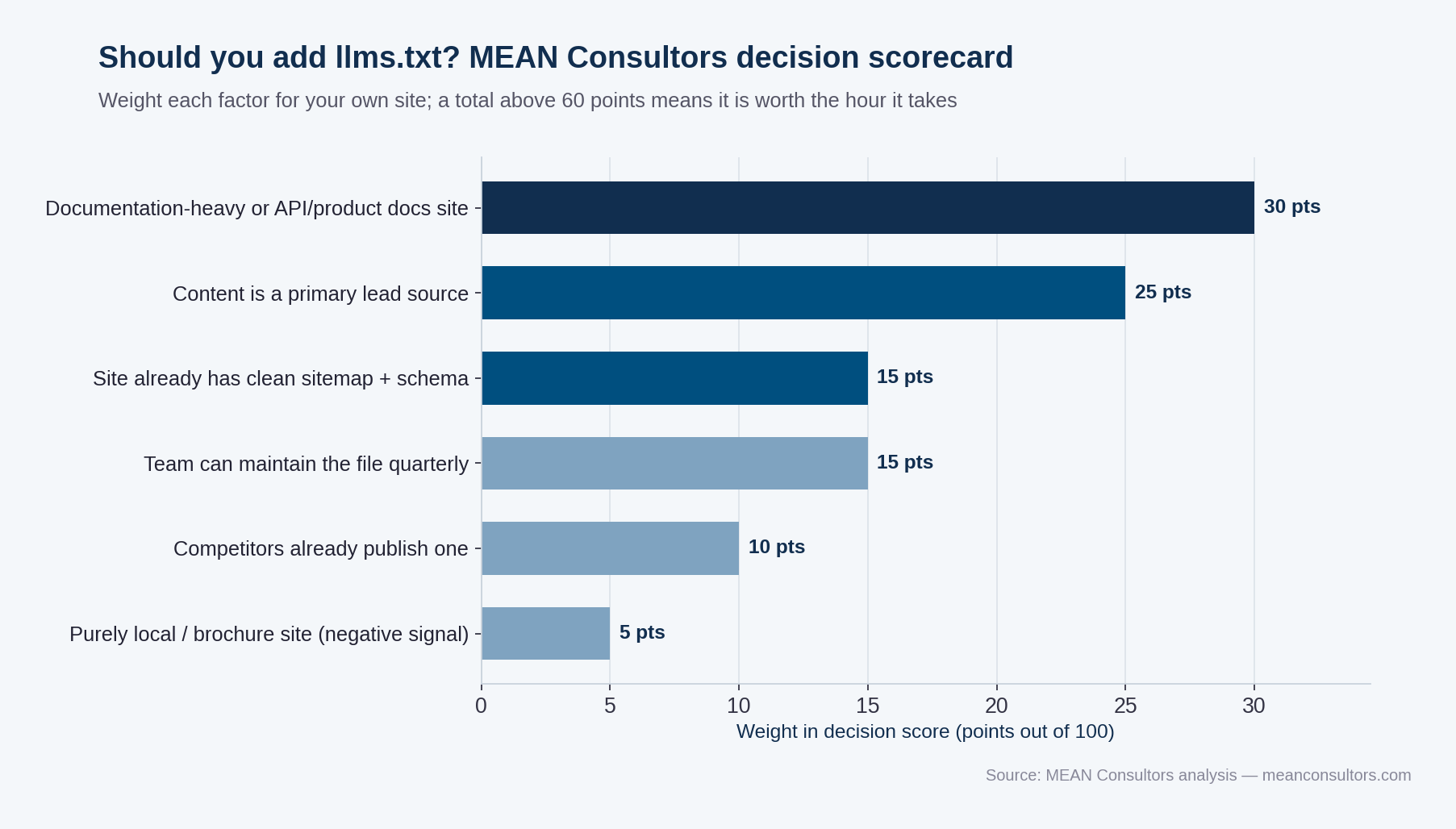
Figure 1: Our decision scorecard for llms.txt — documentation-heavy sites and content-led lead generation carry most of the weight.
llms.txt vs. robots.txt, sitemap.xml, and schema markup
Business owners often assume these four files do the same job. They do not, and confusing them leads to real mistakes — such as blocking an AI crawler in robots.txt and then wondering why an llms.txt file did nothing. The table below is how I explain the division of labor to clients.
| File / layer | Who reads it | What it controls | Status in 2026 |
|---|---|---|---|
| robots.txt | Search and AI crawlers (Googlebot, GPTBot, Google-Extended, etc.) | Permission to crawl; opt-out of AI training | Formal standard (RFC 9309), universally honored by major bots |
| sitemap.xml | Search engine crawlers | Discovery of every indexable URL and its last-modified date | Formal protocol supported by Google and Bing |
| Schema markup (JSON-LD) | Search engines and AI systems parsing your HTML | Machine-readable meaning: organization, products, FAQs, authors | Documented and actively used by Google; strongly correlated with AI citations |
| llms.txt | LLM agents and tools that choose to fetch it | A curated, human-written reading list in Markdown | Community proposal; no confirmed use by major AI search engines |
Notice that robots.txt is a gate, sitemap.xml is a directory, schema is a translation layer, and llms.txt is a reading list. Only the first three have documented support from the companies whose answers you want to appear in. If your XML sitemap and robots.txt are broken, or your pages carry no structured data, adding llms.txt is decorating a house with no foundation.
- llms.txt is a Markdown reading list for AI models, proposed in 2024; it is not a crawler directive and cannot block or permit anything.
- Google and OpenAI document AI-crawler control through robots.txt user-agent tokens, not llms.txt — that is where your opt-in/opt-out decisions actually live.
- In our scorecard, a documentation-heavy site with content-driven lead flow scores 55 of 100 points before any other factor — those sites should add the file today.
When an llms.txt file is worth your time
I use the scorecard in Figure 1 during technical audits. It is not scientific; it is a way to force a quick, consistent decision rather than a forty-minute debate. Here is how the factors play out in practice.
Documentation, API, and product-knowledge sites
If your site has a docs section, a knowledge base, or long explanatory product pages, you are the ideal candidate. Developers already point AI coding assistants at documentation, and those tools are precisely the consumers that fetch llms.txt today. A SaaS company or a manufacturer with detailed spec sheets gets more from the file than any other category.
Content-led lead generation
Firms whose pipeline depends on being found for informational queries — consultancies, agencies, specialty B2B suppliers — benefit from a curated map even if adoption by search-facing AI is uncertain. The file costs an hour, and the exercise of choosing your 20 most important pages tends to reveal gaps in your content architecture anyway.
Local and brochure sites
A five-page site for a dental practice or a landscaping company gains almost nothing. Those businesses win AI visibility through Google Business Profile accuracy, reviews, and local schema. Spend the hour there instead.
How to create and publish an llms.txt file
When we add the file for a client during a web development engagement, the work follows the five steps in Figure 2. The whole thing rarely takes more than an hour once the page inventory exists.
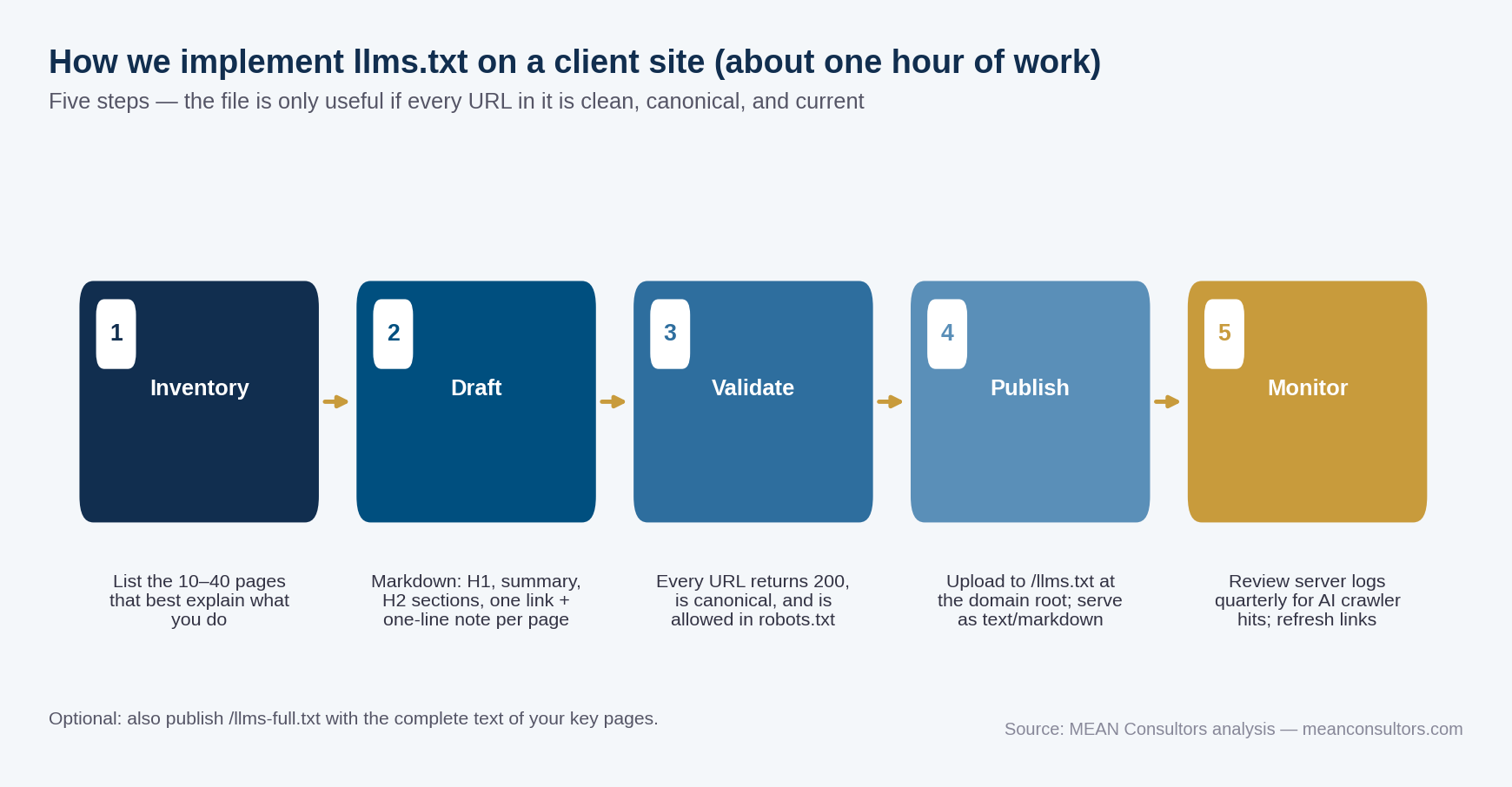
Figure 2: Our five-step implementation process — validation is the step most DIY attempts skip.
- Inventory the right pages. Pick 10–40 URLs that explain what you do, whom you serve, and how you work: service pages, key guides, pricing, about, and contact. Leave out tag archives, thin posts, and anything you would not want quoted.
- Write real descriptions. Each link gets one plain sentence that says what a reader will learn. Do not paste meta descriptions written for click-through; write for a model that needs to decide which page answers a question.
- Validate every URL. Each must return HTTP 200, be the canonical version (no redirects, no tracking parameters), and be allowed in robots.txt for the AI user agents you want to serve.
- Publish at the root. The file must live at yourdomain.com/llms.txt. Serve it with a text/markdown or text/plain content type and make sure your CDN or security plugin does not challenge automated requests to it.
- Consider llms-full.txt. If your key pages total under a few hundred kilobytes of text, publishing the full Markdown alongside the index makes single-request ingestion possible.
- Monitor and maintain. Check server logs quarterly for requests to the file, and update it whenever you launch or retire a major page. A stale llms.txt with broken links is worse than none.
A minimal file looks like this in practice: an H1 with your company name, a one-paragraph blockquote describing your business and location, an H2 called “Services” with a link and note per service page, an H2 called “Guides” with your best evergreen articles, and an “Optional” H2 for secondary pages a model can skip when context is tight. That last section is part of the spec and is a small courtesy that tools respect.
Risks, limits, and what not to expect
The file is low-risk, but not zero-risk. Because it is a plain list of URLs and descriptions, it can leak your content priorities to competitors who read it — not a serious concern for most businesses, but worth a glance. It can also drift out of date faster than your sitemap, because nothing generates it automatically on most WordPress or custom sites. And it does nothing for ranking in traditional Google Search, which still processes your HTML, structured data, links, and Core Web Vitals exactly as before.
What llms.txt cannot do: it cannot force a model to cite you, cannot override a robots.txt block, cannot fix thin or unclear page content, and cannot substitute for the entity clarity that schema markup provides. Treat it as a small, cheap addition to a sound technical base — the same way you would treat a well-written meta description — rather than as a strategy.
My recommendation for most U.S. small and mid-size businesses in 2026 is straightforward. First, confirm your robots.txt policy toward AI crawlers is intentional. Second, get Organization, Service, FAQ, and Article schema live and valid. Third, make sure your most important pages answer their core question in the first hundred words. Then, if your scorecard clears 60 points, spend the hour and publish llms.txt. If it does not, revisit the decision in a year; the proposal may well gain formal support, and you will have lost nothing by waiting on the fundamentals first. For a broader view of how this fits your search strategy, see our SEO services overview.
Frequently Asked Questions
What is an llms.txt file?
An llms.txt file is a Markdown text file placed at the root of a website (yoursite.com/llms.txt) that gives large language models a curated list of the site’s most important pages, each with a short description. It was proposed in September 2024 by Answer.AI as an AI-focused counterpart to robots.txt and sitemap.xml.
Does Google use llms.txt for search or AI Overviews?
Google has not announced any support for llms.txt. Its documented controls for AI use of your content run through robots.txt user-agent tokens such as Google-Extended, and Google representatives have publicly compared llms.txt to the outdated keywords meta tag. Treat it as unsupported by Google Search as of 2026.
Does ChatGPT or Perplexity read llms.txt?
OpenAI documents its crawlers (GPTBot, OAI-SearchBot, ChatGPT-User) and how to control them via robots.txt, but has not confirmed that ChatGPT fetches llms.txt when answering questions. Developer-oriented AI tools and agents do read the file. Publish it as a low-cost addition, not as a guaranteed path to citations.
What is the difference between llms.txt and llms-full.txt?
llms.txt is an index: a short list of links with one-line descriptions. llms-full.txt is an optional companion that contains the complete Markdown text of your key pages so a model can ingest everything in a single request. Most small business sites only need the index file.
Can llms.txt block AI crawlers from my website?
No. llms.txt is a reading list, not a permission file. To block or allow AI crawlers you must use robots.txt with the specific user-agent tokens each provider documents, such as GPTBot for OpenAI or Google-Extended for Gemini training and grounding.
How long does it take to create an llms.txt file?
For a typical small business site with 10 to 40 important pages, about one hour: inventory the pages, write one plain sentence per link, validate that every URL returns 200 and is canonical, upload to the domain root, and set a quarterly reminder to review it.
Should a local service business add llms.txt?
Usually not as a priority. A five- to ten-page local site gains far more AI visibility from an accurate Google Business Profile, reviews, LocalBusiness schema, and clear service pages. Add llms.txt only after those basics are in place, if at all.
- llmstxt.org, “The /llms.txt file” — original proposal and specification (Answer.AI, September 2024)
- Google Search Central, “Overview of Google crawlers and fetchers (user agents)” — includes the Google-Extended token
- OpenAI Platform, “Overview of OpenAI crawlers” — GPTBot, OAI-SearchBot, and ChatGPT-User controls
- IETF, RFC 9309 “Robots Exclusion Protocol”
MEAN Consultors builds fast, crawlable, schema-rich websites for U.S. businesses and handles the technical AI-readiness layer as part of every web development project.