
How to Rank in the Google Map Pack: What Actually Moves the Needle
Last updated: July 16, 2026 · By Joseph Olivas, Founder, MEAN Consultors · 8 min read
The Map Pack — the three local business listings that appear with a map at the top of local search results — is the most valuable real estate in local SEO. For a Jacksonville plumber or a regional retailer, showing up there often matters more than ranking first in the blue links below it. Here is what genuinely moves those rankings, and what is a waste of your time.
Why the Map Pack Matters So Much
Local intent dominates search. Roughly 46% of all Google searches have local intent, and about 42% of local searches result in a click on a Map Pack listing. Better still, 76% of people who run a local search visit a related business within 24 hours. When you win a Map Pack spot, you are not chasing vague awareness — you are intercepting buyers who are ready to act now.

Figure 1: Local search behavior that makes the Map Pack the highest-value target in local SEO.
- About 46% of Google searches carry local intent — and most of those never scroll past the Map Pack.
- Roughly 76% of local searchers visit a business within 24 hours, so a Map Pack spot converts fast.
- Your Google Business Profile drives the largest single share of local pack ranking weight.
The Three Signals Google Actually Weighs
Google is unusually transparent about local ranking. It publicly names three factors: relevance (how well your business matches the search), distance (how close you are to the searcher), and prominence (how well-known and well-reviewed you are). You cannot control distance, but relevance and prominence are largely in your hands.
| Signal | What it means | What you control |
|---|---|---|
| Relevance | How well your profile matches the query | Primary category, services, and on-page keywords |
| Distance | Proximity to the searcher | Service-area settings and location pages (limited) |
| Prominence | Reputation and authority | Reviews, citations, links, and brand mentions |
Because distance is fixed, the winning strategy is to be so relevant and prominent that Google surfaces you even when a competitor is marginally closer. The chart below breaks down where that ranking weight tends to sit.
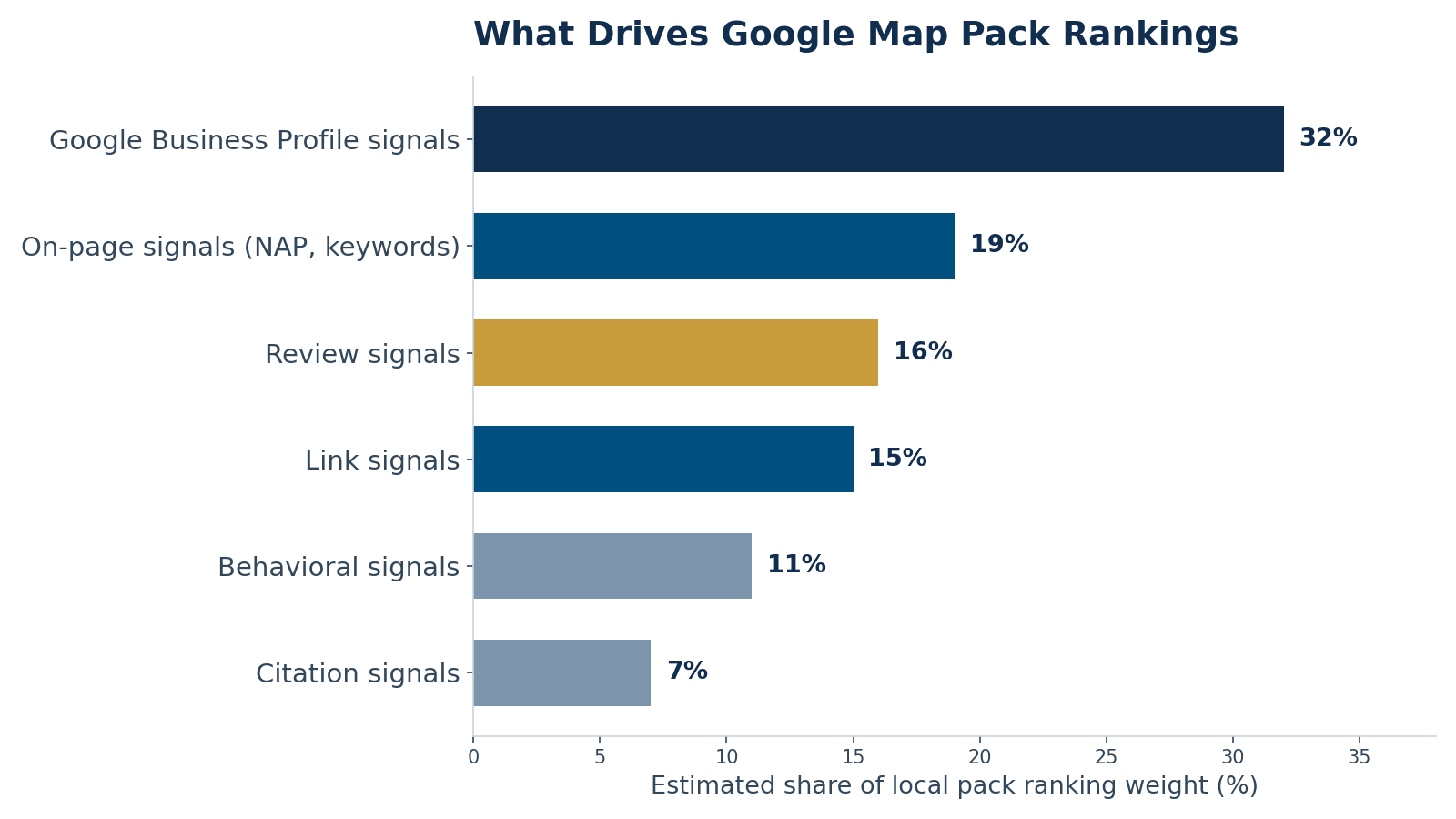
Figure 2: Estimated share of Map Pack ranking weight by factor, based on local search ranking factor surveys.
Google Business Profile signals lead at about 32%, which is why profile optimization is the first thing we tackle in any SEO engagement. Reviews and on-page signals follow closely; links and citations still matter but carry less weight than they used to.
What Actually Moves the Needle
Here is where to spend your effort, in priority order. These are the levers that reliably improve Map Pack visibility — not vanity tasks that feel productive but change nothing.
- Nail your primary category. In ranking-factor surveys it is consistently the number-one lever. Choose the most specific category that fits, not the broadest.
- Complete every field of your Google Business Profile — hours, services, attributes, photos, and a keyword-honest description.
- Earn reviews consistently. Quantity, recency, and steady velocity all matter more than a one-time burst. Respond to every review.
- Keep NAP identical everywhere. Your name, address, and phone must match exactly across your site, profile, and directories.
- Build locally relevant content and links — city-specific service pages and mentions from local organizations.
Where Your Website Fits In
Your Google Business Profile does the heavy lifting, but your website reinforces relevance. Location and service pages that clearly state what you do and where help Google connect your profile to real queries. If your site is thin, slow, or missing local context, you are leaving prominence on the table. Strengthening both together — profile and site — is how the businesses we work with move from page two into the Map Pack. Our web development and SEO teams handle that as one connected effort.
Frequently Asked Questions
What is the Google Map Pack?
The Map Pack (also called the local pack) is the block of three local business listings shown with a map at the top of Google’s results for searches with local intent, such as “plumber near me” or “coffee shop downtown.”
What is the single most important factor for ranking in the Map Pack?
Your Google Business Profile — specifically the primary category you choose. Ranking-factor surveys consistently rank the primary category as the number-one relevance lever, and profile signals overall carry roughly a third of local pack ranking weight.
How long does it take to rank in the Map Pack?
For a new or newly optimized profile, meaningful movement often takes a few weeks to a few months, depending on competition and review velocity. Consistency — steady reviews and accurate citations — compounds over time.
Do reviews really affect Map Pack rankings?
Yes. Review signals — quantity, recency, velocity, and sentiment — account for a meaningful share of ranking weight and have grown more important in recent years. Responding to reviews also signals an active, legitimate business.
Can I rank in the Map Pack without a physical storefront?
Yes, if you serve customers at their locations. Set up a service-area business in Google Business Profile and hide your address while defining the areas you serve. Distance still influences results, so local relevance and prominence matter even more.
MEAN Consultors optimizes Google Business Profiles and local content together so U.S. businesses show up when buyers are ready.