
AI Automation for Professional Services Firms: Where It Actually Helps
Last updated: August 17, 2026 · By Joseph Olivas, Founder, MEAN Consultors · 10 min read
Most of what gets written about AI for professional services is either breathless or defensive, and neither is much use if you run a firm and have a budget to allocate. So here is the practical version. Professional services firms — law, accounting, consulting, engineering, agencies — share a structural problem: the people who generate revenue spend most of their day on work nobody pays for. AI automation is genuinely good at a specific slice of that work and genuinely bad at another, and knowing which is which is the whole decision.
The problem is utilization, not effort
Ask a partner where the firm’s constraint is and you will usually hear about capacity — not enough senior people, not enough hours in the week. Look at the numbers and the constraint is usually somewhere else: the hours already exist, they are just not billable.
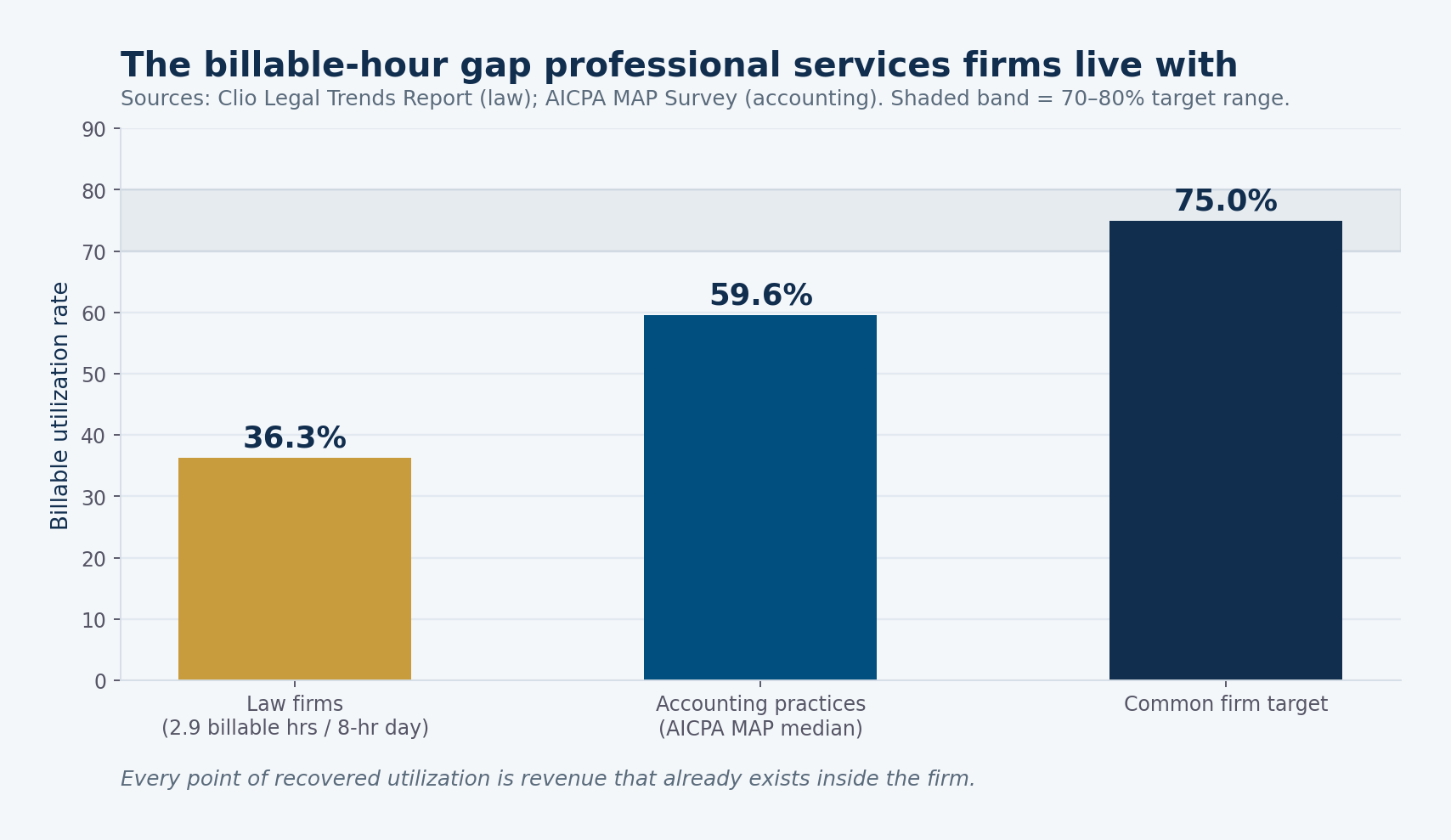
Figure 1: Billable utilization sits well below target across professional services (Clio; AICPA MAP Survey).
Clio’s Legal Trends Report has consistently found that the average lawyer records around 2.9 billable hours in an eight-hour day — roughly 36% utilization. The AICPA’s MAP Survey has reported a median utilization near 59.6% across accounting practices, against a target most firms set somewhere in the 70–80% range. Different professions, different absolute numbers, same structural gap.
The missing hours are not idleness. They go into intake paperwork, document assembly, scheduling, chasing invoices, reconstructing time entries from memory at the end of the day, and the dozens of small operational tasks that keep a practice running. That is the addressable surface. Recovering even a few points of utilization is revenue the firm has already produced and simply failed to capture — which is a very different proposition from selling more work.
- Law firms average about 2.9 billable hours per eight-hour day; accounting practices sit near 59.6% median utilization.
- The gap to a 70–80% target is administrative, not motivational — the hours exist and are being spent on unbillable work.
- Recovered utilization is revenue you have already earned, which makes it a faster payback than new business development.
What AI automation actually does well here
Five workflows account for most of the value I have seen in professional services firms. They are unglamorous, which is precisely why they work.
Client intake and onboarding. Conflict checks, engagement letters, matter or project setup, document collection, and the follow-ups when a client does not send what they promised. This is repetitive, rule-bound, and the first impression a client forms. Automating it compresses days into hours and removes the “we never heard back so we assumed” failure mode.
Document assembly. Firms produce enormous volumes of documents that are 80% template and 20% specific: engagement letters, standard agreements, filings, recurring reports. Generating the draft from structured matter data and having a professional review it inverts the current ratio of time spent producing versus time spent thinking.
Time capture. The single highest-return automation in most firms, because unrecorded time is not a productivity problem — it is lost revenue on work already delivered. Systems that observe activity and propose time entries in context beat memory-based reconstruction at day’s end by a wide margin.
Billing and receivables. Draft invoices from captured time, flag entries with descriptions too thin to survive client review, and run a graduated follow-up sequence on ageing receivables. The follow-up piece matters disproportionately, because chasing payment is the task partners defer longest — it feels awkward, so it does not happen.
Meeting and call documentation. Turning a recording into a structured summary with decisions, commitments and open items, routed into the matter file. The value is less the transcript than the routing: information that reaches the right file without anyone remembering to put it there.
What it does badly, and why that is fine
The honest boundary is judgment. A professional services firm sells three things AI cannot supply: expert judgment under uncertainty, accountability for the outcome, and a relationship with a person who will answer the phone when something goes wrong. A client paying for advice is paying for someone to be responsible for it. That does not delegate.
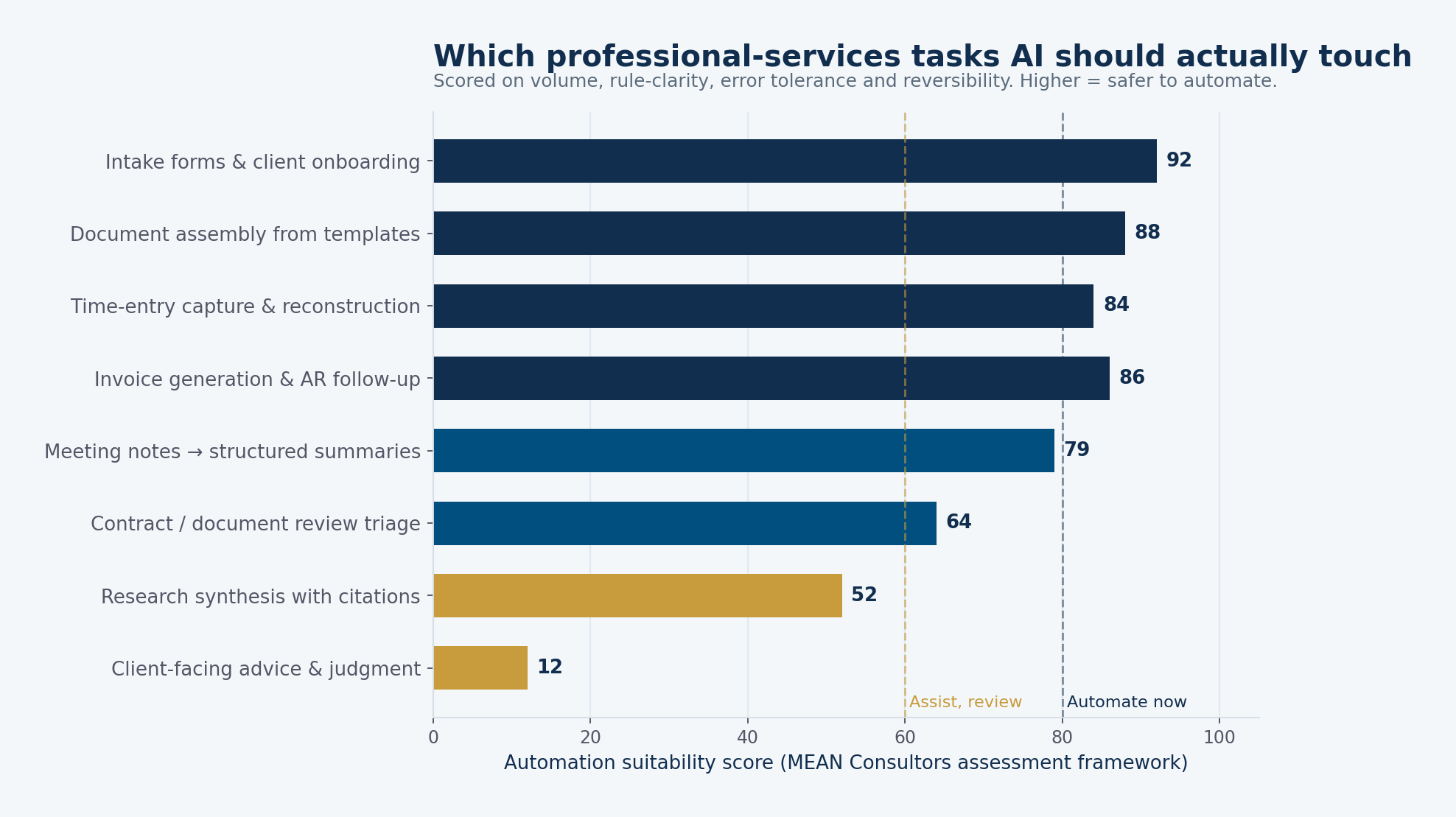
Figure 2: How we score professional-services tasks for automation suitability before recommending anything.
The scorecard above is how we sequence the work. We score each task on four dimensions: volume, how clear the rules are, how tolerant the task is of error, and how reversible a mistake would be. High scores mean automate now. Mid scores — contract review triage, research synthesis — mean AI assists and a professional reviews, which is a real workflow change but not an unattended one. Low scores mean leave it alone.
Research synthesis sits deliberately in the middle at 52. Language models are fluent and confidently wrong in ways that are hard to spot without domain expertise, and in a professional context a fabricated citation is not an inconvenience — it is a liability event. We covered the mechanics of why this happens, and the design patterns that contain it, in our guide to designing around AI hallucinations. In regulated professions the practical rule is simple: AI can find and summarise, a professional verifies before anything leaves the building.
A sequence that works
Firms that get value out of this do it in a specific order, and the order matters more than the tooling.
- Measure first — take one month of baseline data on utilization, days to invoice, and hours per week on the target task
- Start with time capture, because the return is immediate and the metric is unambiguous
- Move to intake next, where the workflow is repetitive and the client-experience gain is visible
- Automate billing and receivables follow-up once time capture is producing clean data to bill from
- Add document assembly for your three highest-volume document types, not all of them at once
- Only then consider assisted review or research workflows, with mandatory professional sign-off
- Re-measure at 90 days against the baseline and be willing to switch off anything that did not move a number
The measurement step is the one firms skip, and skipping it is why so many AI initiatives end in an unresolvable argument about whether they worked. Baselines are cheap before deployment and impossible afterwards. If you want a structured way to run that arithmetic, our guide to calculating ROI on a business automation project lays out the model we use.
Confidentiality is an architecture problem
Professional services firms handle privileged, confidential and regulated information, which changes the implementation but does not rule it out. The mistake is treating this as a policy question — a paragraph in a handbook — when it is an architecture question.
Concretely, that means: enterprise agreements with explicit no-training-on-customer-data terms rather than consumer subscriptions; minimising what data reaches the model at all, since the safest information is the information you never sent; conflict and confidentiality checks built into the workflow rather than layered on afterwards; audit logging of what was processed and by whom; and a human checkpoint before anything client-facing is released. Firms in licensed professions should also check their own regulator’s current guidance, which has been moving quickly.
None of this is exotic. It is the same discipline that applies to any system touching sensitive records — the approach we take with AI automation in healthcare administration, where the regulatory constraints are stricter still and the automation targets turn out to be remarkably similar.
What a realistic result looks like
Be sceptical of anyone quoting a specific percentage improvement before they have seen your firm. The honest version is that results depend on where you are starting from: a firm at 36% utilization with no time-capture system has far more available upside than one already at 70% with tight processes. The same automation produces very different numbers in those two firms.
What is reliably true is the shape of the return. Time capture pays back fastest because it converts existing work into invoiced work. Receivables follow-up shortens cash cycles without adding headcount. Intake and document assembly free senior time that then has to be deliberately redirected toward billable work — that redirection is a management decision, not an automatic consequence, and firms that skip it get freed-up time that quietly refills with other administrative work.
That last point is the one I would emphasise most. Automation creates capacity; it does not decide what to do with it. The firms that see real results pair the AI automation work with an explicit decision about where the recovered hours go — and they measure whether they got there.
- Automate intake, document assembly, time capture, billing and meeting documentation; assist — with review — on triage and research; leave judgment alone.
- Take a baseline before you deploy, or you will never be able to prove the result.
- Confidentiality is an architecture requirement, not a policy paragraph — minimise what reaches the model and keep a human checkpoint before anything client-facing.
Frequently Asked Questions
What can AI automation actually do for a professional services firm?
The reliable wins are administrative rather than advisory: client intake and onboarding, document assembly from templates, capturing time entries as work happens instead of reconstructing them later, invoice generation and receivables follow-up, and turning meeting recordings into structured notes. These share a shape — high volume, clear rules, errors that are visible and reversible.
Will AI replace lawyers, accountants or consultants?
No, and the framing misses where the value is. Professional services firms sell judgment, accountability and relationships, none of which automate. What automates is the administrative layer that consumes the majority of a professional’s day. The realistic outcome is more billable capacity from the same headcount, not fewer professionals.
How much time do professional services firms lose to non-billable work?
More than most partners assume. Clio’s Legal Trends Report puts the average lawyer at roughly 2.9 billable hours in an eight-hour day — about 36% utilization. The AICPA’s MAP Survey has reported a median utilization near 59.6% for accounting practices, against a common target of 70–80%. The gap between actual and target is the addressable opportunity.
Is it safe to use AI with confidential client information?
It can be, but it requires deliberate architecture rather than a consumer subscription. That means enterprise agreements with no-training-on-your-data terms, conflict and confidentiality checks built into the workflow, restricting what data reaches the model in the first place, and human review before anything client-facing goes out. Firms in regulated professions should also confirm their approach against their own bar or licensing body’s guidance.
What should a firm automate first?
Time capture and client intake, in that order for most firms. Time capture because unrecorded time is revenue you have already earned and simply failed to invoice, so the payback is immediate and measurable. Intake because it is the first impression, it is highly repetitive, and delays there cost you engagements before any work begins.
How do we know if it is working?
Pick metrics before you start. Billable utilization rate, average days from work performed to invoice sent, days sales outstanding, and hours per month spent on named administrative tasks. Take a baseline for one month before deployment. Without a baseline, every result becomes an argument.
What does it cost to implement AI automation in a small firm?
It varies with how much integration your existing systems need, which is usually the dominant factor rather than the AI itself. The more useful way to size it is against the return: calculate the hours the workflow consumes today, multiply by your effective hourly rate, and compare that against the implementation. If the payback period runs past twelve months, the workflow is probably the wrong first candidate.
MEAN Consultors builds AI automation for U.S. professional services firms from Jacksonville, Florida — starting with a baseline, not a demo.