
AI Readiness Assessment: Is Your Business Actually Ready to Automate?
Last updated: September 5, 2026 · By Joseph Olivas, Founder, MEAN Consultors · 9 min read
Nearly every AI conversation I have with a business owner starts with a tool: a chatbot they saw, a platform a peer recommended, a vendor pitch that promised to eliminate a role. Almost none start with the question that actually determines whether the project works, which is whether the business itself is ready. This article is the assessment framework we use at the start of AI automation engagements, written so you can score yourself before you talk to anyone, including us.
Why readiness matters more than the tool
The technology has gotten dramatically easier to buy. That is exactly why readiness has become the bottleneck. McKinsey’s recurring State of AI research has found year after year that while adoption of generative AI is widespread, only a minority of organizations report meaningful enterprise-level impact on earnings, and the gap is explained largely by workflow redesign, data, and governance rather than by model choice. The U.S. Census Bureau’s Business Trends and Outlook Survey tells a similar story at the small-business end: AI use is rising steadily, but the businesses reporting it are concentrated in sectors where processes and data were already digital.
In our own work the pattern is consistent. Pilots stall when the workflow being automated lives in three people’s heads and differs between them, when the data is in a filing cabinet or a shared inbox, or when nobody owns the result. None of those is an AI problem. All of them are visible before a dollar is spent, if you look.
The five readiness dimensions and how we weight them
The rubric below adds to 100 points. The weights are not arbitrary; they reflect how often each dimension has been the reason a pilot did not ship in our engagements. Process clarity carries the most weight because it is the failure we see most often and the one that no amount of technology can compensate for.
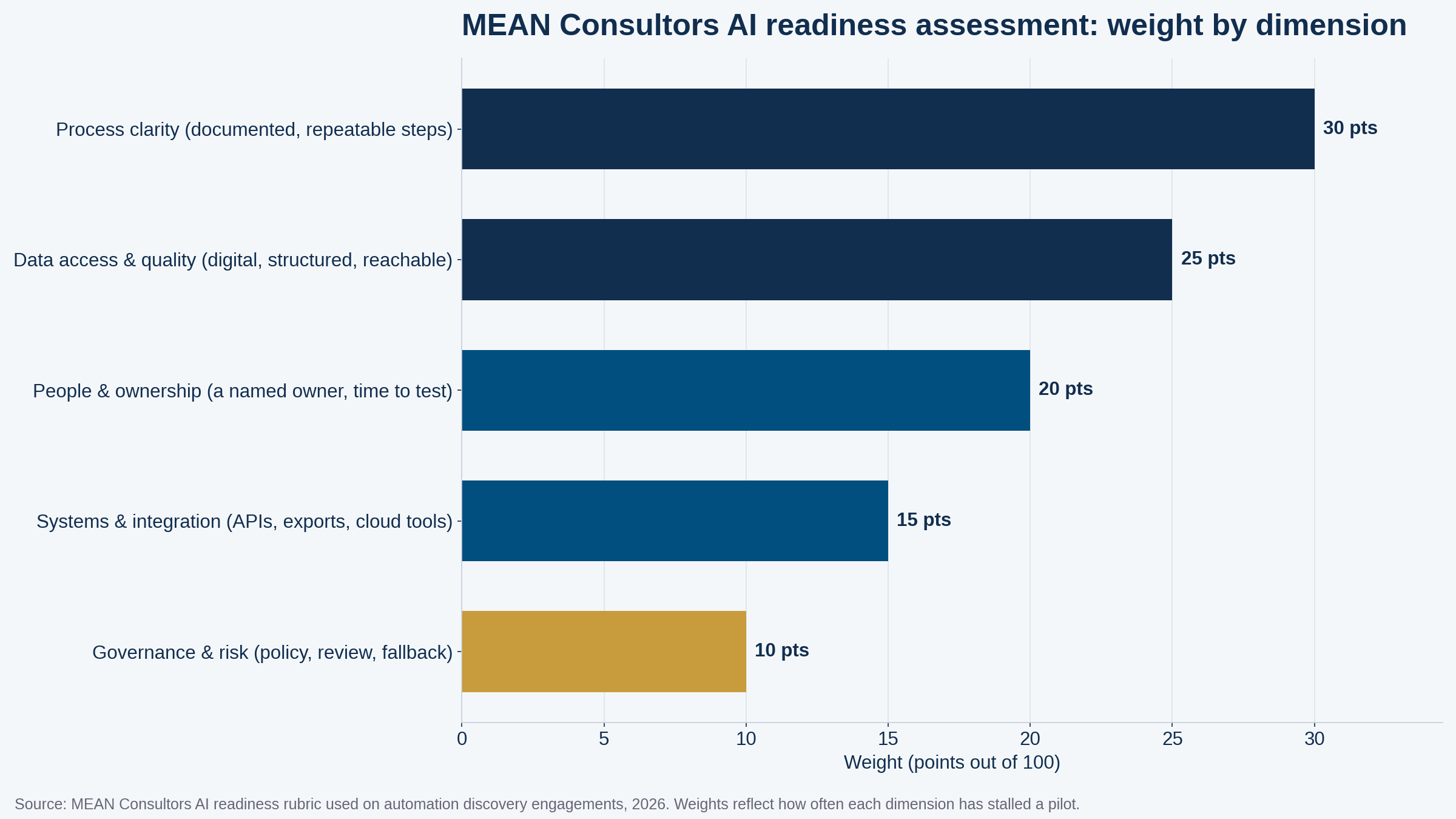
Figure 1: The five dimensions in the MEAN Consultors AI readiness rubric, weighted by how often each has stalled an automation pilot.
| Dimension | Weight | Score yourself: full points if… |
|---|---|---|
| Process clarity | 30 | One target workflow is written down step by step, including who does what, in what system, and what the exceptions are |
| Data access & quality | 25 | The records that workflow touches are digital, reasonably consistent, and can be exported or reached through an API |
| People & ownership | 20 | A named person owns the process, wants it improved, and can spend 2–4 hours a week testing for six weeks |
| Systems & integration | 15 | The tools involved (CRM, accounting, email, ERP) are cloud-based or have APIs; no critical step lives only on one desktop |
| Governance & risk | 10 | You have decided what the AI may do unsupervised, what needs human review, and how you will roll back if it misbehaves |
- Process and data together are 55 of 100 points; if both are weak, the right first project is documentation and data cleanup, not automation.
- People and ownership at 20 points is the dimension most often skipped in proposals and most often the reason a working pilot is never adopted.
- Governance is weighted lowest for a first pilot but grows in importance with every workflow you add.
Dimension 1: Process clarity (30 points)
Pick one process. Not “customer service,” but “handling a return request that arrives by email.” Can you write down, in order, what happens from the moment the email arrives to the moment the customer is refunded, including who does each step, in which system, and what happens when the order number is missing or the item is outside the return window? If yes, you have full points. If the answer depends on which employee you ask, you have a process-mapping project first. This is the same argument we made in workflow mapping before automation, and it remains the single most valuable hour a business can spend before buying any AI tool.
Dimension 2: Data access and quality (25 points)
Scope this to the one workflow. Where do its inputs live? Email inboxes, PDFs, a CRM, a spreadsheet, a legacy database? Can you export a month of them right now? Are the fields you need (customer, date, amount, status) filled in consistently, or does “status” contain twelve variations of “pending”? Modern language models are forgiving of messy text, so a shared inbox is workable; a filing cabinet is not. Half points if the data is digital but inconsistent; zero if any critical step depends on paper or on information that exists only in someone’s memory.
Dimension 3: People and ownership (20 points)
A working automation that nobody adopts is a failed project. Full points require a named owner who does the work today, wants it to change, and has protected time to test and give feedback for roughly six weeks. Partial points if the owner exists but is already at capacity. Zero if the project is being driven by someone who does not touch the process and the people who do have not been asked. Our post on human-in-the-loop automation explains why the owner’s role does not disappear when the automation ships; it changes to reviewing and correcting.
Dimension 4: Systems and integration (15 points)
AI automation almost always has to read from and write to your existing tools. Cloud systems with APIs (most modern CRMs, accounting platforms, help desks, and e-commerce platforms) score fully. Desktop software with export-only capability scores partially. A critical step that lives in a single spreadsheet on one person’s laptop scores zero. This is also the dimension where the build-versus-buy question appears; if your systems are standard, a no-code platform may be enough, and if they are not, you may need custom integration work, a distinction we explore in no-code automation limits.
Dimension 5: Governance and risk (10 points)
For a first pilot the bar is low but real: decide in writing what the AI may do without a human looking (draft a reply, categorize a ticket) versus what requires review (send a refund, change a price), and how you will turn it off. The National Institute of Standards and Technology’s AI Risk Management Framework organizes this around four functions (govern, map, measure, manage) and is the vendor-neutral reference we point clients to when they want to go deeper. If you handle regulated data, read our note on data privacy when using AI tools before the pilot, not after.
- One workflow documented step by step with exceptions
- A month of that workflow’s data exported and inspected
- A named owner with 2–4 hours a week for six weeks
- Systems inventory: which tools have APIs, which have exports, which have neither
- A one-page policy: what the AI may do alone, what needs review, how to switch it off
What your score means
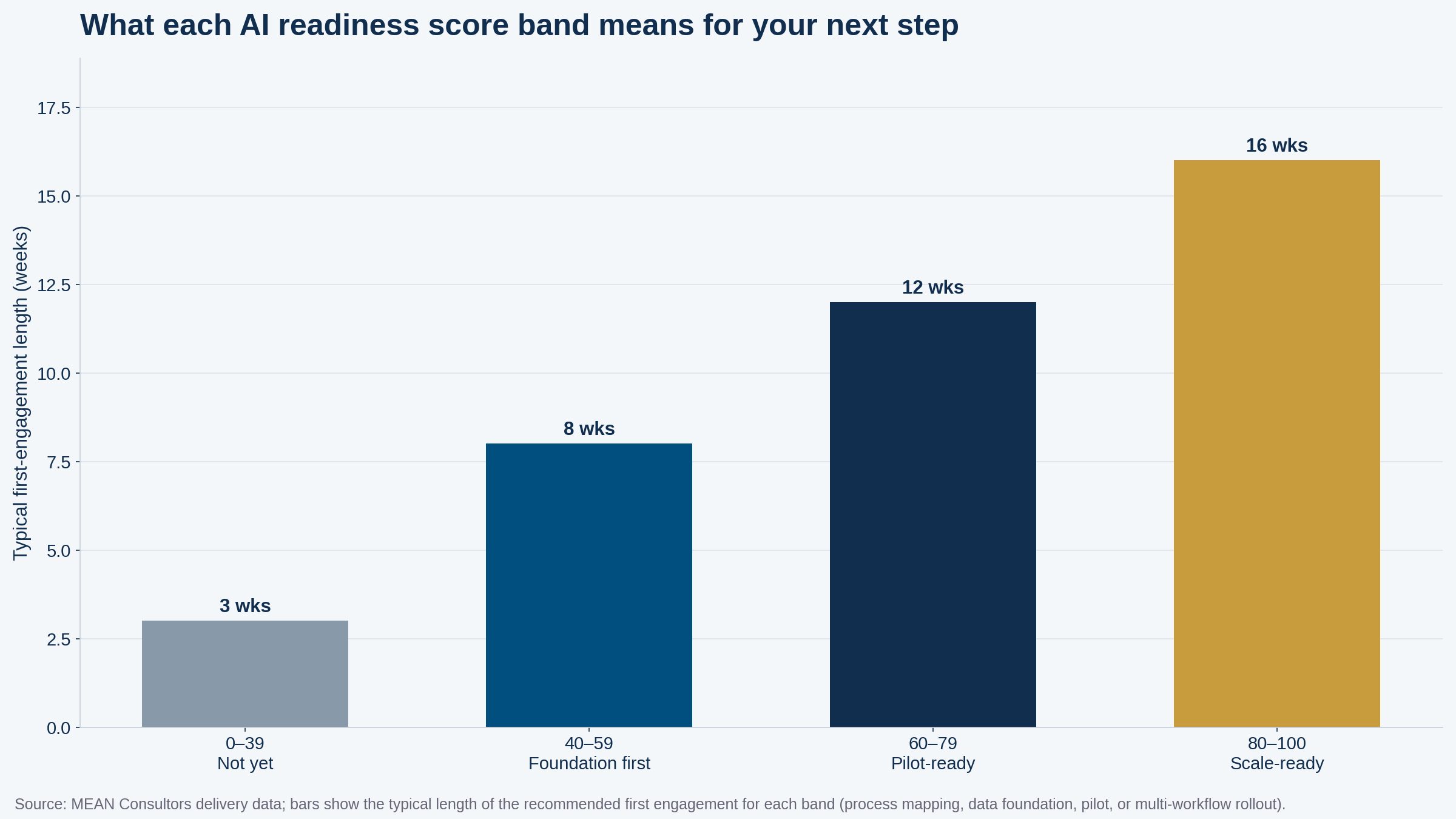
Figure 2: Each readiness band maps to a different recommended first step, and to a different typical engagement length.
A score below 40 means the honest recommendation is a short process-mapping engagement, typically two to four weeks, with no AI involved yet. Between 40 and 59, the priority is usually a data foundation: centralizing records, fixing the worst inconsistencies, and connecting the two or three systems the target workflow touches. From 60 to 79 you are pilot-ready, and a focused six-to-twelve-week pilot on one workflow is the right move; our business process automation primer covers how to pick that first workflow. Above 80, you can plan a rollout across several workflows and start thinking about the operating model, which is when our post on an AI governance framework for small businesses becomes relevant.
How to run the assessment yourself in a week
Day one: pick the workflow, using the criteria of frequency, pain, and low risk. Days two and three: interview the two or three people who do it and write the steps down, exceptions included; the disagreements between them are the most useful output. Day four: export a month of data and inspect it. Day five: score the five dimensions honestly using the table above, and write one paragraph on what the lowest score tells you to do first. If the number surprises you, that is the assessment working. If you want a second opinion on the scorecard, that is a short conversation, and it is one we are glad to have.
Frequently Asked Questions
What is an AI readiness assessment for a business?
An AI readiness assessment is a structured review of whether a business has the processes, data, people, systems, and governance needed for an AI or automation project to succeed. It scores each dimension, identifies the gaps that would stall a pilot, and recommends a realistic first step, which is often not an AI project at all but process documentation or data cleanup.
How do I know if my business is ready for AI automation?
You are likely ready if you can describe at least one repetitive process step by step, the data that process uses lives in digital systems you can export from or connect to, someone on your team owns the process and has a few hours a week to test, and you have a way to review the AI’s output before it affects customers. If two or more of those are missing, start there.
What is the most common reason AI automation projects fail in small businesses?
In our experience the leading cause is process ambiguity: the workflow being automated lives in people’s heads, varies by person, and has undocumented exceptions. AI cannot automate a process the business cannot describe. Data quality problems are the second most common cause, and lack of a clear owner is the third.
Do I need clean data before starting with AI?
You need accessible, reasonably consistent data for the specific process you want to automate, not a company-wide data cleanup. Scope the requirement to one workflow: if the invoices, emails, or records that workflow touches are digital and structured enough to read reliably, that is sufficient to pilot.
How long does an AI readiness assessment take?
For a small or mid-size business, a focused assessment takes one to two weeks: a few hours of interviews with process owners, a review of the systems involved, a look at sample data, and a written scorecard with recommendations. It is deliberately short so the business can act on it quickly.
What should I do if my AI readiness score is low?
Treat it as a roadmap, not a verdict. A low process score means mapping and documenting one workflow first; a low data score means centralizing or cleaning the records that workflow uses; a low people score means naming an owner and protecting their time. Most businesses can move from not-ready to pilot-ready in one to three months by fixing the one or two lowest dimensions.
MEAN Consultors runs the five-dimension assessment in one to two weeks and tells you plainly whether to automate now or build the foundation first.