
Healthcare Website Development Compliance: What Providers Must Get Right
Last updated: August 30, 2026 · By Joseph Olivas, Founder, MEAN Consultors · 9 min read
Most of the provider websites I get asked to review were built by competent designers who were never told the site would end up handling patient data. The design is fine. The copy is fine. Then an appointment request form got added two years after launch, it emails submissions to a front-desk inbox, and the practice has been quietly running a compliance exposure ever since without anyone deciding to.
That is the pattern worth understanding, because it is rarely a dramatic failure. It is a slow accumulation of small, reasonable-seeming decisions. Below is how we approach healthcare web development so those decisions get made deliberately, and what we find when we audit sites where they were not.
What “Compliance” Actually Covers for a Provider Website
The word gets used loosely. For a healthcare website it breaks into four distinct obligations, and confusing them is how practices end up over-engineering one area while leaving another wide open.
HIPAA Security Rule safeguards. These apply when the site creates, receives, maintains, or transmits electronic protected health information. The rule is deliberately technology-neutral — it asks for administrative, physical, and technical safeguards rather than naming products. Access controls, encryption in transit and at rest, audit logging, and integrity controls are the technical pieces that land on the development team.
Business associate agreements. Any vendor that handles PHI on your behalf needs one: the host, the form processor, the scheduling tool, the chat widget, the backup service. No BAA means that vendor should not be in the PHI path at all.
Accessibility. The Americans with Disabilities Act and Section 1557 of the Affordable Care Act both bear on patient-facing digital services, and the Web Content Accessibility Guidelines are the operative technical standard in practice.
Tracking technology disclosure. Analytics, advertising pixels, session recorders, and heat-mapping tools all transmit data to third parties. On pages where that data could reveal a patient’s health condition, that transmission is the risk.
What We Actually Find When We Audit Provider Sites
Over the last two years we reviewed twenty-four healthcare provider websites — small practices, specialty clinics, and two multi-location groups — either as part of a rebuild engagement or as a standalone assessment. The chart below shows how often each category of defect turned up.
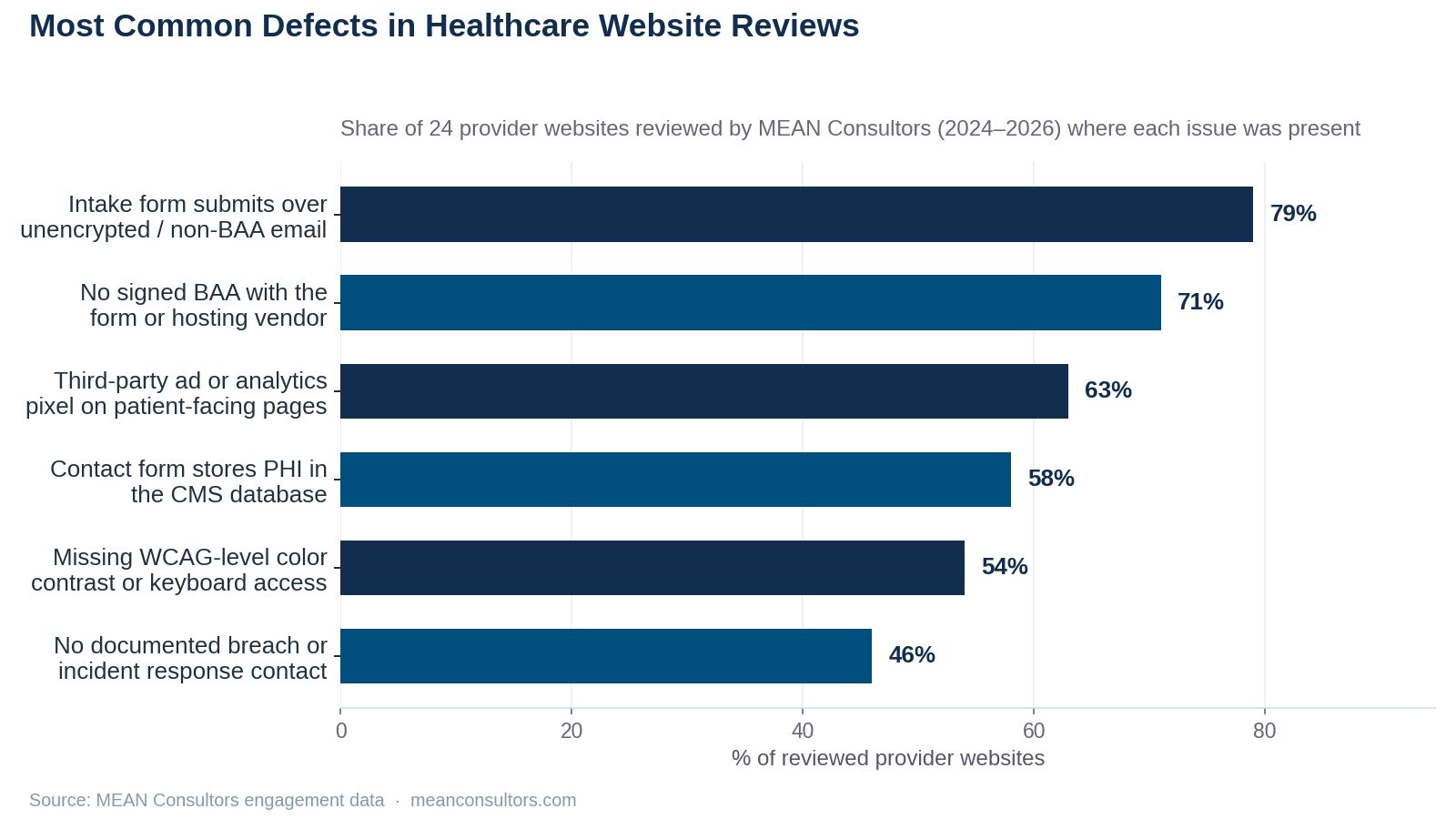
Figure 1: Frequency of compliance and UX defects across 24 healthcare provider website reviews conducted by MEAN Consultors, 2024–2026.
The single most common finding — present on roughly four out of five sites — was an intake or contact form that delivered patient-submitted information to a staff inbox over ordinary email. It is the default behavior of nearly every form plugin ever written, which is exactly why it is so common. Nobody chose it. It came switched on.
The second finding is the one that surprises practice managers most: the absence of a business associate agreement covering the form tool or the hosting environment. Practices that had carefully papered their EHR vendor relationship had simply never thought of the website as part of the same picture.
- 79% of the provider sites we reviewed transmitted intake data over unencrypted or non-BAA-covered email — the most common defect by a wide margin.
- 71% had no signed BAA covering the form processor or the hosting environment, usually because the website was never treated as part of the vendor inventory.
- 63% carried a third-party advertising or analytics pixel on patient-facing pages where the page context itself could disclose a health condition.
- Only about half met basic WCAG contrast and keyboard-navigation expectations, an accessibility exposure entirely separate from HIPAA.
Designing the Intake Data Path First
On a regulated site, the data path is the architecture decision that constrains everything else — hosting, CMS choice, plugin budget, even which analytics you can run. So we settle it before design starts rather than after.
The principle we work to: PHI should never come to rest inside the public content management system, and staff notification should never carry PHI in its body. Here is the flow we implement.
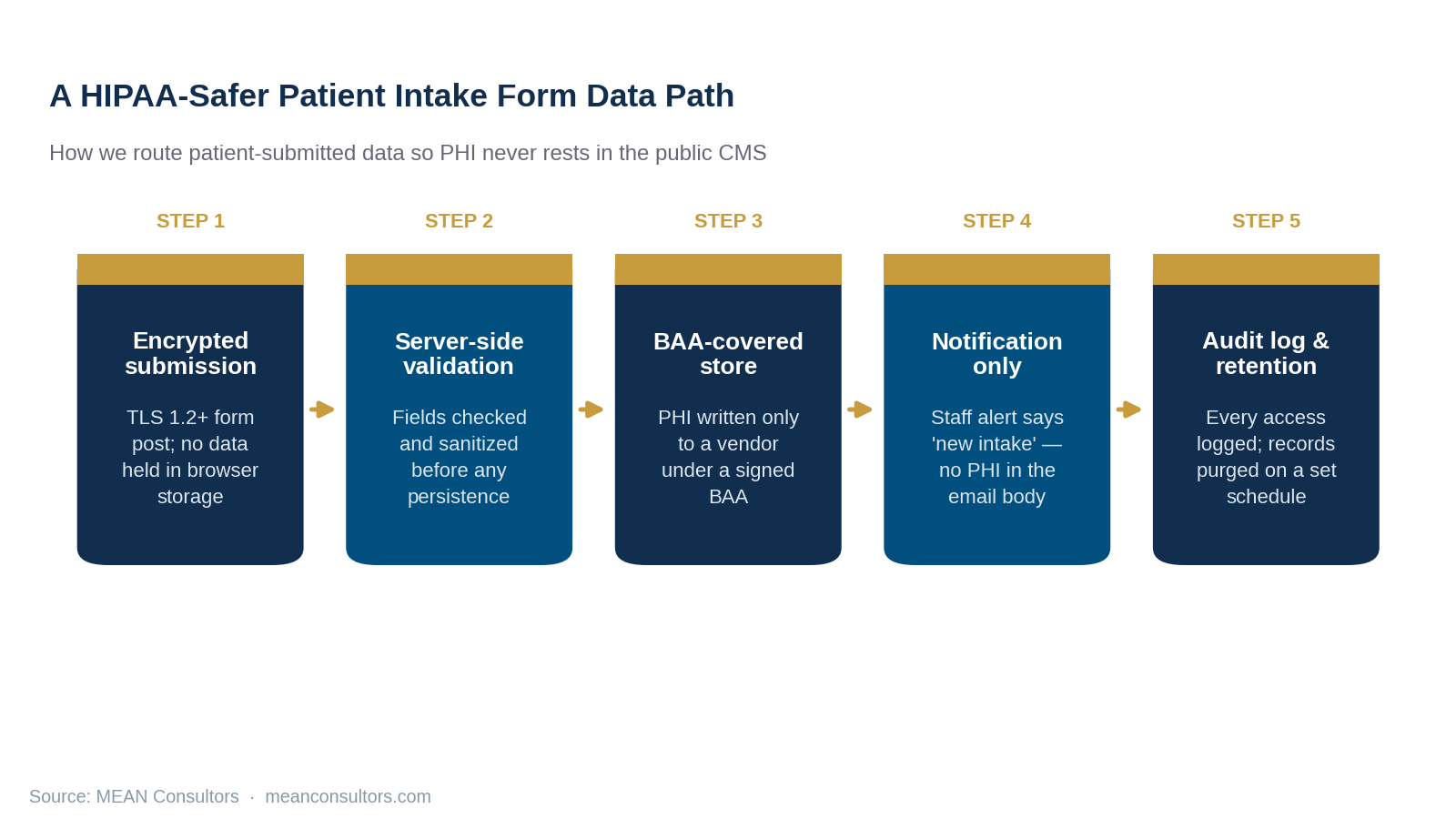
Figure 2: The intake data path MEAN Consultors implements on healthcare provider websites.
Two details in that flow do most of the work. First, the notification step: staff receive an alert that a new intake exists and a link to retrieve it behind authentication, never the submission contents. That one change removes the single most common defect from Figure 1. Second, the retention step: records are purged on a defined schedule rather than accumulating indefinitely in a database nobody audits. Data you no longer hold is data you cannot breach.
If the practice already runs software that should own this data — a portal, an EHR, a scheduling platform — the better answer is often to hand the submission straight to it through an authenticated integration rather than persist a second copy on the web side. That is a custom software integration question more than a website question, and it is worth asking early.
UX That Serves Patients, Not Just Auditors
Compliance-driven builds have a failure mode: the site becomes so cautious it stops being useful. That helps nobody. Patients arriving on a provider site are usually anxious, often on a phone, and frequently looking for one of four things — do you take my insurance, where are you, when can I be seen, and are you the right kind of specialist.
Those four answers belong above the fold or one tap away. Everything else is secondary.
- Accepted insurance plans listed as text on the page, not buried in a PDF a screen reader cannot parse.
- Location, parking guidance, and a tap-to-call number visible without scrolling on mobile.
- Appointment request that asks for the minimum needed to schedule — every extra PHI field is both friction and liability.
- Provider bios with credentials, board certifications, and languages spoken, which carry real weight for patients choosing between clinics.
- Plain-language condition and procedure pages written at a general reading level rather than in clinical shorthand.
- Keyboard-operable navigation and 4.5:1 text contrast as a build standard, verified before launch rather than remediated after a complaint.
Accessibility deserves its own emphasis here because it is the obligation most often deferred. It is also the one with the clearest technical standard and the most straightforward remediation path. We cover the requirements in more depth in our guide to ADA and WCAG website compliance.
CMS and Hosting Decisions That Follow From All This
Once the data path is fixed, the platform question mostly answers itself. The table below is the shortlist we work from.
| Approach | Works when | Watch out for |
|---|---|---|
| WordPress on managed, BAA-covered hosting | Content-heavy provider site; staff need to publish without developers | Plugin sprawl; forms defaulting to email; update discipline |
| Consumer website builder | Brochure-only site with zero PHI collection | Most will not sign a BAA — adding a form later breaks compliance silently |
| Custom application with a headless CMS | Portal features, complex intake, or EHR integration required | Higher build cost; needs a real maintenance budget |
| Existing site + BAA-covered third-party intake | Fast remediation of a site that is otherwise fine | Two vendors to manage; verify the embed does not leak referrer data |
That last row is worth calling out because it is the pragmatic fix for a practice that does not want a rebuild. Swapping the intake path alone resolves the highest-frequency defect without touching the design. We often start there and phase the rest.
Security hygiene applies on top of all of it — patching, least-privilege admin accounts, and monitoring are not optional on a site carrying patient trust. Our general website security checklist covers the baseline every business site should meet, and healthcare sites should treat it as a floor rather than a target.
Frequently Asked Questions
Does HIPAA apply to my practice’s website?
HIPAA applies to the website the moment the site collects, transmits, or stores protected health information on behalf of a covered entity. A brochure site with only a phone number and office hours is generally outside that scope. Add an appointment request form, a patient portal login, a symptom questionnaire, or a chat widget, and the site is now handling PHI — which brings the Security Rule, business associate agreements, and breach notification duties into play.
Do I need a BAA with my web host?
If PHI is stored on or passes through the host’s infrastructure, yes. A business associate agreement is the contract that makes the vendor legally accountable for safeguarding that data. Most shared hosting plans and most consumer website builders will not sign one. This single question eliminates a large share of otherwise attractive hosting options for provider sites, so ask it before you design anything.
Are analytics and advertising pixels allowed on patient-facing pages?
Tracking technologies that transmit identifiable health information to a third party without authorization are a serious risk area, and the U.S. Department of Health and Human Services has published specific guidance on the subject. In practice we keep third-party pixels off pages where the URL, referrer, or form context could reveal a health condition — symptom pages, condition pages, scheduling flows, and the portal — and confine measurement there to a first-party, BAA-covered setup.
How much does a compliant healthcare website cost?
The compliance work is a layer on top of ordinary web development rather than a separate project. In our experience it adds somewhere between fifteen and thirty percent to a comparable non-regulated build, driven mostly by the hosting arrangement, the intake data path, accessibility remediation, and the documentation you will want on file. The variable that moves the number most is how much PHI the site touches.
Is an accessible website legally required for a medical practice?
Healthcare providers face accessibility obligations under the Americans with Disabilities Act and, for many, under Section 1557 of the Affordable Care Act. Courts and regulators have consistently pointed to the Web Content Accessibility Guidelines as the practical standard. Building to WCAG 2.1 Level AA is the defensible position, and it happens to improve usability for every patient, not only those using assistive technology.
Can I use WordPress for a healthcare website?
Yes, with conditions. WordPress itself is not the problem; the default data path is. We use it for provider sites regularly, but we route intake submissions to a BAA-covered service rather than the WordPress database, restrict plugins aggressively, enforce managed hosting with a signed BAA, and treat updates as a scheduled maintenance obligation rather than an afterthought.
MEAN Consultors builds and remediates healthcare provider websites from Jacksonville, Florida — starting with the intake data path, where most of the risk actually sits.