
SEO for SaaS Companies: Ranking for Bottom-of-Funnel Keywords
Last updated: August 28, 2026 · By Joseph Olivas, Founder, MEAN Consultors · 9 min read
Most SaaS content programs I get asked to review have the same shape. There is a well-produced blog full of definitional posts, traffic charts that go up and to the right, and a sales team that cannot name a single deal that came from any of it. The content is not bad. It is aimed at the wrong part of the funnel.
The searches that produce demo requests are not “what is project management software.” They are “Asana alternatives for agencies” and “Monday vs ClickUp pricing.” Those queries get a fraction of the volume, and they are worth more than everything above them combined.
Why bottom-of-funnel keywords win for SaaS
Three things make the bottom of the funnel structurally attractive for a SaaS company, especially one without a large content budget.
First, the competition is different. Category head terms are contested by companies with eight-figure content budgets and a decade of domain authority. “[Your competitor] alternatives for [specific segment]” is contested by two affiliate roundups and nobody else.
Second, the searcher has already done the education you would otherwise have to pay for. They know the category exists. They know they need it. They are picking. A page that meets them there converts at a rate a definitional post never will.
Third, these pages are stable. Category-level content decays with every algorithm update and every new competitor entering the space. A well-maintained comparison page keeps earning as long as both products exist.

Figure 1: SaaS keyword templates scored by purchase intent — the gold band is where demo requests come from.
- Competitor alternatives, head-to-head comparisons, and pricing pages sit at the top of the intent ladder and should be built first.
- Definition-style posts have their place in a topic cluster, but they should never be the first thing a SaaS SEO program ships.
- Low volume is a feature here, not a bug — it is what keeps the competition thin.
Build the keyword map from sales calls, not from a tool
Keyword tools will give you volumes. They will not tell you which three competitors your prospects actually mention, which integration comes up in every second discovery call, or which objection kills deals in the last week. Your sales recordings will.
Spend the first two weeks of a SaaS SEO program listening. Pull the names of every competitor mentioned, every tool prospects say they need this to work with, every phrase used to describe their own segment, and every question that comes up right before a decision. That list becomes the page map. Then use a keyword tool to confirm the phrasing and catch variants — in that order, not the reverse.
What comes out is usually a short, specific set: five to eight competitors worth a page each, six to ten integrations, three or four industry segments, and a pricing explainer. That is your first two quarters of work, and it is far more valuable than fifty blog posts. The same discipline applies to how you research competitors generally, which we cover in our SEO competitor analysis framework.
The five page types that carry a SaaS program
| Page type | Query pattern | What it must contain | Primary CTA |
|---|---|---|---|
| Alternatives page | “[Competitor] alternatives” | An honest list including options that are not you, with the segment each fits best | Start trial / book demo |
| Head-to-head comparison | “[You] vs [Competitor]” | A feature table, a pricing comparison, and a plain statement of who should pick them instead | Book demo |
| Pricing explainer | “[Category] pricing” | Real numbers, how the category prices, and what drives cost up or down | Pricing page / quote |
| Integration page | “[Tool] + [Tool] integration” | What syncs, in which direction, how long setup takes, and known limits | Docs / demo |
| Segment use case | “[Category] software for [industry]” | Vocabulary, workflows, and compliance concerns specific to that industry | Book demo |
The comparison pages are where teams lose their nerve. The instinct is to write a page where you win every row. Prospects read that page, recognize it as marketing, and discount everything on it — including the parts that are true. A comparison page that says plainly “if your team is under ten people and you need this running tomorrow, pick them” earns trust that carries the rest of the page.
Ship them in the right order
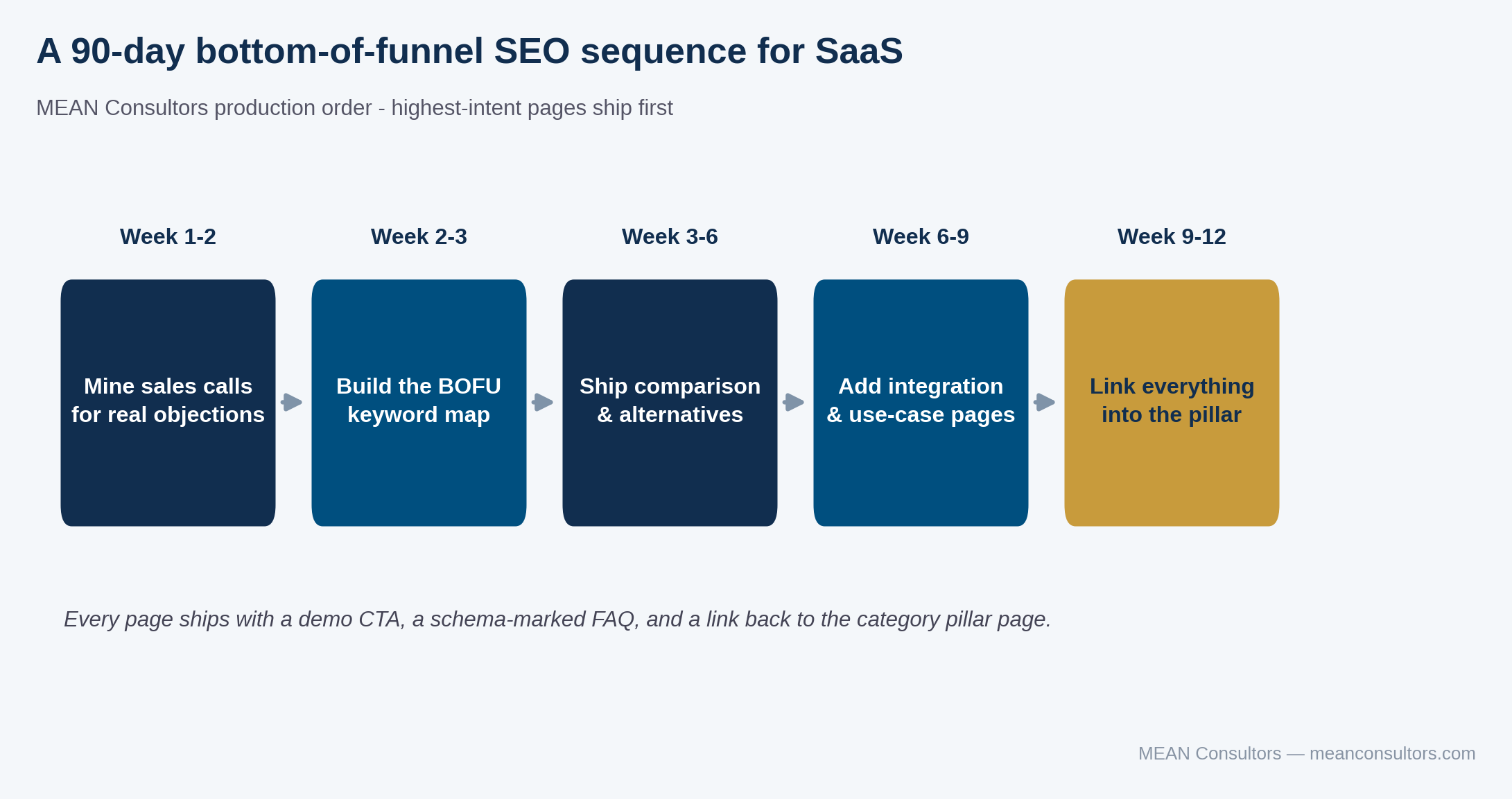
Figure 2: A 90-day production order that puts the highest-intent pages in market first.
The sequencing matters more than the volume. Comparison and alternatives pages ship in weeks three through six because they rank fastest and prove the program works. Integration and use-case pages follow. Internal linking is the last step, not because it is least important, but because you need the pages to exist before you can link them properly.
That final step is where a lot of programs quietly fail. Each bottom-of-funnel page should link up to a category pillar page and sideways to closely related comparisons, and the pillar should link back down. Without that structure you have a pile of orphaned pages sharing a domain. Our guide to topic clusters and pillar pages covers how to build that hub, and the internal linking strategy piece covers the mechanics.
Make them genuinely good, because Google is grading on that
There is an obvious failure mode here: generating thirty near-identical comparison pages from a template and hoping volume wins. It does not, and Google’s guidance on people-first content is explicit that content produced primarily to rank rather than to help gets treated accordingly. Google also emphasizes that trust is the most important component of E-E-A-T.
Practically, that means each page needs something a template cannot produce: a real pricing figure you looked up this quarter, an actual limitation of your own product stated out loud, a screenshot of the integration working, or a migration path written by someone who has done one. Those details cost time. They are also the entire difference between a page that ranks and a page that exists.
- Every comparison page cites the competitor’s current public pricing with the date you checked it.
- Every page names at least one scenario where your product is the wrong choice.
- Every integration page states the sync direction, the latency, and what does not sync.
- Every page carries a schema-marked FAQ answering the objections sales actually hears.
- Every page is reviewed quarterly, because competitor pricing changes and a stale figure destroys credibility.
Measuring a program with a long sales cycle
The reason SaaS SEO gets defunded is almost never that it failed. It is that it was measured with a last-click report on a product with a four-month sales cycle and six touchpoints.
Instrument it differently from the start. For every opportunity created, record which organic entrance pages appear anywhere in the contact’s history. Then report assisted pipeline by page. A pricing explainer that never gets last-click credit but shows up in most closed-won journeys is one of the most valuable pages you own, and only a multi-touch view will show you that. We go deeper on this in our piece on SEO KPIs and revenue impact.
Track three things monthly: rankings for the mapped bottom-of-funnel terms, demo requests with an organic touch anywhere in the journey, and assisted pipeline by entrance page. Everything else is a diagnostic, not a result. If you need help building the program itself, that is what our SEO services team does for B2B and SaaS clients.
Frequently Asked Questions
What are bottom-of-funnel keywords in SaaS SEO?
Bottom-of-funnel keywords are searches made by people who have already decided they need a tool in your category and are now choosing between options. They follow predictable patterns: “[competitor] alternatives,” “[you] vs [competitor],” “[category] pricing,” “best [category] software for [segment],” and “[tool] + [tool] integration.” Volume is low. Purchase intent is high.
How long does SaaS SEO take to produce pipeline?
Comparison and alternatives pages typically start ranking within 6 to 12 weeks because competition on those long-tail phrases is thinner than on category head terms. Category-level rankings take considerably longer. This is exactly why bottom-of-funnel pages should ship first — they are the part of the program that can show results inside a quarter.
Should SaaS companies write comparison pages about competitors?
Yes, provided they are accurate and fair. Those searches already happen, and if you do not publish a comparison, an affiliate roundup site will and it will rank. The rule is that a prospect should be able to read your comparison page, choose the competitor, and still feel you were honest. Overstate your case and the page converts worse, not better.
How many bottom-of-funnel pages does a SaaS company need?
Fewer than most teams assume. A focused set of 15 to 30 pages — your top competitors, your main integrations, and the two or three industry segments you sell to best — covers the majority of high-intent search in a typical B2B category. Beyond that you start producing near-duplicate pages that compete with each other.
Do bottom-of-funnel pages hurt my top-of-funnel content?
No, as long as each page targets a distinct query and you link them deliberately. Problems come from publishing several pages that answer the same question in slightly different words. Keeping one clear page per intent and linking supporting pages up to a category pillar page prevents that overlap.
How do I measure SaaS SEO if the sales cycle is long?
Stop measuring on last-click revenue alone. Track assisted pipeline: which organic entrance pages appear anywhere in the touchpoint history of opportunities created. A pricing page that never gets last-click credit but appears in 60% of closed-won journeys is doing more work than any single-attribution report will show.
MEAN Consultors builds bottom-of-funnel SEO programs for SaaS and B2B companies — mapped from your sales calls, sequenced to show results inside a quarter.