
The Hidden Costs of Cheap Website Builders (And What They Really Cost Your Business)
Last updated: July 15, 2026 · By Joseph Olivas, Founder, MEAN Consultors · 8 min read
Every week a business owner tells me they saved money by building their own site on a $16-a-month plan. On paper they did. But the sticker price of a website builder is only the first line of the invoice. The real bill shows up later — in fees you didn’t see coming, growth you never captured, and a rebuild you have to pay for anyway. Here is where the money actually goes.
The sticker price is a fraction of the true cost
Website builders advertise a monthly number and let you assume that’s the whole cost. It rarely is. Once you need e-commerce, remove-branding, a custom domain, real email, and the “business” tier features, the effective monthly price on most mainstream builders lands two to four times higher than the headline plan. And that’s before the costs that never appear on any plan comparison at all. If you want a grounded look at what a purpose-built site actually runs, our web development team can scope it honestly — but first, see how a “cheap” site accumulates cost over three years.
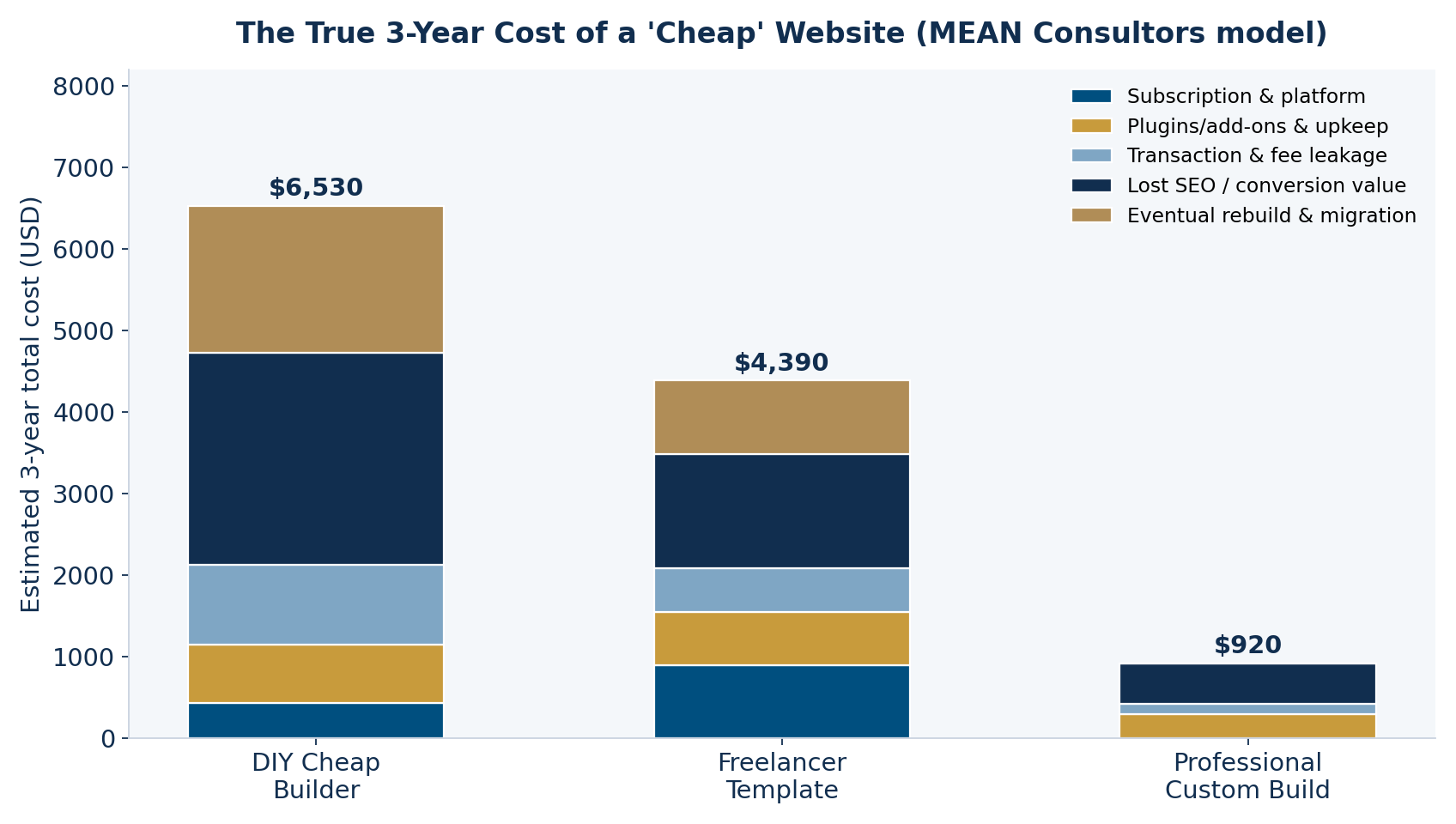
Figure 1: MEAN Consultors’ three-year total-cost-of-ownership model. The DIY builder’s low subscription is dwarfed by fee leakage, lost growth, and an eventual rebuild.
| Cost category | What it looks like on a cheap builder | Why it hurts |
|---|---|---|
| Platform & upgrades | Tiered plans, “business” features locked behind higher pricing | The plan you actually need is 2–4x the advertised price |
| Transaction fees | Extra 0.5–3% on top of standard card processing | Scales with your revenue — the more you sell, the more it costs |
| Add-ons & apps | Booking, email, pop-ups, SEO tools billed separately | A stack of $10–$30 subscriptions adds up fast |
| Lost SEO & speed | Bloated templates, limited technical control | Slower pages bounce visitors before they convert |
| Rebuild & migration | Locked-in content, no clean export | You pay to rebuild what you already paid to build |
- The advertised monthly plan typically covers a fraction of what a functioning business site needs.
- Transaction-fee markups and stacked app subscriptions grow as your business grows.
- The biggest hidden cost is invisible: revenue lost to slow, templated pages that don’t convert.
The most expensive line item is the revenue you never see
Here is the cost nobody puts on a spreadsheet. Cheap builders lean on heavy, one-size-fits-all templates that load slowly and give you little control over performance. Speed is not a vanity metric — it’s money. Google’s own research found that as mobile page load time goes from one second to three seconds, the probability that a visitor bounces increases 32%, and from one to five seconds it jumps 90%. Every one of those bounces is a customer who left before they ever saw your offer.
For a business doing even modest traffic, a few percentage points of lost conversion each month compounds into thousands of dollars a year — far more than any subscription you were trying to save on. That’s why in our cost model, “lost SEO and conversions” is the single largest slice of the true price of a cheap site.

Figure 2: Where the hidden lifetime cost concentrates. Lost SEO and conversions plus a forced rebuild account for nearly two-thirds of the real bill.
Lock-in: paying twice for the same website
Most website builders are walled gardens. Your content, design, and structure live in their proprietary system, and when you outgrow the platform — and growing businesses always do — there is no clean way to take it with you. You don’t migrate; you rebuild from scratch. So you end up paying for the website twice: once for the cheap version, and again for the real one. The businesses that avoid this are the ones that build on an open, portable foundation the first time. Our take on that trade-off lives in our guide comparing WordPress and custom-coded websites.
When a cheap builder actually is the right call
To be fair, DIY builders aren’t always the wrong choice. They can be genuinely smart in specific situations. The mistake is defaulting to one for a business that has any real growth ambition.
- You need a single-page “we exist” placeholder while you validate an idea.
- Your business will never sell online or handle bookings through the site.
- You expect low traffic and aren’t competing on search visibility.
- The site is truly temporary and you’re fine rebuilding later.
If more than one of those is false for you, a cheap builder is a false economy. You’ll spend the next three years paying the hidden costs and then pay again to leave. A professionally built site — whether through us or anyone reputable — is an investment that stops leaking money.
Frequently Asked Questions
How much do cheap website builders really cost per year?
The advertised plan is usually $12–$30 a month, but the plan a real business needs — with e-commerce, custom domain, no forced branding, and business features — commonly runs two to four times higher. Add transaction-fee markups and separate apps, and the effective annual cost often lands well above what owners expect when they sign up.
Are website builders bad for SEO?
Not inherently, but they limit your technical control and often ship heavy, slow templates. Because page speed directly affects bounce and conversion rates, that performance ceiling quietly costs you traffic and revenue over time. A site engineered for speed and clean structure will almost always outrank a bloated template in a competitive market.
Can I move my website off a builder later?
Rarely without a full rebuild. Most builders lock your content and design inside their proprietary system with no clean export, so “migrating” usually means recreating the site elsewhere. That’s why the eventual rebuild is one of the largest hidden costs.
What’s the real difference between a $16/month builder and a professional site?
Control and total cost. A professional site is built on a portable foundation, optimized for speed and search, and designed to grow with you — so you don’t pay fee markups, stack subscriptions, or rebuild in two years. Over a three-year horizon it frequently costs the same or less than the “cheap” option once lost revenue is counted.
Is it ever worth starting cheap and upgrading later?
Only if the site is genuinely temporary. If you’ll depend on it for leads or sales, starting cheap usually means paying twice and losing growth in between. Building it right once is the more economical path for any business planning to stick around.
MEAN Consultors builds fast, portable, search-ready websites that stop leaking revenue — scoped honestly for the business you’re growing into.