
Custom Software for Logistics and Distribution Companies: When to Build
Last updated: August 27, 2026 · By Joseph Olivas, Founder, MEAN Consultors · 10 min read
Distribution businesses run on a stack that grew by accretion. An ERP bought in 2014. A WMS the third-party logistics partner insisted on. A carrier portal per carrier. An EDI provider for the two retail accounts that demand it. And holding it all together, a set of spreadsheets maintained by two people who have been there long enough to know which columns matter.
That stack usually works. The question worth asking is what it costs you — in expedited freight, in chargebacks, in inventory you cannot trust, and in the fact that the business cannot take on a new large account without hiring more coordinators. This guide covers how we assess that at MEAN Consultors and how we phase custom software development for distributors without putting the warehouse at risk.
The shape of the sector, and why software fit varies so widely
Transportation and warehousing is not one industry with one software need. According to U.S. Bureau of Labor Statistics data, as of June 2024 the three largest components of the sector were warehousing and storage at 27% of all sector jobs, truck transportation at 24%, and couriers and messengers at 16%.
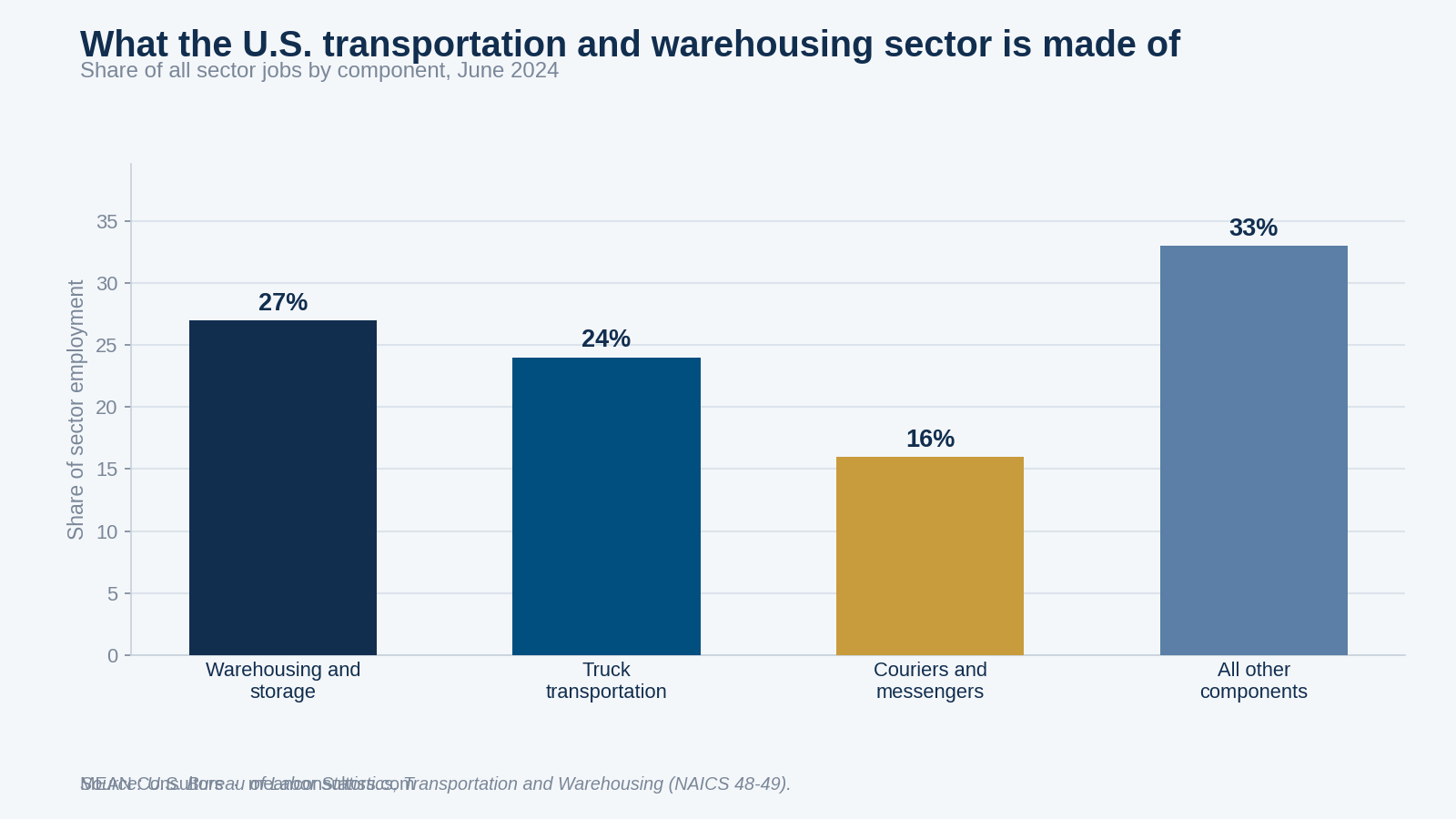
Figure 1: Composition of U.S. transportation and warehousing employment by sector component, June 2024. Source: U.S. Bureau of Labor Statistics.
That split matters for a software decision. A warehousing-heavy operation’s constraints are inventory accuracy, slotting, and labor productivity. An asset-based trucking operation’s constraints are dispatch, compliance, and equipment utilization. A last-mile courier’s constraints are routing density and proof of delivery. Vendors sell to all three with the same brochure, which is a large part of why so many platform implementations underdeliver.
The same BLS data underlines why the coordination layer is worth automating: employment of logisticians is projected to grow 17% from 2024 to 2034, much faster than average, with a median annual wage of $80,880 as of May 2024. Coordination work is growing and it is not cheap labor. Every hour of it you can remove compounds.
Where the buy/build line actually falls
We do not recommend custom software for functions where mature products exist and your requirements are ordinary. Here is the split we work from.
| Function | Default recommendation | When custom is justified |
|---|---|---|
| Receiving, putaway, cycle counting | Buy a WMS | Rarely. Only for genuinely unusual storage or handling constraints. |
| Financials, GL, AP/AR | Buy / keep the ERP | Effectively never. Build integrations, not a replacement. |
| Carrier rating, labels, tracking | Buy or use carrier APIs | When selection logic depends on your own margin and service rules. |
| Customer-specific fulfillment rules | Build | Almost always. This is where every distributor is genuinely different. |
| Cross-system operational visibility | Build | Whenever answering “where is this order” requires opening three systems. |
| Customer-facing ordering portal | Build | When your catalog, pricing tiers, or contract terms exceed what a standard portal models. |
| Operational reporting and exception alerts | Build | When operations managers are rebuilding the same spreadsheet weekly. |
| EDI translation and compliance | Buy the translator, build the mapping layer | When partner-specific requirements keep breaking a generic setup. |
The pattern is consistent: buy the physical-process software, build the business-logic software. Your competitors have the same WMS options you do. They do not have your customer agreements, your margin structure, or your service commitments — and those are exactly what the spreadsheets are encoding today.
- Buy standard warehouse and financial systems; build the customer-specific logic and cross-system visibility layer that makes your operation distinct.
- BLS data shows warehousing and storage is now the largest component of the sector at 27% of jobs, ahead of truck transportation at 24% — the software priorities of those two operations are not the same.
- Logistician employment is projected to grow 17% from 2024 to 2034 at a median wage of $80,880, so the coordination work custom software removes is both growing and expensive.
- The strongest build signal is a workflow that requires a person to reconcile two systems on a recurring schedule.
Seven signals a distributor has outgrown its stack
- Someone exports from two systems and reconciles them in Excel on a fixed schedule — that person is a human integration and their spreadsheet is your real system.
- You pay chargebacks or service-level penalties that trace to information delay rather than physical failure.
- Onboarding a large new customer requires hiring coordinators rather than configuring rules.
- Inventory accuracy is good in the WMS and wrong everywhere else, because the sync is partial or batch.
- Your customers ask for order status by phone or email because there is no portal that tells them.
- Expedited freight is a recurring, budgeted line item rather than an exception.
- Nobody can produce margin by customer or by lane without a multi-day manual exercise.
One or two of these is normal. Four or more and the manual coordination cost has almost certainly passed the cost of building. The framework in our build-versus-buy software framework is worth working through before you scope anything, and the general signs you need custom software covers the non-industry-specific version of this test.
How to phase the build without stopping the warehouse
The risk in logistics software is not technical. It is operational: a warehouse cannot pause while you cut over. Our phasing exists to keep the physical operation running through every stage.

Figure 2: The six-phase sequence MEAN Consultors uses for logistics and distribution builds.
Two phases deserve expansion because they are the ones most often shortened under schedule pressure, and shortening either is what produces the projects that fail.
Mapping the physical process means being on the floor. Watching a picker walk a route reveals constraints that no requirements workshop will surface — the shelf that is out of reach so those SKUs get miscounted, the printer that jams so labels get batched, the returns desk that has no system at all and runs on a clipboard. Software designed from a conference room encodes the process people describe. Software designed from the floor encodes the process that actually happens.
Piloting one site in parallel means running the old and new processes simultaneously for at least one full operating cycle and reconciling the numbers. If the new system says you shipped 4,180 units and the old one says 4,206, you find out why before six sites depend on the answer. Distributors resist this because it duplicates effort for a few weeks. It is the cheapest insurance in the project.
The integration layer is the project
Distributors consistently underestimate this. The screens are the visible part; the integrations are where the time goes. A typical mid-size distributor’s custom application ends up talking to an ERP, a WMS, two or three carrier APIs, an EDI translator, a payment processor, and often a customer’s own procurement system.
Three principles keep that manageable. First, translate everything into one internal representation at the boundary, so the core application never contains carrier-specific or partner-specific logic. Second, make every integration idempotent and replayable, because counterparty systems will go down mid-transaction and you need to re-run without duplicating shipments. Third, log every message in and out with enough context to answer “what did we send them and when” two months later, because eventually a trading partner will assert you did not send something and you will need the receipt.
The general patterns here are covered in API integration for business systems, and if your stack includes an ecommerce channel, the CRM, ERP and ecommerce integration blueprint maps the same ownership questions across those three systems.
Building the case internally
The approval conversation goes better when it is framed against the current cost rather than against zero. The line items that usually add up fastest are coordinator hours spent reconciling systems, expedited freight caused by late information, chargebacks and service-level penalties, inventory carrying cost from accuracy buffers, and the revenue you decline because onboarding a large account would require headcount you do not have.
Quantify those from your own records rather than from a vendor’s benchmark, and the number is usually both larger and more defensible than anyone expected. Calculating ROI on custom software walks through the model we use with clients.
Frequently Asked Questions
Should we replace our WMS or build around it?
Build around it in almost every case. A warehouse management system that handles receiving, putaway, and picking correctly is expensive to replace and rarely the actual constraint. The constraint is usually the layer above or beside it: customer-specific rules, carrier selection logic, cross-system visibility, or the reporting your operations managers rebuild in spreadsheets every Monday. Custom software targeted at that layer delivers faster and carries far less risk than a platform replacement.
How long does a logistics software project take?
A focused first release targeting one workflow at one site is typically a three to five month effort from discovery to pilot. A full order-to-cash or warehouse-operations platform is a multi-phase program measured in quarters. The variable that moves the timeline most is not the software — it is how many integrations you need and how cooperative each counterparty’s API or EDI setup is.
What about EDI? Do we still need it?
Yes. Retail and large-manufacturer trading partners still run on EDI and will for the foreseeable future, and their compliance requirements are non-negotiable if you want the business. Modern custom systems generally handle both: EDI where the partner requires it, REST APIs where the partner supports it, and a common internal representation so the rest of your system does not care which arrived.
Can custom software work alongside an ERP we can’t change?
That is the most common scenario we build into. The ERP stays the system of record for financials and master data, and the custom application handles the operational workflow, syncing through an integration layer with clear ownership rules about which system wins for each field. Defining those ownership rules is the single most important design decision in the project.
How do we avoid disrupting the warehouse during rollout?
Pilot narrowly and run in parallel. Pick one distribution center, one lane, or one customer and run the new system alongside the existing process until the numbers reconcile for a full cycle. It feels slow and it costs some duplicate effort for a few weeks, but it is dramatically cheaper than discovering a picking logic error across six sites during peak season.
Is a mobile or handheld interface worth the extra cost?
For anything touched on the warehouse floor, yes. The interface people use while holding a scanner in one hand determines whether the data in your system is accurate. Poorly designed floor interfaces do not merely annoy staff — they produce workarounds, and workarounds produce the bad inventory data that then invalidates everything downstream.
What does this typically cost?
Cost scales with integration count and workflow complexity far more than with screen count, so a meaningful number requires scoping. What we can say is that the honest comparison is not custom software versus zero, it is custom software versus the fully loaded cost of the manual coordination, error correction, and expedited freight the current process generates each year.
MEAN Consultors builds the operational layer that sits between your ERP, your WMS, and your customers — phased so the warehouse never stops.