
How Much Does Custom Software Development Cost in 2026?
Last updated: August 19, 2026 · By Joseph Olivas, Founder, MEAN Consultors · 10 min read
“What does custom software cost?” is the first question almost every prospect asks me, and the answer they want is a number. I understand why — they are trying to work out whether to keep reading or close the tab. So rather than give the consultant’s non-answer, this article shows the actual model: how the number is built, what the 2026 rate context is, and which decisions move the total most.
One thing to be clear about upfront: the ranges below are a transparent model, not a price list. They are hours multiplied by a rate. If your project’s hours differ, so does your cost.
The only cost formula that survives scrutiny
Every honest software estimate reduces to estimated hours × blended hourly rate, plus a contingency for what you have not discovered yet. Everything else — feature counts, screen counts, story points — is a means of estimating the hours.
The rate side has a floor set by labour economics. The U.S. Bureau of Labor Statistics reports a median annual wage for software developers of roughly $132,700, which is about $64 an hour, and projects employment in the field to grow around 15 per cent between 2024 and 2034 — much faster than the average occupation. A billable rate has to cover that wage plus benefits, payroll taxes, quality assurance, project management, tooling, non-billable time and margin. That is how a $64 wage becomes a $95 to $185 blended rate at an established U.S. firm, and why rates have not fallen despite a decade of better tooling.
The hours side is where estimates go wrong, and it is where you have leverage.
Custom software cost ranges by project tier (2026)
Below are four tiers we use to place a project before detailed scoping, with the hour ranges we associate with each and the resulting cost band at $95–$185 per hour. Treat the low end as a well-defined project with few integrations and the high end as one with real complexity, compliance requirements or legacy data to move.

Figure 1: Custom software cost ranges by project tier, modelled as engineering hours times a $95–$185 blended U.S. rate.
| Project tier | Typical hours | Modelled cost range | Typical timeline |
|---|---|---|---|
| Tier 1 — Internal tool, single workflow | 300–700 | $28,500 – $129,500 | 2–4 months |
| Tier 2 — Departmental app with integrations | 700–1,600 | $66,500 – $296,000 | 4–8 months |
| Tier 3 — Customer-facing platform / MVP SaaS | 1,600–3,200 | $152,000 – $592,000 | 7–14 months |
| Tier 4 — Multi-module enterprise system | 3,200–7,000+ | $304,000 – $1,295,000+ | 12–24 months |
Two notes on reading that table. First, the wide bands are honest, not evasive: the difference between the low and high end of a tier is usually integrations, data migration and compliance, not feature count. Second, timelines do not compress in proportion to budget. Doubling the team on a Tier 2 project rarely halves the calendar.
Where the money actually goes
Clients are often surprised that writing application code is under half the effort. The rest is the work that makes the code correct, integrated, deployable and usable — and the part that gets cut when a quote comes in suspiciously low.
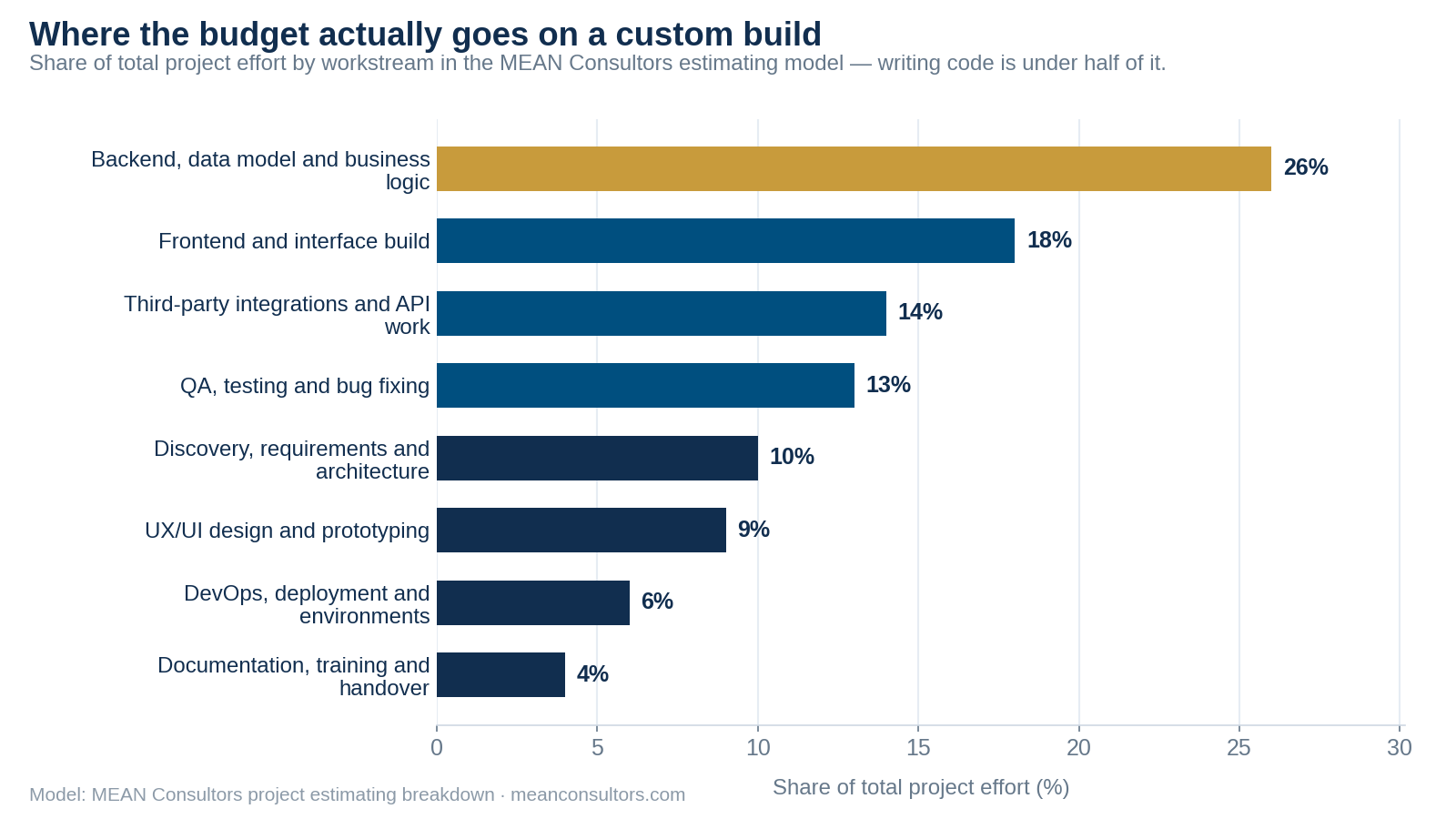
Figure 2: Share of total project effort by workstream in our estimating model.
- Backend and frontend implementation account for about 44% of project effort; integrations, QA, discovery, design, DevOps and documentation make up the other 56%.
- At a BLS median developer wage of roughly $64 an hour, a $95–$185 blended billable rate is arithmetic, not markup — it absorbs benefits, QA, management and non-billable time.
- Budget 15–25% of the build cost annually for maintenance; skipping it converts a working system into a rewrite.
The two line items most often deleted to win a bid are discovery and QA. Both reappear later at a higher price. Requirements ambiguity found during development costs more than it would have cost to resolve on paper, and defects found after launch cost more than defects found in testing. If you are comparing quotes, check whether the cheap one includes these at all — a written requirements document is the cheapest insurance in the process.
Seven factors that move your number most
- Number and quality of integrations. A modern documented API is a day. An undocumented legacy system with no test environment can be weeks.
- Data migration. Moving twelve years of inconsistent records is its own project, and it is routinely underestimated.
- Compliance scope. HIPAA, PCI or SOC 2 requirements add audit trails, access controls, encryption work and documentation across the whole build.
- User roles and permissions. One role is simple. Six roles with overlapping permissions multiplies both build and test effort.
- Design ambition. A clean functional interface using a component system is far cheaper than a bespoke branded experience with custom interactions.
- Decision speed on your side. Idle development time waiting for approvals is billed time. Slow feedback loops are a real cost line.
- Scope discipline. Mid-project additions cost more than the same features would have cost in the original plan, because they arrive after architecture is settled.
How to spend less without getting less
The highest-leverage move is narrowing the first release rather than thinning every feature. A tool that does one workflow completely for one team produces value in month three and teaches you what to build next. A system that does eight workflows at seventy per cent produces frustration and rework.
After that: reduce phase-one integrations to the ones that block the workflow, reuse established components instead of rebuilding solved problems, and invest properly in requirements before development starts. The commercial structure matters too — whether you contract fixed price or time and materials changes who carries the risk of the unknowns, and therefore what the price includes.
It is also worth pressure-testing whether you should build at all. Our build versus buy framework walks through the decision, and if the honest answer is a licensed product with light configuration, that is a better outcome than a custom system you did not need.
Cost of ownership, not cost of build
The build number is the one people compare, and it is the smaller half of the decision over a five-year horizon. Add hosting and infrastructure, monitoring, dependency and security updates, support, and the enhancements a system in active use always generates. Fifteen to twenty-five per cent of the build cost per year is a workable planning figure.
Set against that, custom software has no per-seat licence, so its cost curve flattens as you grow while a subscription’s keeps climbing. That crossover is the actual financial argument for building, and we work through it in detail in our comparison of custom software versus SaaS total cost of ownership.
If you want a scoped number for your own project rather than a modelled range, that is what a discovery conversation produces — and it is where our custom software development engagements start.
Frequently Asked Questions
How much does custom software development cost in 2026?
For a single-workflow internal tool, expect roughly $28,000 to $130,000. A departmental application with real integrations typically runs $65,000 to $300,000. A customer-facing platform or first SaaS release commonly lands between $150,000 and $600,000, and a multi-module enterprise system runs from about $300,000 upward. Those figures come from an hours-times-rate model, not a price list, so the honest answer for any specific project requires scoping the hours first.
Why do custom software quotes vary so much for the same brief?
Because the brief is rarely as complete as it feels. Two vendors reading the same three-page description will make different assumptions about integrations, data migration, security review, browser and device support, and how much of the existing process has to be preserved. Most of the spread between quotes is assumption spread, not margin. Ask each vendor to list what they assumed and the numbers usually converge.
Is it cheaper to build custom software or buy off-the-shelf?
Off-the-shelf is almost always cheaper to start and can be more expensive to live with, because per-seat licensing compounds and workarounds accumulate. Custom software has a high upfront cost and near-zero marginal cost per user. The crossover depends on seat count, how unusual your process is, and how long you plan to run the system. Model it over five years rather than comparing an invoice to a subscription.
What hourly rate should I expect for custom software development in the U.S.?
Blended rates from established U.S. firms commonly sit in the $95 to $185 per hour range for a mixed team of engineers, designers and a project lead. For context, the U.S. Bureau of Labor Statistics puts the median annual wage for software developers at about $132,700, roughly $64 an hour, and a billable rate has to cover benefits, management, quality assurance, tooling, downtime and profit on top of that wage.
How can I reduce the cost of a custom software project without cutting quality?
Narrow the first release rather than thinning every feature. Ship one workflow end to end for one team, then expand. Reuse proven components instead of building a bespoke version of a solved problem. Reduce the number of integrations in phase one. And invest in requirements before development starts, because ambiguity discovered mid-build is the single most expensive category of change.
What ongoing costs should I budget after launch?
Plan on 15 to 25 per cent of the original build cost per year for maintenance, dependency and security updates, hosting, monitoring and small enhancements. That figure is not optional overhead; software that receives no maintenance becomes a security liability and then a rewrite, which costs far more than the maintenance would have.
Does using AI coding tools make custom software cheaper?
It shifts where the hours go more than it removes them. Assisted coding can accelerate boilerplate, test scaffolding and refactoring, but requirements, architecture, integrations, review, testing and deployment still dominate the timeline on real business systems. Treat any vendor promising an order-of-magnitude cost reduction from tooling alone with the same scepticism you would apply to any other unexplained discount.
MEAN Consultors scopes custom software projects for U.S. businesses from Jacksonville, Florida — hours, assumptions and exclusions written down before anyone quotes a price.