
Your First AI Automation Project for Business: What to Pick and Why It Matters
Last updated: September 6, 2026 · By Joseph Olivas, Founder, MEAN Consultors · 9 min read
Most companies do not fail at AI automation because the technology does not work. They fail because the first project was the wrong one — too ambitious, too fuzzy, or too risky — and when it stalled, the appetite for a second attempt went with it. I have watched this happen to businesses with excellent teams and real budgets. This guide is about avoiding it: how to choose a first project that will succeed, and why that choice matters more than the project itself.
Why your first AI automation project matters more than you think
Adoption is no longer the question. McKinsey’s most recent State of AI survey found that 78% of organizations use AI in at least one business function. What remains unsolved is turning use into value: RAND’s 2024 analysis of AI project outcomes concluded that more than 80% of AI projects fail — roughly twice the failure rate of IT projects that do not involve AI — and traced most failures to misunderstood problems, inadequate data, and a focus on the technology rather than the business need.
Those causes are all selection problems. A first project chosen for its headline potential rather than its fit will hit every one of them. A first project chosen for fit does something more valuable than saving money: it builds the internal evidence, the data habits, and the confidence that let your business automate the next five processes. If you have not yet checked whether your organization is set up to succeed, our AI readiness assessment covers the prerequisites; this article assumes you have cleared them and now need to decide what to build.
What makes a good first project: the six criteria
We score every candidate process against six criteria before recommending one. The weights in Figure 1 reflect what we have seen actually predict a successful pilot in small and mid-size businesses.
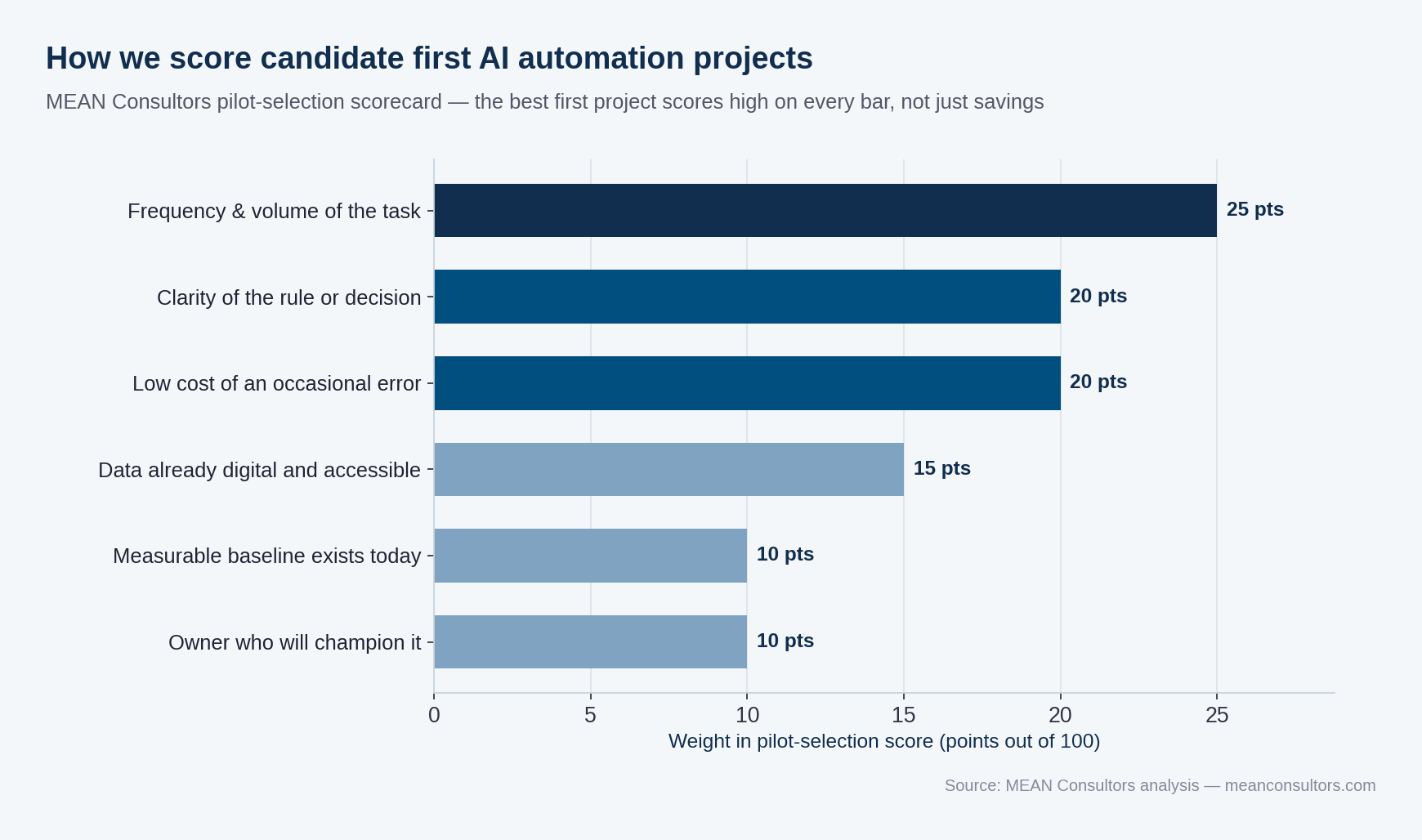
Figure 1: Our pilot-selection scorecard — frequency, clarity, and low error cost carry 65 of 100 points.
Frequency and volume
Automation pays back in proportion to how often the task runs. A process performed fifty times a day by three people is a better candidate than one performed monthly by an executive, even if the monthly task is more annoying. High volume also means the pilot generates enough examples in 90 days to measure accuracy honestly.
Clarity of the rule or decision
Ask whether a new hire could do the task correctly after reading a one-page instruction sheet. If yes, an AI system can too. If the honest answer is “it depends, you develop a feel for it,” the task is a poor first project — not impossible, but it needs judgment that is hard to specify and harder to verify.
Low cost of an occasional error
Every automated system makes mistakes. The first project should be one where a mistake is cheap to catch and cheap to fix: a misrouted email, a flagged-for-review invoice, a draft reply a person edits before sending. Do not start with anything that touches money movement, regulatory filings, or customer commitments without a person in the loop.
Data that is already digital and accessible
If the inputs live in a shared inbox, a spreadsheet, or a system with an API, you can start now. If they live on paper, in someone’s head, or in a system with no export, you have a data project before you have an automation project — and that is a different first step.
A measurable baseline
You must be able to state, before you start, how long the task takes, how often it is done, and what the error rate is today. Without a baseline, you cannot prove the pilot worked, and an unprovable pilot does not get a sequel. Workflow mapping before automation is how you establish it.
An owner who will champion it
The person who does the task today must want it automated. Pilots imposed on a reluctant team get quietly worked around, and the data goes bad. Pick a process whose owner is asking for help.
- McKinsey reports 78% of organizations now use AI in at least one function, yet RAND finds over 80% of AI projects fail — selection, not technology, is the gap.
- In our scorecard, frequency, rule clarity, and low error cost carry 65 of 100 points; a candidate below 60 total is not a first project.
- A first project’s real deliverable is evidence: a measured before-and-after that funds the next three automations.
Good first projects vs. tempting-but-wrong ones
The table below lists the candidates we see most often, scored on the criteria above. The right-hand column is the one to read; it explains why the appealing projects usually belong second or third, not first.
| Candidate first project | Typical score | Why it fits — or does not |
|---|---|---|
| Inbound email / ticket triage and routing | High (80–90) | Constant volume, clear categories, errors are visible and cheap, inbox is already digital |
| Invoice, PO, or order data extraction into your system | High (75–90) | Repetitive, rule-bound, baseline is obvious; keep human approval on anything above a threshold |
| First-draft replies to common customer questions | High (70–85) | Frequent and measurable; a person edits and sends, so error cost stays low |
| Meeting notes and follow-up task extraction | Medium (60–75) | Useful and safe, but volume and dollar impact are smaller; good second project |
| Weekly reporting compiled from several systems | Medium (55–70) | Clear rules, but low frequency; fits when data access is already clean |
| Sales forecasting or demand prediction | Low (35–50) | Needs historical data quality most SMBs lack; errors are expensive and slow to detect |
| Fully autonomous customer-facing chatbot | Low (30–45) | High visibility, judgment-heavy, brand risk on every error; do this after you have a track record |
| Automating the CEO’s strategic decisions | Very low | Rare, unclear rules, catastrophic error cost — the worst first project imaginable, and a common request |
If you want a longer list of processes to score, our rundown of the most automatable tasks in a growing business is a good source of candidates. Notice how the high-scoring rows share a shape: a person still reviews the output. That is deliberate. Human-in-the-loop design is what keeps error cost low enough for a first project to be safe, and it is how the system earns the right to run unsupervised later.
How to run the first project: the 90-day path
Scope discipline is what separates pilots that finish from pilots that drift. We run first projects on a fixed 90-day timeline with five phases, shown in Figure 2. The deadline is not arbitrary; it is short enough to hold attention and long enough to collect meaningful accuracy data.
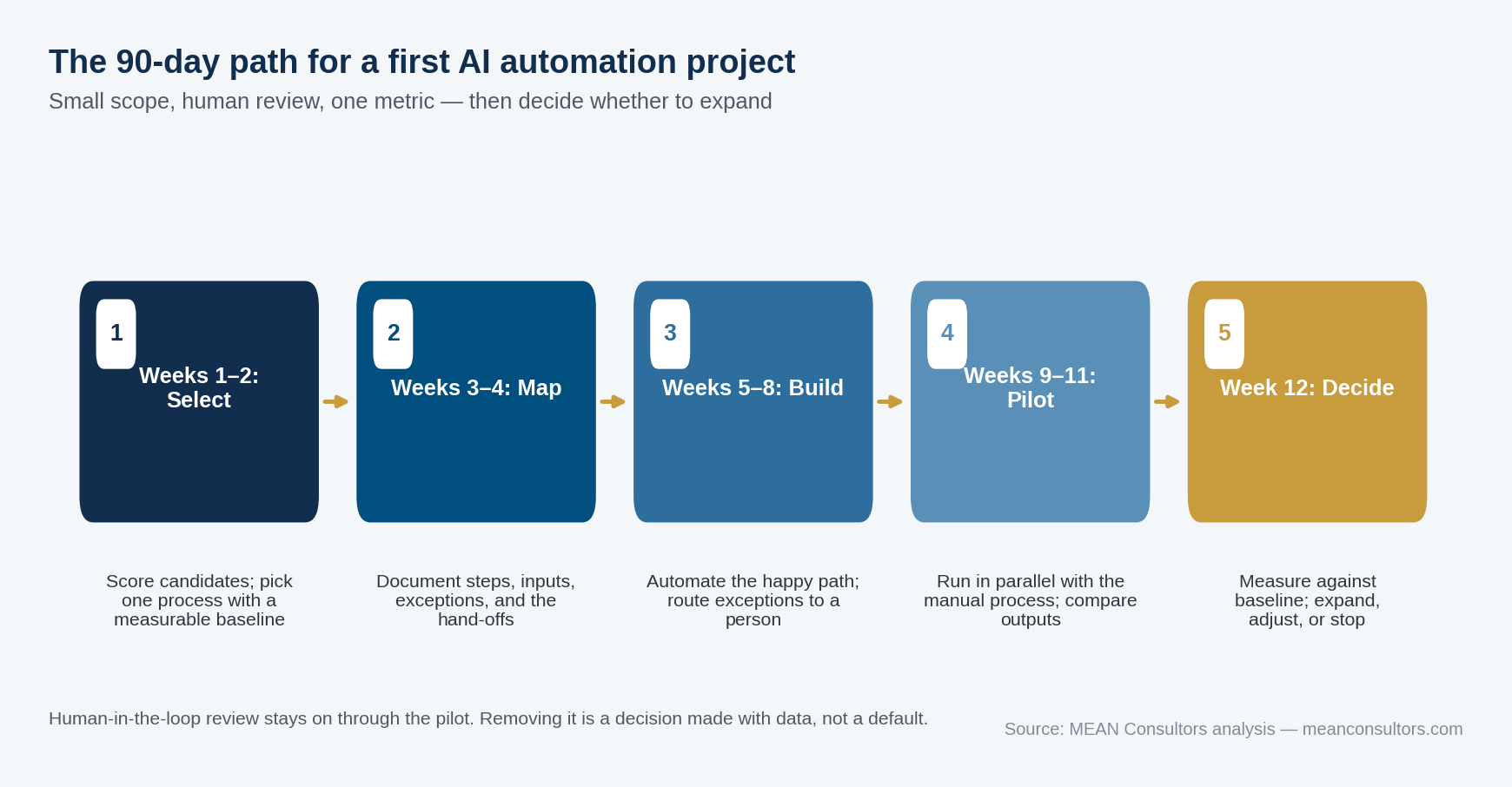
Figure 2: The 90-day first-project path — the pilot runs alongside the manual process so results are directly comparable.
- Weeks 1–2, select: score three to five candidate processes with the scorecard; pick the highest-scoring one that has a willing owner and a baseline you can measure this week.
- Weeks 3–4, map: document every step, input, output, exception, and hand-off. Most surprises surface here, and fixing them on paper is free.
- Weeks 5–8, build: automate the common path only. Anything ambiguous is routed to a person with the context they need to decide quickly. Log every decision.
- Weeks 9–11, pilot in parallel: run the automation alongside the manual process. Compare outputs daily; track accuracy, time saved, and how often the system escalates.
- Week 12, decide: compare against the baseline. Expand the scope, tune and re-run, or stop. All three are legitimate outcomes; only “drift on without deciding” is a failure.
- Throughout: one metric owns the project — hours saved, cycle time, or error rate. Report it weekly to whoever funds the next project.
The technology choice matters less than most owners expect at this stage. Many first projects run well on established automation platforms with an AI step for classification or extraction; others need a small custom service when the data or integrations are unusual. When we scope AI automation for a client, we choose the lightest tool that meets the reliability requirement, and we design so that the pilot can be rebuilt on sturdier infrastructure — often with our software development team — if it earns expansion. Building for scale before you have proven value is how first projects run out of budget.
Measuring success and deciding what comes next
A first project succeeds when three things are true at day 90: the automation handles the majority of volume without human correction, the measured time or error savings against baseline are real, and the process owner wants to keep it. Payback is usually fast for a well-chosen pilot because scope is small; our guide to automation payback periods walks through the arithmetic. But the return that matters most is the one that does not appear on the spreadsheet: you now have a team that has mapped a process, defined acceptance criteria, watched an AI system make and recover from mistakes, and measured the result. That team will pick the second project better than any consultant could.
What comes next follows naturally. Expand the first automation to adjacent steps in the same workflow — if you extracted invoice data, add matching against purchase orders. Then take the second-highest scorer from your original list. By the third project you will have your own scorecard weights, tuned to your business, and the hard part — starting — will be behind you. If you are still deciding where automation fits at all, our introduction to business process automation is the right place to begin before you pick a project.
Frequently Asked Questions
What is a good first AI automation project for a small business?
A high-volume, rule-heavy, low-risk task with digital inputs and a measurable baseline: inbound email or ticket triage, extracting invoice or order data into your system, or drafting replies to common customer questions for a person to review and send. Each is frequent, easy to measure, and cheap to correct when the system errs.
How do I choose which process to automate first?
Score candidates on six criteria: frequency and volume, clarity of the rule, low cost of an occasional error, data already digital and accessible, a measurable baseline, and a process owner who wants the help. Pick the highest scorer with a willing owner; avoid anything under roughly 60 of 100 points as a first project.
How long should a first AI automation pilot take?
About 90 days: two weeks to select, two to map the process, four to build the common path with human review for exceptions, three to run in parallel with the manual process, and a final week to measure against baseline and decide whether to expand, adjust, or stop.
Why do so many AI automation projects fail?
RAND’s 2024 analysis found more than 80% of AI projects fail, roughly twice the rate of non-AI IT projects, mostly due to misunderstood problems, inadequate data, and a focus on technology over business need. Choosing a small, well-defined, measurable first project addresses all three causes.
Should my first AI automation project be a customer-facing chatbot?
Usually not. A fully autonomous customer-facing chatbot is highly visible, judgment-heavy, and carries brand risk on every error. Start with an internal process where a person reviews outputs, build a track record, and then extend into customer-facing work with the evidence and safeguards you have developed.
Do I need custom software for a first AI automation project?
Often not. Many first projects run on established automation platforms with an AI step for classification or extraction. Custom development makes sense when data or integrations are unusual, or when a pilot has proven value and needs sturdier, scalable infrastructure.
How do I measure whether a first AI automation project worked?
Establish a baseline before starting — time per task, volume, and error rate — then track one primary metric weekly during the pilot. At day 90 the project succeeds if the automation handles most volume without correction, savings against baseline are real, and the process owner wants to keep it.
MEAN Consultors scopes 90-day AI automation pilots for U.S. small and mid-size businesses, with a measured baseline, human-in-the-loop design, and a clear expand-or-stop decision at the end.