
Custom Software vs. Off-the-Shelf: How to Make the Right Call
Last updated: July 13, 2026 · By Joseph Olivas, Founder, MEAN Consultors · 8 min read
Almost every business owner I talk to asks the same question in some form: should we buy a ready-made tool or have something built? It is one of the most consequential technology decisions a small or mid-size company makes, and it gets framed badly — as if custom always means expensive and off-the-shelf always means safe. The real answer depends on how unique your workflow is, how long you plan to run the tool, and how much of your team’s day the software touches.
The Real Trade-Off Isn’t Price — It’s Fit
Off-the-shelf software (SaaS subscriptions, packaged products) is built for the average of thousands of customers. That is its strength and its ceiling. You get a mature product on day one, but you also inherit every compromise the vendor made to serve everyone at once. Custom software is the inverse: it is built for exactly one company — yours — which is why it fits your process precisely and why it costs more to create. When you evaluate the two, the honest question is not “which is cheaper?” but “how much is my business paying, in time and workarounds, to fit the tool I already have?” If you want a partner to scope that question with you, our custom software development team does exactly this kind of build-versus-buy analysis before a line of code is written.
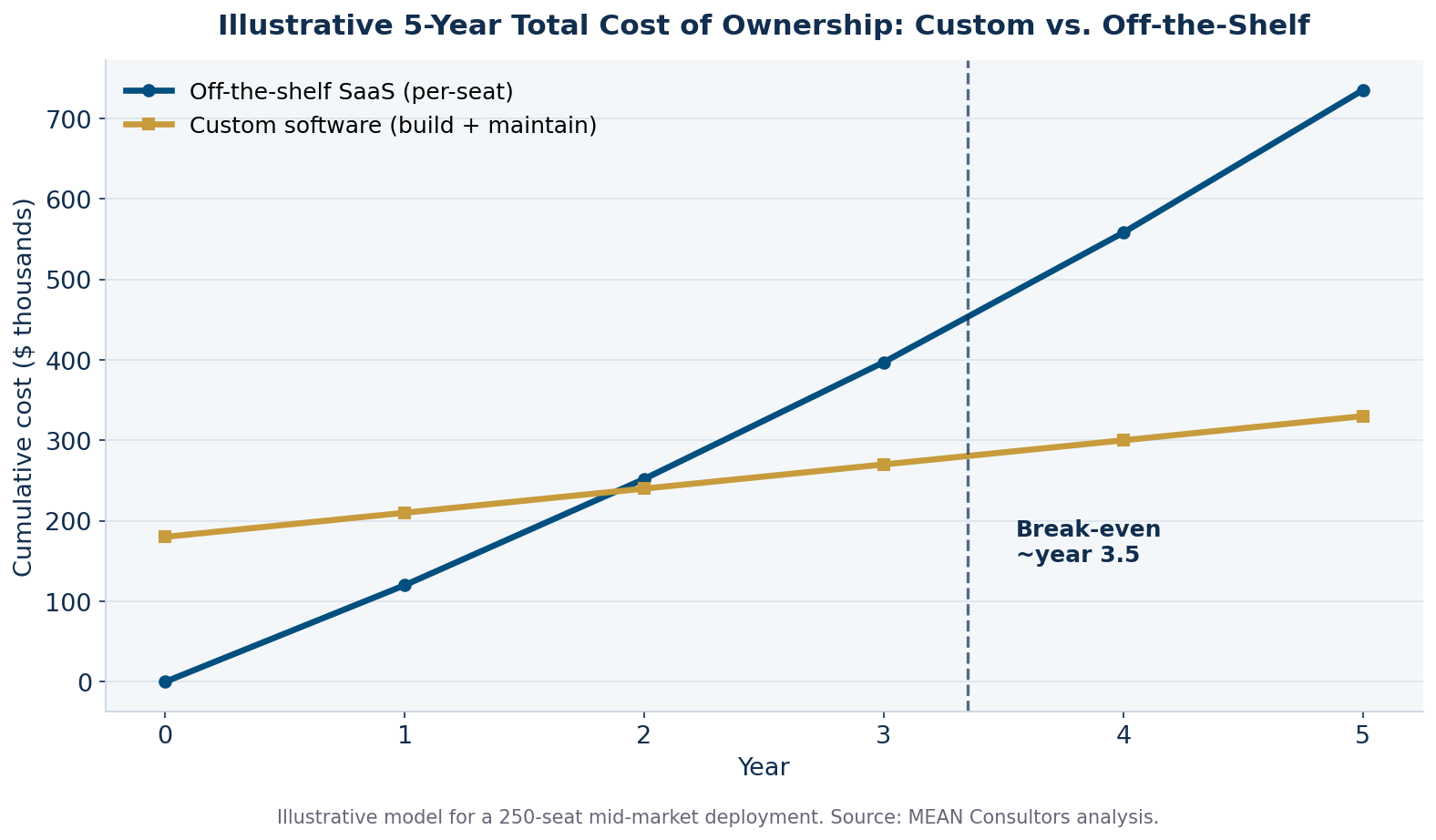
Figure 1: An illustrative five-year cost model. Off-the-shelf looks cheaper early; per-seat pricing and feature tiers close the gap over time.
What People Get Wrong About Cost
The sticker price of a SaaS subscription is the beginning of the cost, not the end. Independent data on software waste makes this concrete. Zylo’s 2025 SaaS Management Index — drawn from more than 40 million licenses and $40 billion in managed spend — found that 52.7% of purchased SaaS licenses sit idle, costing the average organization about $21 million per year, and that spend now averages $4,830 per employee, up nearly 22% year over year. In other words, most companies are already over-paying for tools they under-use. When people compare custom software to off-the-shelf, they measure the custom build’s full cost honestly but forget that the “cheap” subscription quietly compounds through per-seat scaling, integration work, and tier upgrades.
- Over half of SaaS licenses go unused (52.7%, per Zylo 2025) — the headline subscription price rarely reflects real value delivered.
- Off-the-shelf front-loads convenience; custom front-loads cost. The crossover in total cost of ownership often lands around year three for tools that touch many users.
- Fit is the multiplier. A tool that matches your workflow exactly removes the daily tax of workarounds, duplicate data entry, and “we do it in a spreadsheet on the side.”
Custom vs. Off-the-Shelf, Side by Side
Here is how the two approaches compare across the dimensions that actually drive the decision. No single row wins the argument — the right choice is whichever column matches your priorities for this workflow.
| Factor | Off-the-Shelf (SaaS) | Custom Software |
|---|---|---|
| Time to launch | Days to weeks | Weeks to months |
| Upfront cost | Low (subscription) | Higher (one-time build) |
| Long-term cost | Recurring, scales with seats | Predictable maintenance |
| Workflow fit | You adapt to the tool | The tool fits your process |
| Ownership & data | Vendor-controlled | You own it outright |
| Roadmap control | Vendor decides features | You decide priorities |
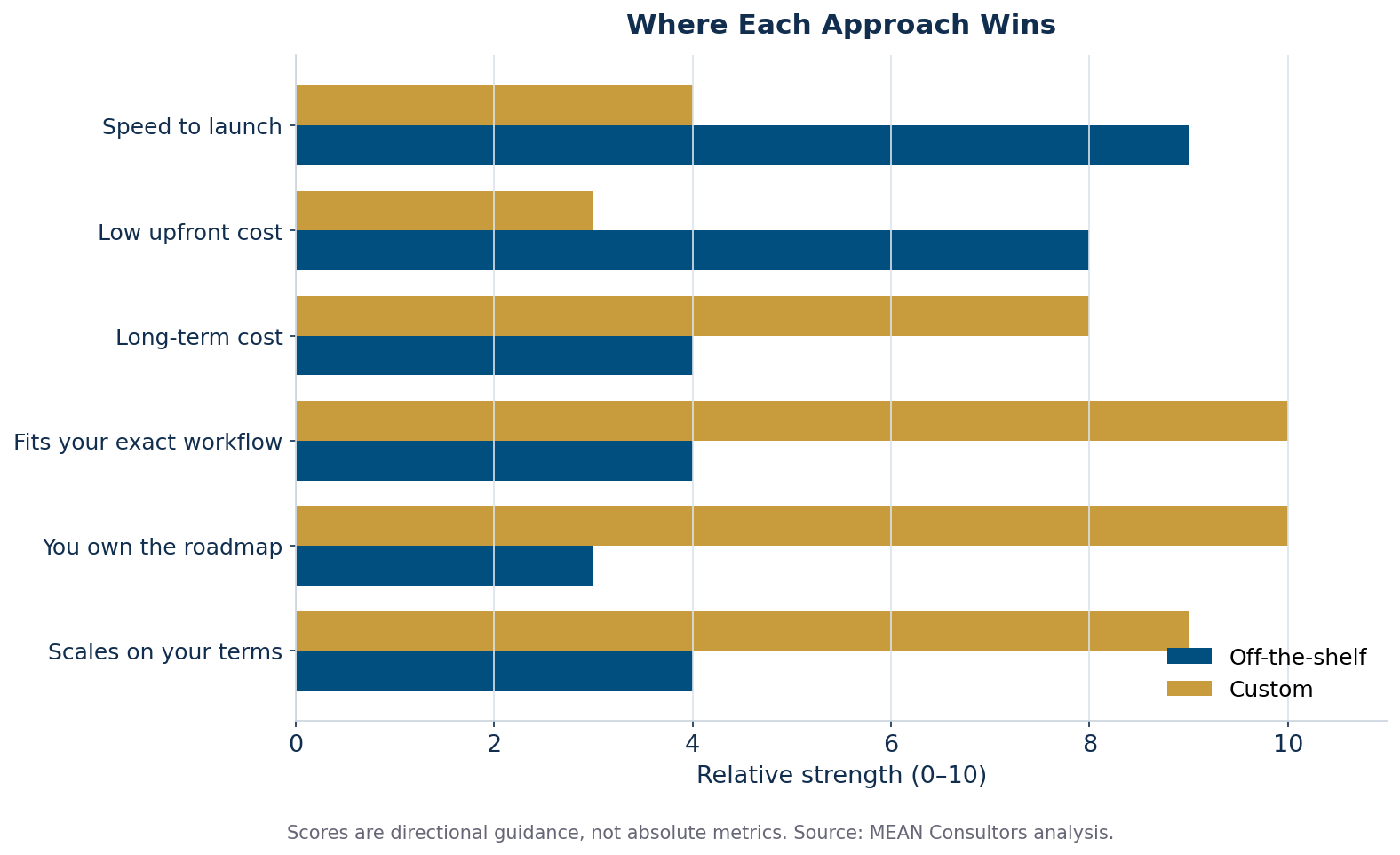
Figure 2: Directional strengths of each approach. Off-the-shelf leads on speed and upfront cost; custom leads on fit, ownership, and long-term control.
When Off-the-Shelf Is the Right Call
Buying is usually smarter when the job is standard and well-served by mature products. If you need email, accounting, payroll, or basic CRM, there is no reason to build — the market has solved those problems well. Reach for off-the-shelf when:
- Your process is common and you are happy to follow industry-standard workflows.
- You need the tool running now, not next quarter.
- The function is not a source of competitive advantage — it just needs to work.
- Your team is small and you would rather rent capability than maintain it.
When Custom Software Pays Off
Custom becomes the better investment when the software sits close to how you actually make money. If your team is stitching three subscriptions together with spreadsheets, re-keying the same data into multiple systems, or paying for features you will never use just to unlock the one you need, you are already funding a custom build — in wasted hours instead of code. McKinsey’s research on the future of work estimates that around half of current work activities are technically automatable with today’s technology; a system built around your process is how you capture that time instead of leaving it in manual steps. Consider building when:
There is also a hybrid path that many of our clients land on: keep off-the-shelf tools for commodity functions and build custom only for the one or two workflows that differentiate you. You do not have to choose a single philosophy for your entire stack.
A Simple Way to Decide
When a client is genuinely torn, I walk them through four questions. If most answers point the same way, the decision usually makes itself.
- Is this workflow standard or unique to us? Standard leans buy; unique leans build.
- How long will we run it? A few months leans buy; many years leans build.
- How many people and how much data does it touch? More reach raises the payoff of a precise fit.
- Are we paying a “workaround tax” today? If your team already props up a SaaS tool with side spreadsheets, custom often wins.
Frequently Asked Questions
Is custom software always more expensive than off-the-shelf?
No. Custom costs more upfront, but off-the-shelf costs recur and scale with every seat and feature tier. Over a multi-year horizon — especially for tools many employees use daily — total cost of ownership often crosses over, and a custom system can end up cheaper while fitting your process far better.
How long does it take to build custom software?
It depends on scope. A focused internal tool can ship in a few weeks; a full platform can take several months. A good development partner will scope a minimum viable version first so you get value early rather than waiting for one big launch.
When does off-the-shelf software make more sense?
When the function is standard (accounting, email, payroll), when you need it live immediately, when budget is tight, or when the workflow is not a competitive differentiator. Do not build what you can reliably rent.
Can I start with off-the-shelf and switch to custom later?
Yes, and many companies do. Off-the-shelf tools are a great way to prove a process works before you invest in building your own version. The key is choosing tools that let you export your data cleanly so a future migration is not painful.
How do I know if my workflow is too unique for off-the-shelf tools?
A reliable signal is the “workaround tax.” If your team keeps side spreadsheets, re-enters the same data across systems, or pays for a full software tier just to use one feature, the market product no longer fits — and a custom build will likely pay for itself in reclaimed time.
MEAN Consultors scopes the build-versus-buy decision and delivers custom software only when it genuinely pays off for your business.