
SEO for Manufacturers and Industrial Suppliers
Last updated: August 29, 2026 · By Joseph Olivas, Founder, MEAN Consultors · 10 min read
Industrial websites tend to fail in a very particular way. The site looks fine. It has a homepage that says “precision manufacturing since 1978,” an About page with a photo of the shop floor, a Capabilities page that lists eleven processes in a bulleted column, and a contact form. It is not a bad website. It is just invisible, because the person searching is not typing “precision manufacturing.” They are typing “5-axis CNC machining 17-4 PH stainless tight tolerance.”
That gap — between how manufacturers describe themselves and how buyers search — is the whole opportunity. Industrial categories are usually far less contested than consumer ones, so a supplier who publishes genuinely specific technical content can outrank much larger competitors within a year. This is how I approach it.
How industrial buyers actually search
The buyer for a machined part is not a marketer. Usually it is a design engineer, a sourcing specialist, or a maintenance lead, and they search the way they work — with numbers, materials, and process names. That produces a demand profile that looks nothing like a typical B2B keyword list.
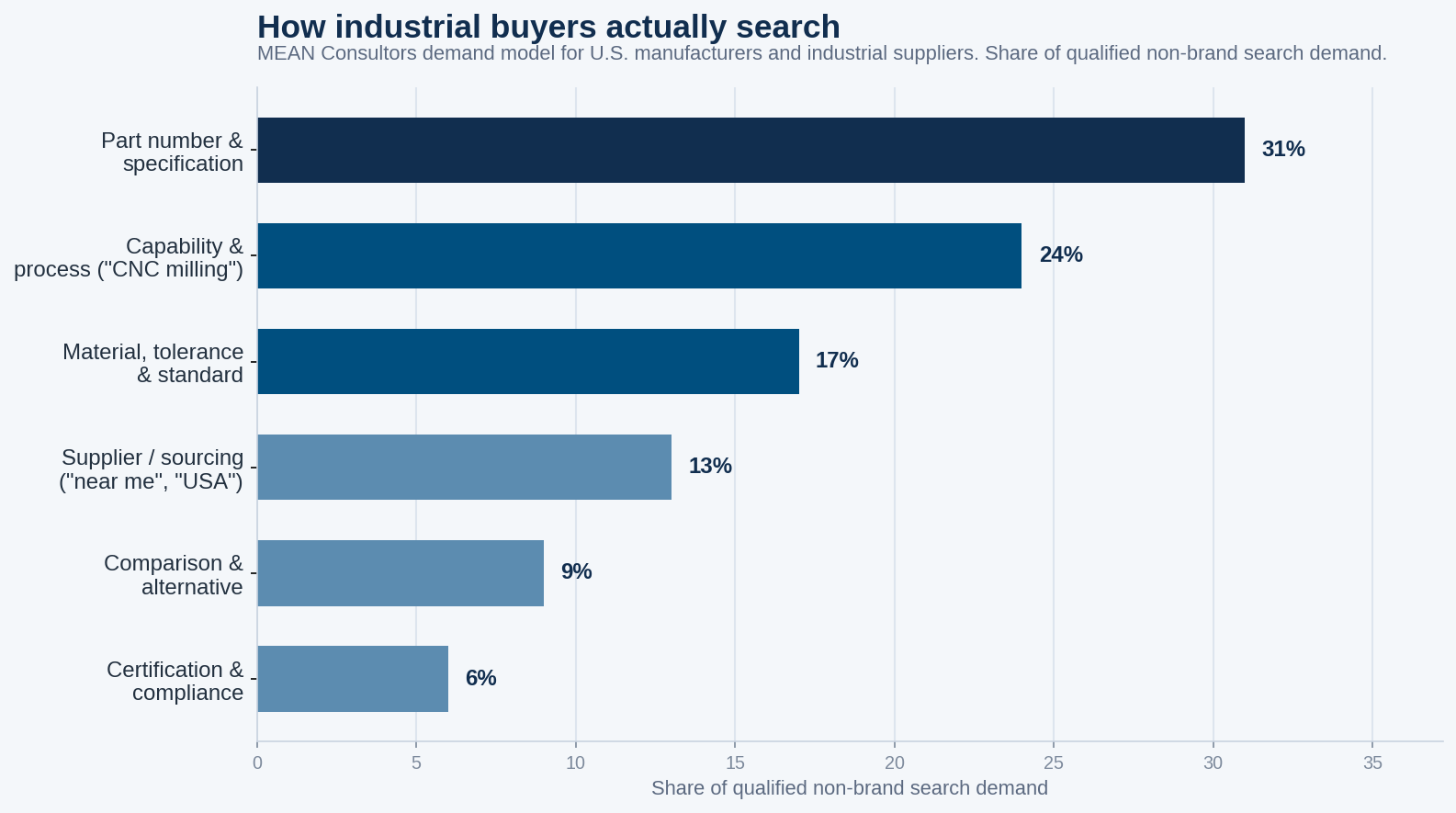
Figure 1: MEAN Consultors’ demand model for U.S. manufacturers and industrial suppliers, by share of qualified non-brand search demand.
Two implications follow from Figure 1. The first is that capability and specification language — the top three bands, about 72% of qualified demand — is where your page inventory has to be. The second is that most keyword research tools will tell you these terms have almost no volume. That is a measurement artifact, not reality. Long, technical, numeric queries fragment into thousands of low-volume variants that tools round down to zero, and they are searched by exactly the people who sign purchase orders. Judge industrial keywords by who searches them, not by the monthly volume estimate.
The practical move is to stop starting from a keyword tool. Start from your quoting inbox. Every RFQ your sales team received in the last year contains the actual vocabulary of your market: the materials, the tolerances, the standards, the industries. Extract that, group it, and you have your page plan. Our SEO service engagements for industrial clients almost always begin with reading quotes rather than running a keyword report.
- Part-number, capability, and material queries account for about 72% of qualified non-brand demand in our industrial model — and are the pages most manufacturer sites lack.
- Keyword tools systematically underreport technical industrial queries; source your terms from RFQs and sales email instead.
- Supplier-sourcing and “near me” searches are real but minority demand at roughly 13%; do local SEO once, then invest in capability content.
The capability page is the unit of work
If you take one thing from this article, take this: a bulleted list of eleven capabilities on one page is eleven pages that do not exist. Each process deserves its own URL, its own H1, its own spec table, and its own RFQ path.
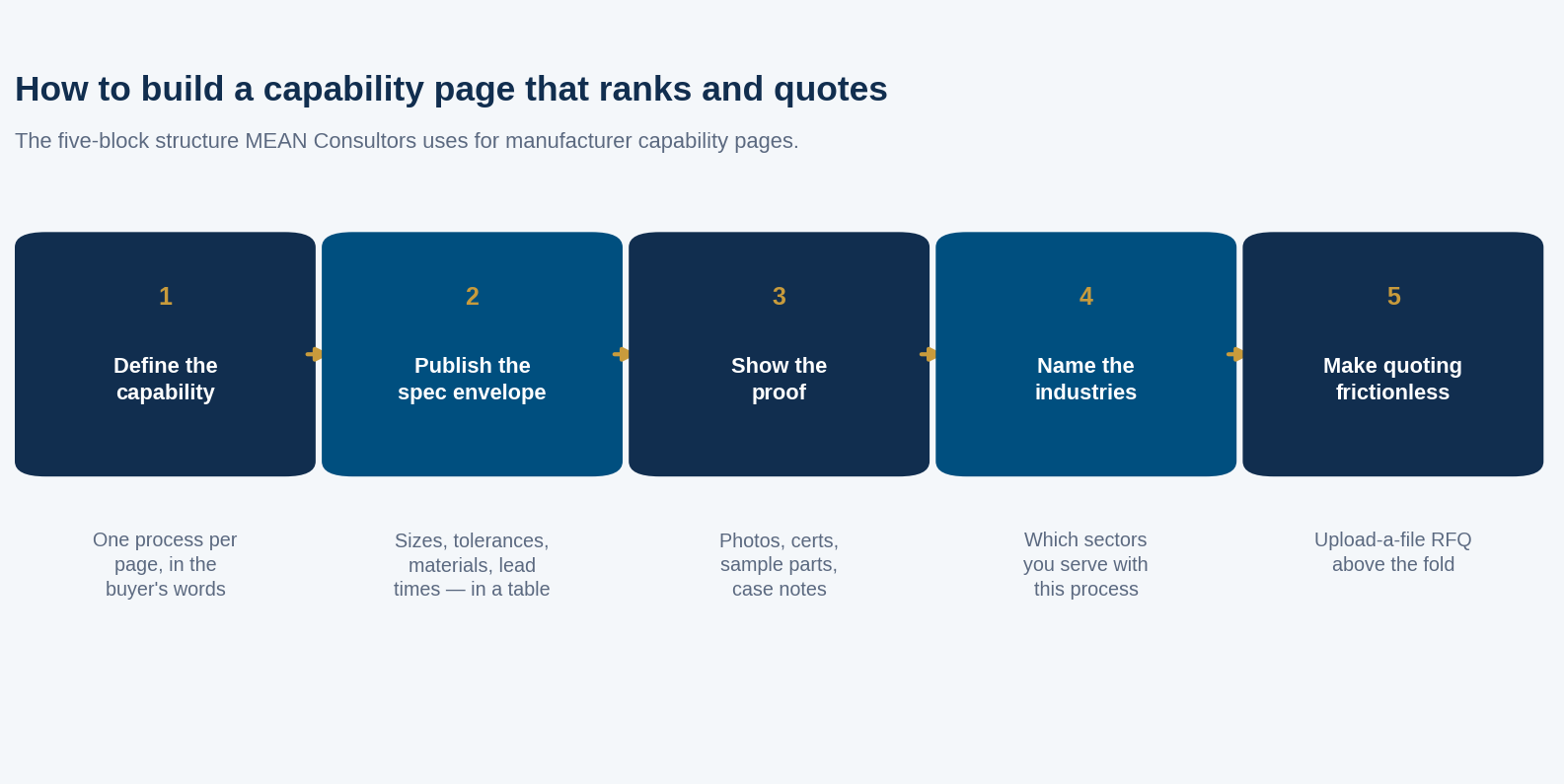
Figure 2: The five-block capability page structure MEAN Consultors uses for manufacturers and industrial suppliers.
The spec envelope in block two is the part most manufacturers resist, usually for one of two reasons. Either they worry competitors will see their limits, or they want the buyer to call so sales can qualify them. Both are worth losing an argument over. Competitors already know your machine list — it is on the equipment manufacturer’s customer page. And the buyer who has to call to learn whether you can hold ±0.0005” will simply call someone whose website says so.
Publishing the envelope also filters your inbound in your favor. When the page states the material range, size range, tolerance capability, typical lead time, and certifications held, the RFQs that arrive are pre-qualified. Several industrial clients have told me the biggest change after this work was not the volume of quotes but the share of quotes they could actually win.
Google’s guidance on creating helpful, people-first content reads like it was written for this problem: demonstrate first-hand expertise, answer the question the searcher actually has, and avoid summarizing what everyone else already published. A spec table is first-hand expertise in its purest form.
| Page type | Query it answers | Must include | Priority |
|---|---|---|---|
| Capability page | “5-axis CNC machining services” | Spec envelope, equipment list, tolerances, RFQ upload | Build first — one per process |
| Material page | “machining Inconel 718” | Behavior of the material, typical applications, what you can hold | Build second — top 6 materials |
| Industry-served page | “aerospace machining supplier” | Sector requirements, certifications, relevant part examples | Build third |
| Standards reference | “AS9100 vs ISO 9001 difference” | Plain explanation, what it means for the buyer | Ongoing — strong link magnet |
| Part / catalog page | Exact part number | Specs, availability, downloadable CAD, structured data | Only if you sell a stable catalog |
| Location page | “machine shop near me” | NAP consistency, service radius, real photos | Once, then leave it |
Technical work that matters more in industrial than elsewhere
Three technical items carry unusual weight on manufacturing sites.
Structured data on part and product pages. If you publish a catalog, marking up part pages properly is one of the highest-leverage technical jobs available — it makes specifications machine-readable rather than trapped in a rendered table. Google’s structured data documentation covers the mechanics, and we walk through implementation in our product schema markup guide.
Faceted catalog navigation. Industrial catalogs with filters for material, size, thread, and finish can generate tens of thousands of near-duplicate URLs and consume a crawl budget that should be going to your capability pages. Decide deliberately which facet combinations are indexable and which are not.
PDF sprawl. Most manufacturers have a decade of spec sheets and catalogs sitting in PDFs. PDFs can rank, but they are dead ends: no navigation, no RFQ form, no internal links, and a poor mobile experience. The highest-value ones should be rebuilt as HTML pages with the PDF offered as a download. Getting the site structure right around all of this is covered in our guide to site architecture for SEO.
- One indexable page per capability, per top material, and per served industry
- A real spec envelope on every capability page — ranges, tolerances, certifications, lead times
- File-upload RFQ form present on every capability page, not only on Contact
- Faceted catalog rules defined: which filter combinations get indexed, which get noindexed
- Top 20 legacy PDFs rebuilt as HTML pages with the PDF as a secondary download
- Certifications (ISO 9001, AS9100, ITAR registration) stated on the pages where they qualify you, not only on About
- Google Business Profile complete, with service radius and real facility photos
Getting cited by AI search, not just ranked
An increasing share of industrial research now begins in an AI assistant, and the sourcing behavior there is different. These systems favor content that makes specific, attributable, checkable claims — which is a description of a well-built spec table.
Practically, that means writing every capability page so a machine can extract an answer: lead with a direct statement of what you do and what you can hold, put the numbers in a real HTML table rather than an image, name materials and standards explicitly, and date the page so freshness is verifiable. Vague superlatives — “world-class quality,” “unmatched precision” — are not just weak marketing, they are unquotable. A sentence like “we hold ±0.0002” on 6061-T6 up to 24 inches, AS9100D certified” is both stronger copy and a citable fact.
The same discipline applies to how you describe your operation. The U.S. small manufacturing base is large and fragmented — the NIST Manufacturing Extension Partnership exists precisely because most American manufacturers are small firms competing on capability rather than scale. In a field of near-identical shop descriptions, the supplier who publishes actual numbers is the one both engineers and machines can distinguish.
What to measure
Rankings are a poor primary metric here because the winning queries are numerous and tiny. Measure instead: RFQ submissions from organic, the share of those RFQs that fall inside your capability envelope, the number of capability and material pages published against the plan, and total non-brand organic entrances to capability pages as a group. That last one smooths out the long-tail noise and shows the trend clearly.
Give it nine months before judging. Industrial buying cycles are long, and a supplier shortlisted in March may not issue a purchase order until the fall. The lead indicator you can trust at month three is whether qualified RFQs are arriving from pages that did not exist before.
Frequently Asked Questions
How is SEO for manufacturers different from regular B2B SEO?
Two things make it different. First, the search vocabulary is technical and often numeric — part numbers, alloy designations, tolerances, standards like ASTM or ISO — which means keyword tools underreport the demand badly. Second, the buying committee is engineer-led, so the page that wins is the one that publishes specifications rather than benefits. A manufacturer’s SEO program is mostly an exercise in publishing technical information the sales team currently emails out one PDF at a time.
Should we build pages around capabilities or around products?
Both, but capabilities first. Capability pages — one page per process, such as CNC machining, powder coating, or injection molding — capture the largest share of qualified non-brand demand and they are the pages engineers use to shortlist suppliers. Product or part pages matter when you sell a catalog with stable SKUs. If you have limited resources, build the capability set completely before you touch the catalog.
Do part numbers and specification tables actually help rankings?
Yes, and they help twice. They match the literal way industrial buyers search, and they give AI-driven search surfaces something concrete and attributable to cite. A capability page with a real spec envelope — sizes, tolerances, materials, lead times, certifications — is far more likely to be quoted in an AI overview than a page of adjectives, because the specifics are checkable.
Is local SEO worth it for a manufacturer that ships nationwide?
It is worth doing, but it is not the growth lever. A complete Google Business Profile and consistent citations help you win the “machine shop near me” and “fabricator in [state]” queries, which in our demand model are a meaningful but minority share of qualified searches. National capability and specification content is where the volume is. Do local once, correctly, then move on.
How long before a manufacturing SEO program produces quote requests?
Expect early movement at three to four months and meaningful RFQ volume between months six and nine. Industrial niches are usually less contested than consumer categories, so rankings can come faster than in B2C — but the buying cycle behind them is longer, so leads lag rankings by a further quarter. Judge the program at nine months, not three.
What content should a manufacturer publish besides capability pages?
Three types earn their keep: materials and standards references that answer the questions engineers actually ask, industry-served pages that connect a capability to a sector’s requirements, and problem-driven case notes describing a part that was hard to make and how you made it. Skip company news. Nobody sources a supplier because you attended a trade show.
Do we need an RFQ form or is a phone number enough?
You need a file-upload RFQ form, and it needs to be on every capability page rather than buried under Contact. Engineers arrive with a drawing. If the only path forward is a phone call, a meaningful share of qualified traffic leaves to find a supplier who accepts a STEP file at 11pm.
MEAN Consultors builds capability-led SEO programs for U.S. manufacturers and industrial suppliers — from RFQ vocabulary research through page build and technical cleanup.