
Faceted Navigation and SEO: Solving the Duplicate Content Nightmare
Last updated: August 16, 2026 · By Joseph Olivas, Founder, MEAN Consultors · 8 min read
Faceted navigation is the filter panel down the left side of a category page: size, color, brand, price range, material. Shoppers love it. It is one of the highest-value UX features an e-commerce site has. And it is also, reliably, the single largest technical SEO liability on most online stores I audit.
The reason is arithmetic. Each filter your template exposes multiplies the number of URLs a crawler can reach, and almost every one of those URLs shows a subset of products that already appear on the parent category page. You have not created new content. You have created thousands of thin variations of existing content, all competing with each other and all consuming crawl capacity that should be going to your actual product pages.
The math that makes this urgent
People underestimate how quickly this compounds. Take one category page with five selectable values per facet. With a single facet you get 5 filtered URLs. It looks harmless. Add a second facet and you are at 35. Add a fifth and a single category page has generated more than 7,700 unique crawlable combinations.

Figure 1: Unique crawlable filter combinations generated from a single category page at five selectable values per facet. The growth is exponential, not linear.
Now multiply that by the number of category pages you have. A modest catalog with 40 categories and five facets each is theoretically exposing over 300,000 filtered URLs — for a store that might only sell 3,000 products. That is a hundred crawlable URLs per product, and Google has to sort through all of them to find the pages you actually want ranked.
Google’s own guidance on managing crawling of faceted navigation URLs names the two consequences directly: overcrawling, where crawlers spend time on countless non-valuable URLs, and slower discovery of important new content. The second one is the expensive one. If you launch 200 new products and Googlebot is busy working through filter permutations, those products sit undiscovered.
- Five facets at five values each produce 7,775 crawlable combinations from one category page — the growth is exponential.
- Google explicitly names overcrawling and delayed discovery of new content as the costs of unmanaged faceted navigation.
- The solution is selective indexing, not blanket blocking: a small number of high-demand combinations genuinely deserve to rank.
Why “just noindex everything” is the wrong answer
The instinct is to slap a noindex tag on every filtered URL and call it solved. It is not solved, for two reasons.
First, noindex does not save crawl budget. Google still has to request the URL to see the tag. If your problem is that crawlers are drowning in 300,000 filter permutations, adding a meta tag to all 300,000 of them does nothing about the drowning — it only changes what happens after the page is fetched. Robots.txt disallow is the tool that prevents the request in the first place.
Second, you are throwing away rankings you should be winning. “Men’s waterproof hiking boots size 11” is a real query with real commercial intent, and the filtered URL that serves exactly that inventory is genuinely the best result for it. Blocking it means either ranking a broader, less relevant category page or ceding the query to a competitor. On most stores I look at, somewhere between five and thirty filter combinations per category are worth indexing — and everything else is not.
This is the same discipline as deciding which pages belong in a content hierarchy at all, which I covered in site architecture for SEO. Faceted navigation is just that problem with the volume turned up.
A facet-by-facet decision framework
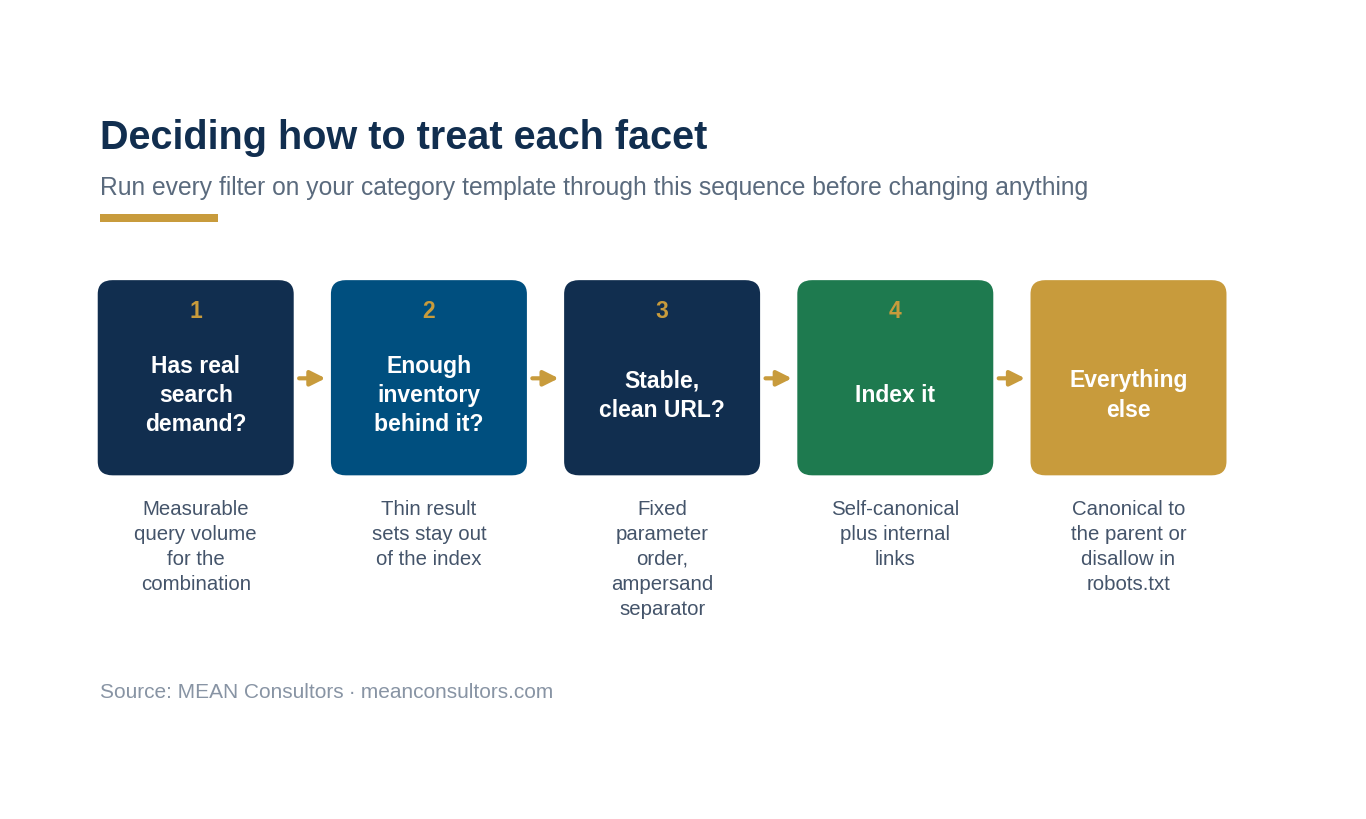
Figure 2: The sequence we run every filter through before touching a line of code. Only combinations that clear all three gates get indexed.
Three questions, in order:
Does the combination have real search demand? Not “could someone theoretically search this” — does keyword data show measurable volume? Brand plus category usually does. Color plus price range almost never does. This is the gate that eliminates the vast majority of combinations.
Is there enough inventory behind it? A filtered page returning three products is thin content that will not hold a ranking and will look sparse to anyone who lands on it. We set a floor — typically eight to twelve products — below which a combination does not get indexed regardless of demand. Related to this: decide up front how you handle combinations that go empty, which connects to the broader question of handling out-of-stock and discontinued product pages.
Is the URL stable and clean? Google’s crawling documentation is specific here: use the standard & separator rather than commas, semicolons, or brackets, keep the order of filters consistent so the same selection always produces the same URL, and return a 404 when a filter combination has no results. If ?color=blue&size=m and ?size=m&color=blue both resolve, you have doubled your problem for free.
| Facet type | Typical demand | Recommended handling |
|---|---|---|
| Category + brand | High | Index — often deserves its own static landing page |
| Category + core attribute (size, material) | Moderate | Index selectively, above the inventory floor |
| Color | Low to moderate | Index only where the query data supports it |
| Price range | Very low | Canonicalize to parent category |
| Sort order (price, newest, rating) | None | Canonicalize to parent; never index |
| Pagination beyond page 1 | None | Self-canonical, crawlable, not indexed as a target |
| Three or more facets combined | Negligible | Disallow in robots.txt |
Notice that sort order gets no consideration at all. Sorting the same 60 products by price ascending versus rating produces byte-for-byte different HTML and exactly zero difference in what the page is about. It is the purest form of duplicate content on an e-commerce site.
Implementing it without breaking anything
The order matters here as much as it does in any migration, because a robots.txt rule that fires before your canonical tags are in place will lock Google out of URLs it cannot then re-evaluate.
- Inventory every facet your template exposes, including ones only reachable on mobile
- Pull query data for the top combinations and mark the ones clearing your demand threshold
- Normalize URL generation: fixed parameter order, ampersand separator, no empty parameters
- Add self-referencing canonicals to the combinations you are indexing
- Canonicalize sort-order and price-range URLs to the parent category
- Only after canonicals are live and crawled, add robots.txt disallow rules for the long tail
- Make indexed combinations reachable through real internal links, not just the filter widget
- Return a 404 or a helpful empty state for combinations with no matching products
One implementation note that saves arguments later: if your filtering is driven by URL fragments — anything after a # — Google does not use fragments for crawling and indexing, so those URLs are invisible to search either way. That is not automatically a win. It means your genuinely valuable filter combinations cannot rank at all, and you will need server-rendered parameter URLs for the ones that matter.
How to tell whether it worked
Give it six to eight weeks and watch three things in Search Console. Crawl stats should show a shift in requests away from parameter URLs toward product and category pages. The Pages report should show a drop in “Crawled — currently not indexed” and “Duplicate without user-selected canonical.” And impressions on your indexed filter combinations should start appearing for the long-tail queries you targeted.
What you should not expect is an immediate ranking jump on your main category pages. Cleaning up faceted navigation removes a drag on the system; it does not by itself make a category page more relevant. Pair it with the on-page work in the e-commerce SEO checklist and the structural work in our SEO engagements to see the compounding effect.
Frequently Asked Questions
Does faceted navigation cause a Google penalty?
No. There is no manual or algorithmic penalty for faceted navigation. The damage is mechanical rather than punitive: crawl budget gets consumed by low-value URLs, new content is discovered more slowly, and ranking signals get split across near-identical pages. Nothing is being penalized — the site is simply making it harder for Google to find and consolidate what matters.
Should I use robots.txt or noindex for filtered URLs?
Use robots.txt disallow when the goal is to stop Google from crawling the URLs at all, which is the right call for the long tail of multi-facet combinations. Use noindex when you need Google to crawl a page — for example to follow links on it or process a canonical — but not index it. Do not apply both to the same URL: if it is blocked in robots.txt, Google cannot read the noindex tag.
How many filter combinations should I actually index?
Far fewer than most stores expect. In our engagements the answer is usually between five and thirty combinations per category, all of them clearing a measurable search-demand threshold and an inventory floor of roughly eight to twelve products. Everything else is canonicalized or blocked. If you are indexing hundreds of combinations per category, the list has not been filtered by demand.
What URL structure should faceted navigation use?
Google’s crawling documentation recommends the standard ampersand as a parameter separator rather than commas, semicolons, or brackets, since non-standard separators are hard for crawlers to parse. Keep the parameter order deterministic so the same selection always produces the same URL, avoid empty parameters, and return a 404 status when a combination yields no results.
Can I use canonical tags to point every filtered URL to the category page?
You can, and for sort-order and price-range filters you should. But canonicalizing everything means giving up the long-tail queries that specific filter combinations are best positioned to win. It also does not save crawl budget, since Google must fetch the page to read the canonical. Treat it as one option among three, not the default.
Do filtered pages need unique meta titles and descriptions?
Any combination you have decided to index does, yes. Templated but variable titles work well — pattern the category, the applied filter, and a qualifier so each indexed combination has a distinct, accurate title. Combinations you are not indexing do not need the effort.
How does this interact with pagination?
Treat them as separate problems. Paginated pages within a category should be crawlable with self-referencing canonicals so Googlebot can reach deeper products, but they are not ranking targets. Faceted URLs are a filtering question. Where they overlap — page 3 of a filtered result — the filtering decision governs: if the combination is disallowed, its pagination is too.
MEAN Consultors maps every facet on your catalog, decides what deserves to rank, and implements the canonical and robots rules without breaking the shopping experience.