
Choosing an SEO Agency: Questions to Ask Before You Sign a Contract
Last updated: September 5, 2026 · By Joseph Olivas, Founder, MEAN Consultors · 9 min read
A large share of the SEO work we do at MEAN Consultors starts as a rescue. A business signed a twelve-month agreement, received a monthly PDF of keyword positions, and eighteen months later cannot say whether it got a single customer from the spend. Almost every one of those situations could have been avoided with a better set of questions on the first two calls. This is the list I would give a friend, organized around the eight questions that expose the most risk.
Before the first call: know what your site needs
You cannot judge a proposal without a baseline. Before you take a single sales call, spend an hour running the checks in our guide on how to do an SEO audit before hiring an agency. You will come out of it with a short list of real problems, such as slow pages, thin service content, missing local citations, or a site structure that buries your money pages. That list becomes the yardstick. If a proposal never mentions the problems you already know you have, the agency did not look at your site, and that tells you how the engagement will go.
It also helps to decide what SEO is for in your business. For a plumber, it is phone calls from the map pack. For a B2B distributor, it is quote requests from product and category pages. The right agency for one is often wrong for the other, and the SEO services pitch should change accordingly.
The eight questions, weighted by how much risk they expose
Not every question carries equal weight. Over dozens of inherited engagements, we have seen which unanswered questions predicted a bad outcome most reliably. The chart below shows how we weight them when we help clients evaluate proposals.
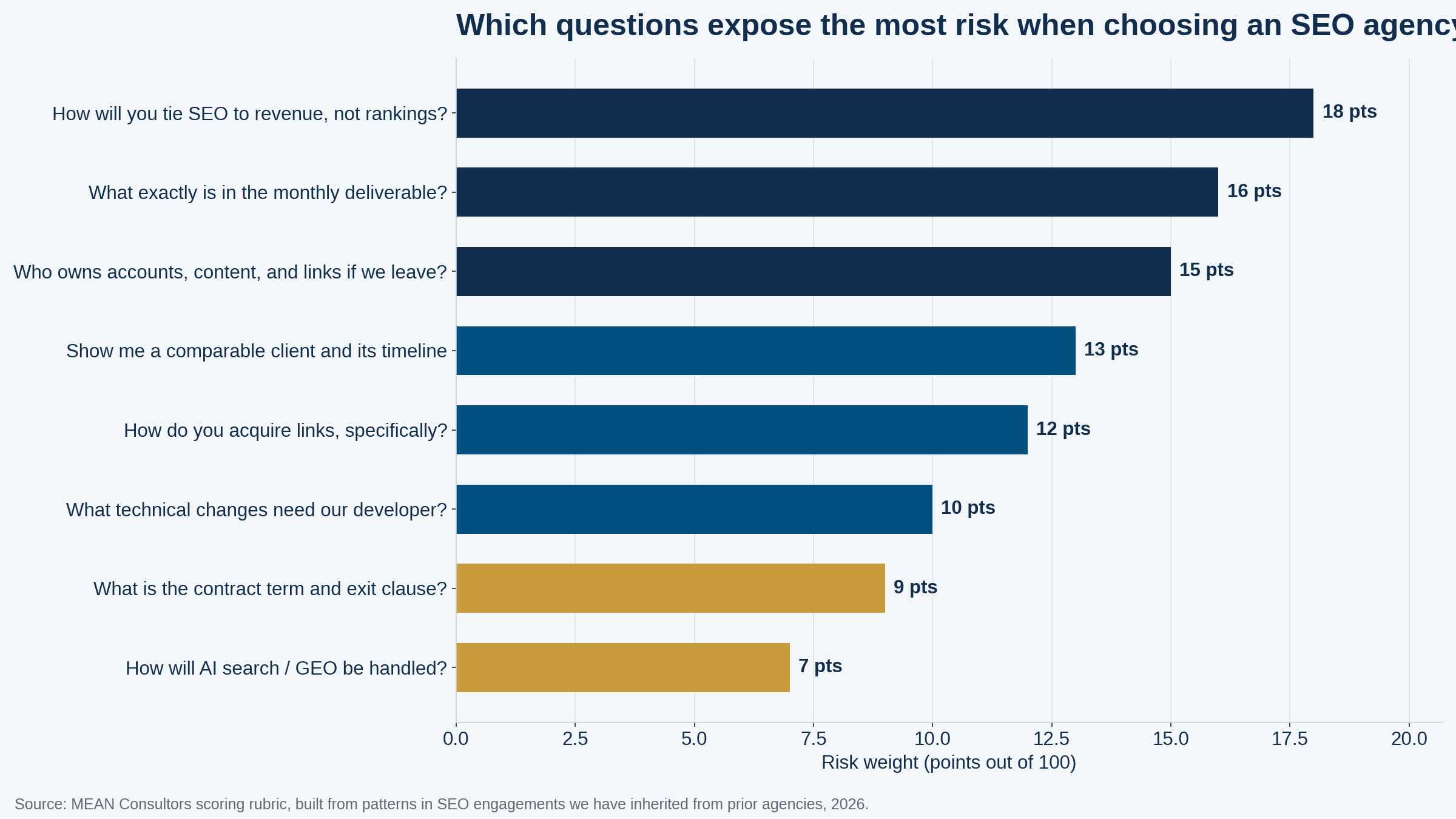
Figure 1: The eight questions in MEAN Consultors’ agency-evaluation rubric, weighted by how strongly a weak answer has predicted a poor engagement.
| Question | A strong answer sounds like | A weak answer sounds like |
|---|---|---|
| 1. How will you tie SEO to revenue? | “We set up lead and call tracking in month one and report qualified leads by landing page.” | “We’ll get you to page one for your main keywords.” |
| 2. What is in the monthly deliverable? | A list: X pages optimized, Y articles, Z technical tickets, a call with a named strategist. | “Ongoing optimization and monitoring.” |
| 3. Who owns what if we leave? | “You own everything. Accounts are under your Google login from day one.” | “Content stays with us; we can license it.” |
| 4. Show me a comparable client | A similar-size business, its starting point, and what changed over 6–12 months. | Logos of large brands with no detail. |
| 5. How do you acquire links? | Digital PR, partner and supplier pages, resource outreach, with examples. | “We have a network.” |
| 6. What needs our developer? | A scoped list from the audit with effort estimates. | “We handle everything.” (on a custom-coded site) |
| 7. Term and exit? | 6–12 months, 30-day exit after month six, full handover documented. | 24 months, auto-renew, early-termination fee. |
| 8. AI search / GEO? | Specific: structured data, answer formatting, tracking AI referrals. | “Google is Google.” |
- The three highest-weighted questions (revenue linkage, deliverables, ownership) account for 49 of 100 points because each one, if answered badly, has cost clients real money in engagements we inherited.
- Specificity is the tell. Strong agencies answer with lists, names, and numbers; weak ones answer with adjectives.
- The contract term itself is less important than the exit clause and the handover obligations attached to it.
Question 1: How will you connect the work to revenue?
Rankings are an input, not an outcome. An agency that reports only positions is asking you to trust that positions turn into customers. Ask instead how they will measure qualified leads, phone calls, form fills, and (for e-commerce) assisted revenue from organic traffic, and how they will attribute those to specific pages and changes. The answer should involve call tracking, form event tracking, and Search Console data joined to your CRM or analytics. We wrote about the metrics that matter in our guide to setting SEO KPIs beyond rankings; if the agency’s reporting sample looks nothing like that, keep looking.
Question 2: What, exactly, do I receive each month?
“Ongoing optimization” is not a deliverable. A good proposal lists what happens in month one (audit, tracking setup, keyword and competitor research), what happens monthly afterward (a number of pages optimized, articles written, technical fixes shipped, links earned), and who does it. Ask whether the strategist on the sales call is the person who will work on your account, and how many other accounts that person manages. Ask what the report will contain and request a redacted sample. Our post on SEO reporting for clients and executives describes what a useful one looks like.
Question 3: Who owns the assets when we part ways?
This is the question most business owners forget, and it is the one that hurts most later. Three things must be yours: the Google accounts (Search Console, Analytics, Business Profile, Tag Manager) created under your organization’s login with the agency as a user; the content, with copyright assigned to you in the contract; and any links, meaning the agency must not use redirect domains or link networks it controls that can be switched off when you leave. Also ask about hosting and DNS if the agency touches them. If the answer to any of these is “we retain,” the price is not really the price.
- All Google properties are owned by your organization; agency is added as a user, not the owner
- Contract assigns full copyright of delivered content to you on payment
- No redirect domains, PBNs, or agency-controlled link sources
- Written handover obligation: passwords, documentation, open tickets within 14 days of termination
- No exclusivity clause preventing you from hiring another vendor for adjacent work
Questions 4 and 5: Proof and link building
Ask for a client that looks like you: similar size, similar market, similar starting point. You want to hear where they were, what the agency changed, and how long it took, with permission to speak to that client. Large logos with no story are marketing, not evidence.
On links, the honest answer is a method, not a promise. Legitimate approaches include digital PR, industry directories, supplier and partner pages, local sponsorships, and content that earns citations. Google’s spam policies are explicit that buying or exchanging links to manipulate rankings violates its guidelines and can lead to manual actions. An agency that cannot or will not describe where links come from is describing a risk you will inherit. Our overview of link building in 2026 covers what still works.
Question 6: What will need my developer?
Many SEO recommendations are development tasks: fixing render-blocking scripts, restructuring URLs, adding structured data, improving Core Web Vitals. On a WordPress site with a good theme, an agency can often do these itself. On a custom-coded or headless site, it cannot, and the retainer quietly stops covering the most important work. Ask for the technical findings from the audit as a scoped list with effort estimates, and ask who implements each one. If you do not have in-house development, this is where an agency with a real web development team earns its fee.
Questions 7 and 8: The contract, and the future
Six to twelve months is a fair term; organic results rarely show clearly before month four. What matters more is the exit: a 30-day termination right after an initial period, no auto-renewal without written consent, and a documented handover. Read the indemnity and liability clauses; you should not be indemnifying the agency for its own link-building choices.
Finally, ask how the agency thinks about AI search. Google states in its helpful content guidance that reliable, people-first content is the foundation for both traditional results and AI features, so an agency that dismisses the question entirely is behind. A good answer mentions structured data, direct-answer formatting, and tracking referrals from AI engines. Our explainer on GEO versus traditional SEO is a fair benchmark for what they should know.
From first call to signed contract
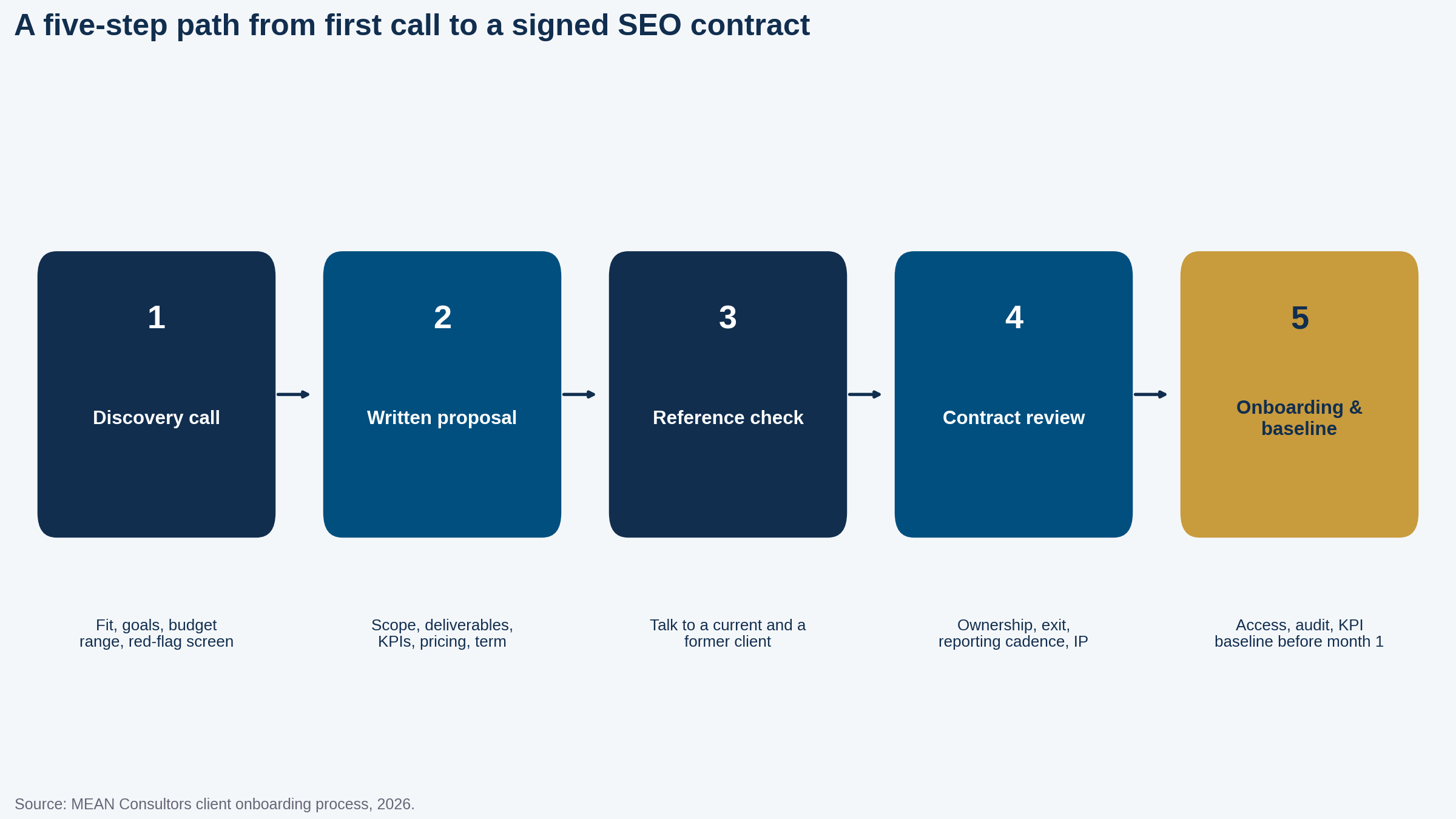
Figure 2: The five steps MEAN Consultors recommends between a first agency conversation and a signed SEO contract.
Give the process the time it deserves. Two or three discovery calls, written proposals you can compare side by side against your baseline audit, one current and one former client reference, and a contract review focused on ownership and exit will take three to four weeks. That is a small delay against a twelve-month commitment, and it is the difference between hiring a partner and buying a PDF.
Frequently Asked Questions
What questions should I ask an SEO agency before hiring them?
Ask how they will connect SEO work to revenue rather than rankings, exactly what is delivered each month, who owns the content, links, and accounts if you leave, how they acquire backlinks, what technical changes will require your developer, what the contract term and exit terms are, and how they handle AI search. The answers matter less than whether the agency can answer specifically.
How long should an SEO contract be?
Six to twelve months is typical and reasonable, because organic results usually take four to six months to show clearly. Be cautious with contracts longer than twelve months that lack a performance-based exit, and with month-to-month arrangements that let an agency avoid committing to any measurable outcome.
What is a red flag when choosing an SEO agency?
The clearest red flags are guaranteed rankings, refusal to explain link-building methods, reports that only show keyword positions, a claimed special relationship with Google, and contracts where the agency keeps ownership of content or Google accounts. Google itself warns that no one can guarantee a number-one ranking.
Should an SEO agency own my Google Search Console and Analytics accounts?
No. You should own every Google property, with the agency added as a user. If an agency insists on creating accounts under its own login, treat it as a deal-breaker; losing access to years of Search Console data when you switch providers is a real and common cost.
How much does hiring an SEO agency cost?
U.S. agencies serving small and mid-size businesses commonly charge monthly retainers that range from around $1,500 to $10,000 or more depending on scope, market competitiveness, and whether content production is included. Rather than anchoring on the number, ask what the retainer buys each month and how that maps to your KPIs.
Do I need an SEO audit before choosing an agency?
It helps considerably. A baseline audit tells you what your site actually needs, lets you compare proposals against a real list of problems rather than a generic pitch, and gives you a benchmark to measure the agency against. You can run a basic one yourself before taking sales calls.
MEAN Consultors’ SEO engagements come with a scoped deliverable list, client-owned accounts, and revenue-based reporting from month one.