
AI Chatbots vs. Traditional Chatbots: What’s Actually Different in 2026
Last updated: July 21, 2026 · By Joseph Olivas, Founder, MEAN Consultors · 8 min read
“We already have a chatbot” is one of the most common things I hear when businesses ask about AI. Usually what they have is a rules-based bot from a few years ago that frustrates customers into typing “agent” as fast as possible. The technology underneath chatbots changed fundamentally with large language models, and the difference is not cosmetic. Here is what actually separates an AI chatbot from a traditional one in 2026 — and how to tell which one you need.
The Core Difference: Rules vs. Understanding
A traditional chatbot is a decision tree. It matches your message against a list of keywords or buttons and returns a pre-written response. If your question was anticipated by whoever built the flow, it works; if you phrase it unexpectedly or ask something off-script, it fails or loops. An AI chatbot, by contrast, runs on a large language model that interprets the intent behind your words, remembers earlier turns in the conversation, and can compose a relevant answer even for a question no one scripted. That single shift — from pattern-matching to language understanding — is what makes modern bots feel like they are actually listening. If you are weighing where this fits in your operations, our AI automation services start with exactly this question.
The Numbers: Why Resolution Rate Is the Real Story
The headline metric for any customer-facing bot is how many conversations it finishes without handing off to a human. This is where traditional and AI chatbots diverge dramatically. Gartner has noted that traditional self-service channels fully resolve only about 14% of issues, while AI-native platforms are achieving 55–70% first-contact resolution, and companies using AI for tier-1 support resolve roughly 65% of issues without human intervention.
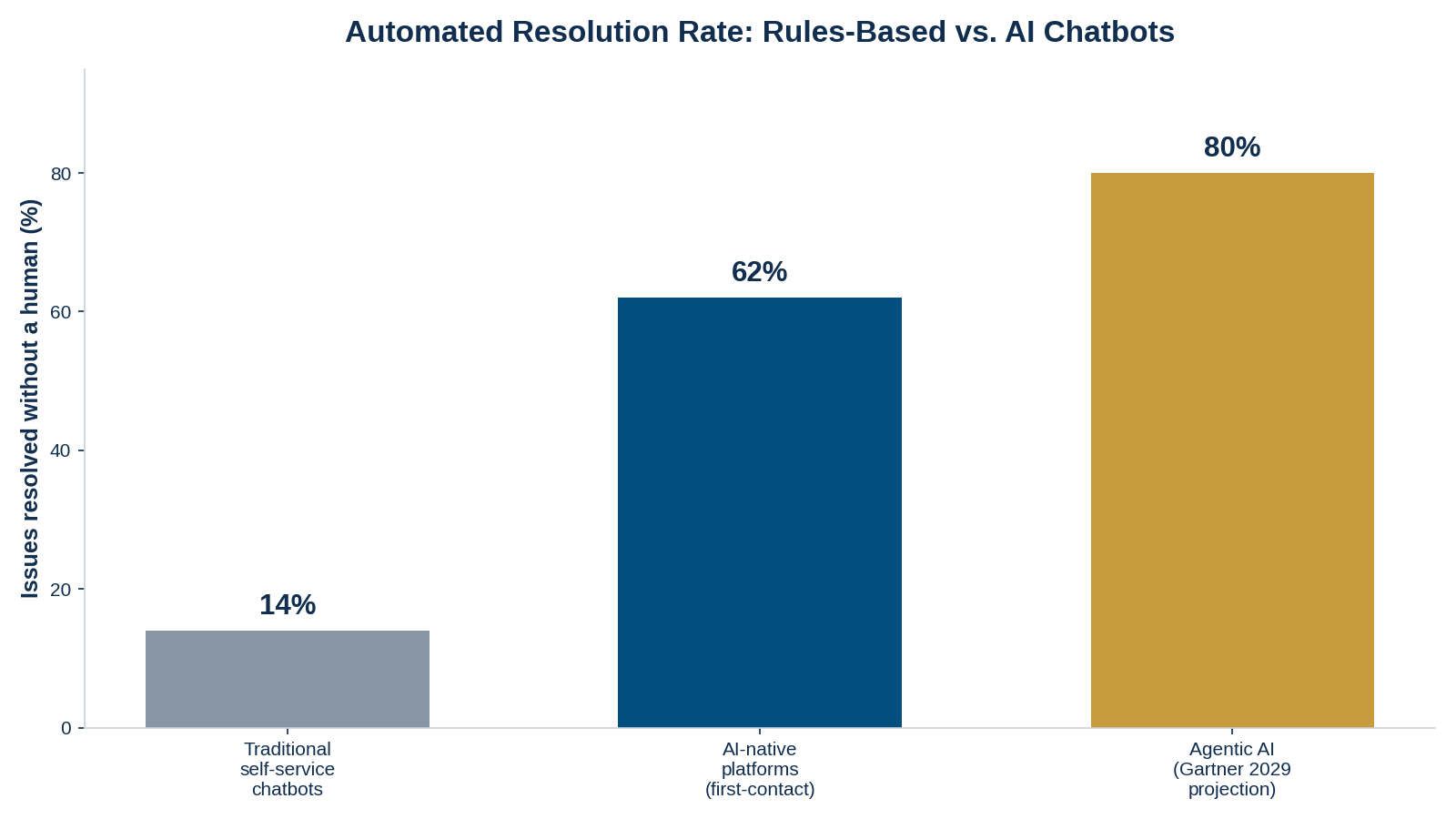
Figure 1: Automated resolution rates rise sharply from rules-based bots to AI-native and agentic systems (Gartner).
- Traditional self-service resolves only ~14% of issues on its own — the rest escalate to humans.
- AI-native chatbot platforms reach 55–70% first-contact resolution today.
- Gartner projects agentic AI will resolve about 80% of common customer service issues by 2029.
The financial implication is why executives care. Gartner has estimated conversational AI will reduce contact center labor costs by roughly $80 billion in 2026. For a small or mid-size business, the same math scales down but still matters: every conversation the bot finishes correctly is a support ticket your team never has to touch.
Side-by-Side: What Each Type Can and Can’t Do
The table below is the comparison I walk clients through when they are deciding whether to upgrade an existing bot or start fresh.
| Capability | Traditional (rules-based) | AI chatbot (LLM-powered) |
|---|---|---|
| Understands unscripted phrasing | No — keyword/button match only | Yes — interprets intent |
| Remembers conversation context | Limited or none | Yes — multi-turn memory |
| Handles questions it wasn’t built for | No | Often, via reasoning over your content |
| Setup effort | Manual flow-building | Trained on your docs/knowledge base |
| Ongoing maintenance | Edit every flow by hand | Update source content; model adapts |
| Risk of wrong answers | Low but rigid | Needs guardrails to prevent hallucination |
Where Traditional Bots Still Make Sense
AI is not automatically the answer. A rules-based bot is genuinely fine — sometimes better — for narrow, high-stakes, or fully predictable interactions. If your bot only needs to check an order status, book an appointment, or route a caller to the right department, a deterministic flow is cheaper, faster, and carries zero risk of an off-script answer. The complexity and cost of an AI chatbot only pay off when customers ask varied, open-ended questions that a decision tree can’t anticipate.
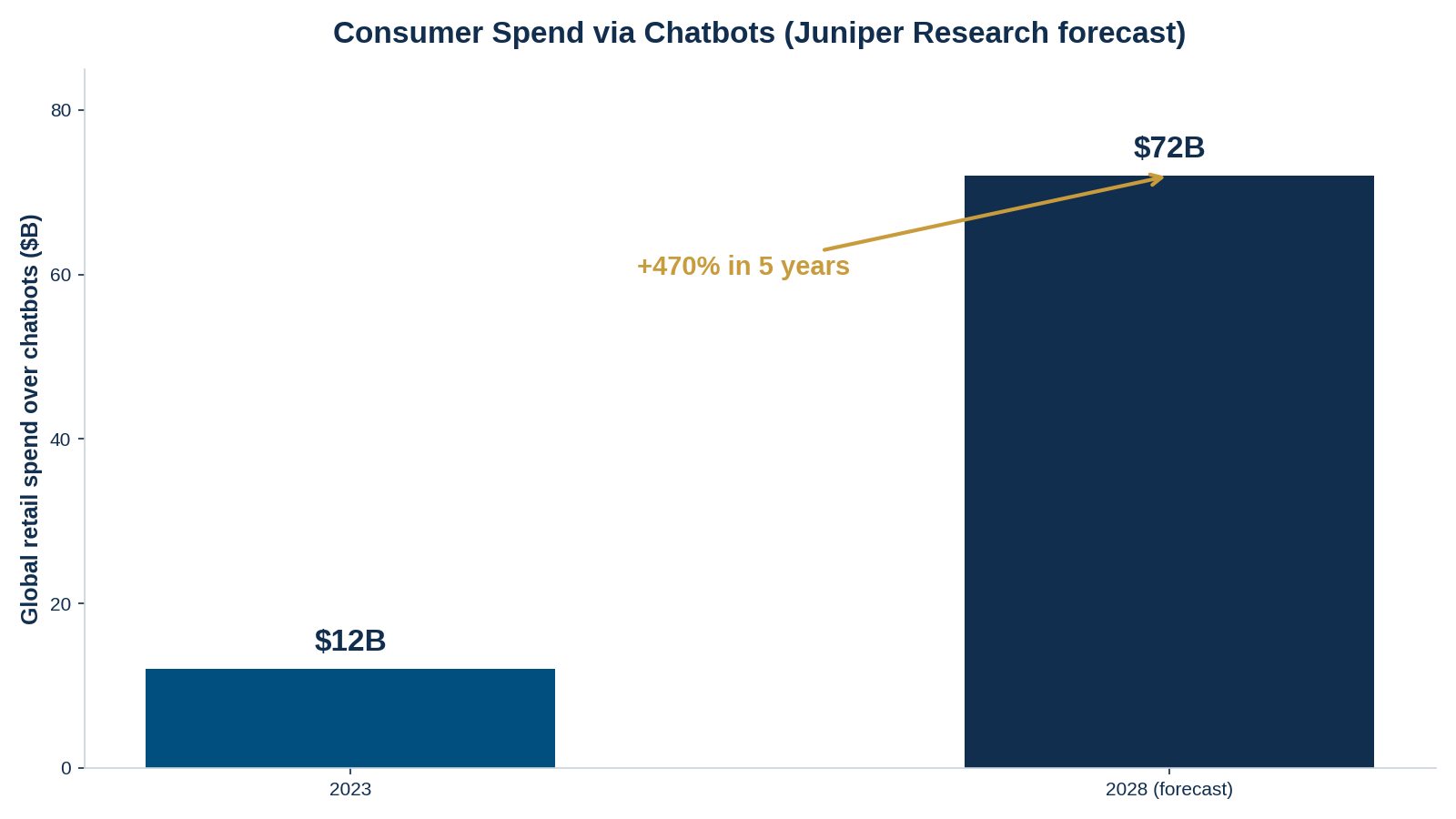
Figure 2: Consumer spend transacted over chatbots is forecast to grow roughly 470% from 2023 to 2028 (Juniper Research).
The market momentum is real, though. Juniper Research forecasts global retail spend transacted over chatbots will climb from about $12 billion in 2023 to $72 billion by 2028 — a roughly 470% increase — driven largely by more capable, cost-effective language models. The direction of travel is clearly toward AI, but that is a reason to implement it well, not a reason to bolt it onto everything.
How to Decide Which One You Need
- Do customers ask varied, open-ended questions, or a short list of predictable ones?
- Do you have solid documentation (FAQs, policies, product info) an AI bot could learn from?
- How costly is a wrong or made-up answer in your industry — inconvenient, or dangerous?
- What share of your current support volume is repetitive tier-1 questions?
- Do you have a clean way to escalate to a human when the bot is unsure?
If your customers ask a wide range of questions, you have decent documentation, and a lot of your volume is repetitive, an AI chatbot will likely pay for itself quickly. If your interactions are narrow and fully predictable, or a wrong answer carries real risk, a well-built traditional flow — or a hybrid that uses rules for transactions and AI for open questions — is the smarter starting point. Chatbots are only one slice of a broader shift; if you want the wider picture, see how they relate to other automation in our overview of AI-driven business automation.
What a Well-Built AI Chatbot Actually Requires
The reason two businesses can deploy “an AI chatbot” and get wildly different results comes down to implementation, not the underlying model. The single biggest factor is grounding. A raw language model will happily invent a return policy that sounds plausible; a properly built bot uses retrieval-augmented generation to pull answers from your actual policies, product data, and help articles before responding. That is the difference between a bot that reassures customers and one that quietly creates support tickets and refund disputes.
The second factor is escalation design. A good AI chatbot knows when it does not know — and hands the conversation to a human cleanly, with the context already captured, rather than looping or guessing. The third is measurement. You should be able to see resolution rate, escalation rate, and which questions the bot handles poorly, then feed that back into the source content. A bot you cannot measure is a bot you cannot improve.
None of this is exotic, but all of it takes deliberate setup. When clients tell me their previous AI chatbot “didn’t work,” it is almost never the model — it is a bot that was pointed at the open internet instead of the company’s own knowledge, with no escalation path and no analytics. Getting those three fundamentals right is what turns the resolution-rate numbers above from a vendor claim into something you actually see in your own support queue.
Frequently Asked Questions
What is the main difference between an AI chatbot and a traditional chatbot?
A traditional chatbot follows scripted rules and decision trees, so it can only answer questions it was explicitly programmed for. An AI chatbot uses a large language model to understand the intent behind a message, remember conversation context, and generate answers to questions it was never directly scripted for.
Are AI chatbots better than rule-based chatbots?
For varied, open-ended customer questions, yes — AI chatbots resolve far more conversations without a human (55–70% first-contact resolution versus about 14% for traditional self-service). But for narrow, predictable, or high-stakes tasks, a rule-based bot can be cheaper and safer because it never goes off-script.
Can AI chatbots give wrong answers?
Yes. Because they generate language, AI chatbots can “hallucinate” confident but incorrect answers if they aren’t grounded in your real content. Proper implementation uses retrieval-augmented generation to tie answers to your documented information and clear escalation rules for when the bot is unsure.
Do I need to replace my existing chatbot to use AI?
Not always. Many businesses keep deterministic flows for transactions like order status or booking, and add an AI layer for open-ended questions. A hybrid setup often delivers the best mix of reliability and coverage without discarding what already works.
How much can an AI chatbot save my business?
It depends on volume, but the mechanism is simple: every repetitive question the bot resolves is a ticket your team never handles. Gartner estimates conversational AI will cut contact center labor costs by roughly $80 billion in 2026 industry-wide; for a small business the savings scale down but the per-ticket logic is the same.
MEAN Consultors designs grounded, well-guardrailed AI chatbots — or the right hybrid — so automation actually resolves issues instead of frustrating customers.