
AI Bias and Fairness: What Business Leaders Should Understand
Last updated: August 24, 2026 · By Joseph Olivas, Founder, MEAN Consultors · 9 min read
When business owners hear “AI bias,” many file it under big-tech problems — something for Google’s ethicists to argue about. That’s a mistake I try to correct early in every AI engagement. If you use an AI tool to screen résumés, score leads, approve financing, set prices, or route customer service, bias is your operational and legal risk the moment those decisions touch real people. You don’t need a data science degree to manage it. You need to understand where bias comes from, what it costs when ignored, and the handful of controls that catch most of it. That’s what this guide covers.
What AI Bias Actually Is (Without the Jargon)
An AI model learns patterns from historical data and reproduces them. Bias, in the practical business sense, is when those reproduced patterns systematically disadvantage a group — by race, sex, age, ZIP code, disability, or any characteristic that shouldn’t drive the decision. The critical insight for leaders: the model doesn’t need to be told about protected characteristics to discriminate on them. Proxies do the work. ZIP code correlates with race. Employment gaps correlate with parenthood and disability. A model optimizing purely for “similar to past successful hires” can quietly encode every bias those past decisions contained.
This is why “we don’t collect race data, so we can’t be biased” — a line I’ve heard from more than one vendor — is a red flag rather than a reassurance. The U.S. Federal Trade Commission made the stakes plain in its guidance on AI: companies are accountable for discriminatory outcomes of the algorithms they use, and “our vendor built it” is not a defense. Under existing law — the FTC Act, the Fair Credit Reporting Act, the Equal Credit Opportunity Act — the business deploying the model owns the outcome.
Where Bias Enters: The Four Doorways
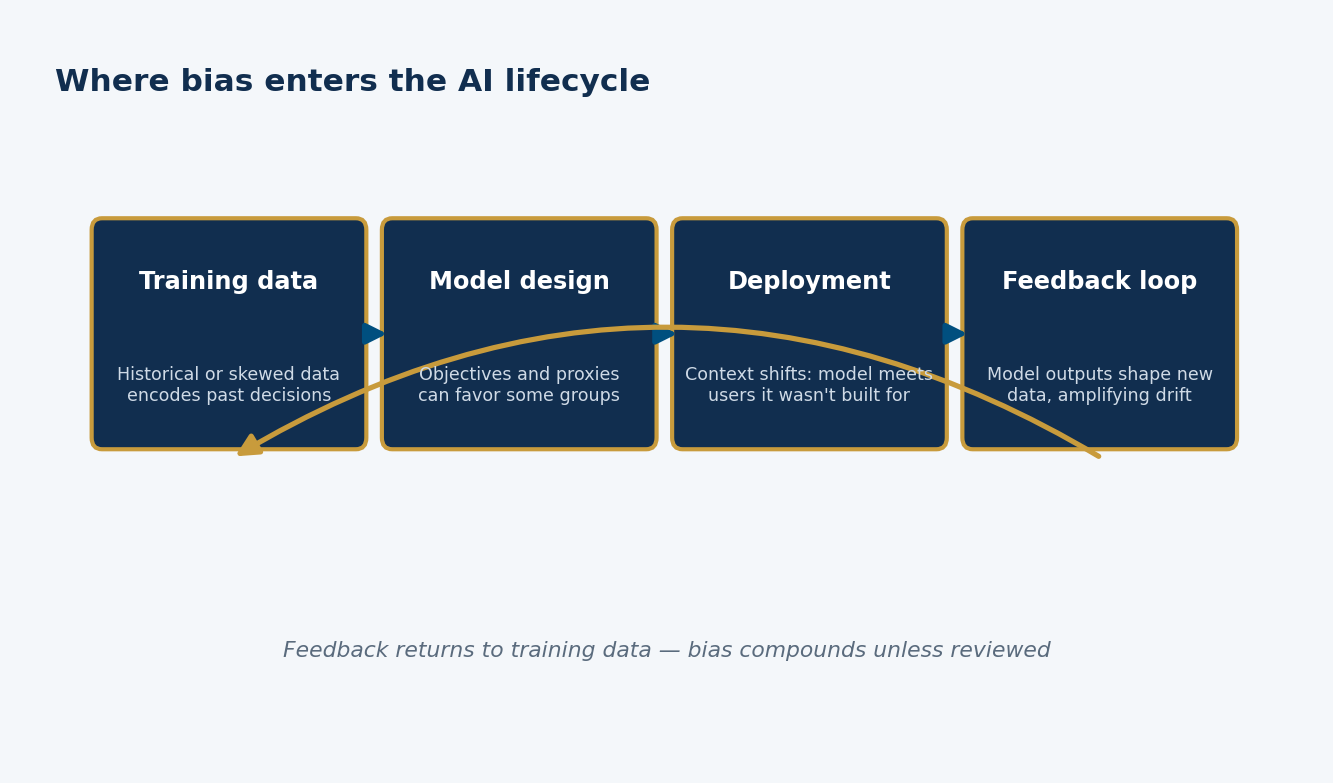
Figure 1: Bias enters at four points in the AI lifecycle — and the feedback loop compounds it unless reviewed.
Training data. The most common doorway. If a lending dataset reflects decades of uneven approvals, a model trained on it learns those approvals as ground truth. Skewed samples matter too: a support chatbot trained mostly on one dialect of English will serve other customers worse.
Model design. What the model is told to optimize shapes who it favors. A hiring model optimizing “likelihood of two-year retention” may penalize groups with historically higher turnover for reasons — like inflexible schedules — the business itself caused.
Deployment context. A model validated on one population meets another. A pricing model tuned on national data may behave very differently in your specific market. Context shift is why vendor benchmarks never substitute for testing on your own customers.
Feedback loops. The quietest doorway. Model outputs shape new data — the leads it scores highly get the follow-up calls, which “proves” they were the best leads — and yesterday’s tilt becomes tomorrow’s training data. Without periodic review, bias compounds.
- AI bias is a business liability under existing U.S. law — the FTC has stated plainly that companies own the outcomes of the algorithms they deploy, vendor-built or not.
- Bias enters through four doorways: training data, model design, deployment context, and feedback loops — and models discriminate through proxies even when protected attributes are never collected.
- The practical controls are vendor due diligence, outcome testing on your own customer data, human review of high-impact decisions, and a recurring audit cadence anchored to the NIST AI RMF.
What It Costs When It Goes Wrong
The risk shows up on four ledgers. Legal exposure: discrimination claims in hiring, credit, housing, and insurance carry statutory penalties, and regulators have signaled that “the algorithm did it” invites more scrutiny, not less. Regulatory action: the FTC has required companies to delete models built on improperly obtained or misused data — meaning the AI investment itself can be forfeit. Customer trust: biased outcomes that surface publicly — and they do surface — damage a small brand far faster than a large one. And decision quality: this one is underrated. A biased model is a wrong model. If your lead scoring systematically undervalues a customer segment, you’re not just being unfair — you’re leaving revenue on the table in a market your competitors can serve.
For small and mid-size businesses the exposure is concentrated in tools you buy rather than build, which makes procurement your main control point. The diligence questions belong in the same conversation as security and data handling — we covered the security half in our guide to vetting AI vendors for SOC 2 compliance, and the data half in data privacy when using AI tools.
The Controls: What Leaders Should Actually Do
You don’t audit the algorithm; you audit the outcomes and the vendor. Here’s the working checklist we implement with clients of our AI & automation practice:
- Ask every AI vendor: What data was this trained on? How do you test for disparate outcomes? Can we see fairness testing results for a population like ours?
- Before launch, run the tool on a sample of your own historical data and compare outcomes across customer segments you can observe.
- Keep a human decision-maker on every high-impact call — hiring, credit, pricing exceptions — with real authority to override the model.
- Log AI-assisted decisions so outcomes can be audited by segment later; you can’t review what you didn’t record.
- Assign an owner. Fairness reviews that belong to everyone belong to no one.
- Anchor the whole program to the NIST AI Risk Management Framework — it’s free, voluntary, and gives you defensible structure without enterprise overhead.
Then put the reviews on a calendar. A one-time fairness check decays for the same reason the feedback loop compounds — the model and your customer base both drift:
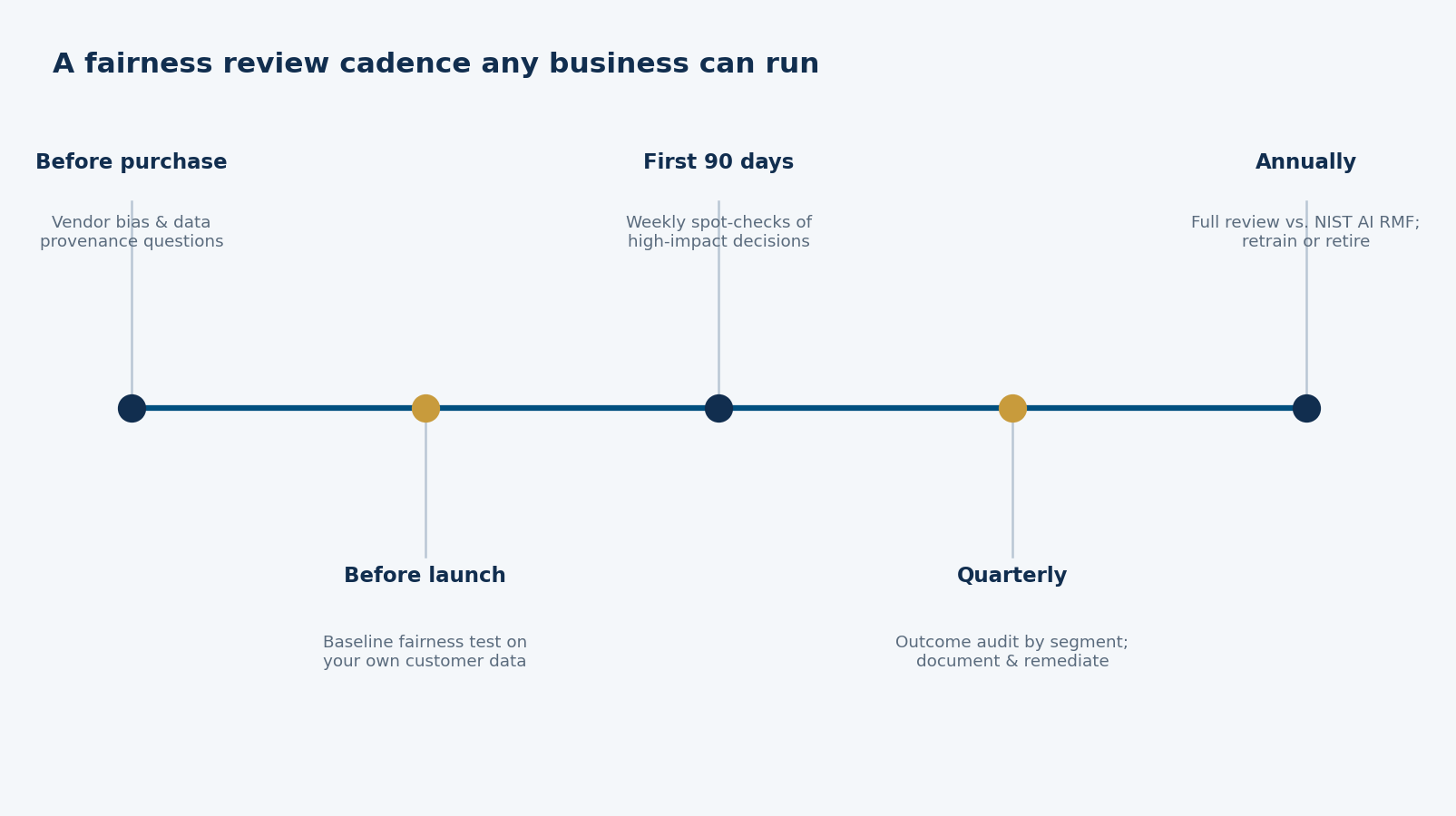
Figure 2: A fairness review cadence any business can run — from pre-purchase diligence through annual review.
A Note on “Perfectly Fair” — It Doesn’t Exist
One thing leaders should know going in: researchers have shown that several reasonable mathematical definitions of fairness cannot all be satisfied at once. Equalizing approval rates across groups, equalizing error rates, and calibrating scores identically are, in most real cases, mutually exclusive goals. This isn’t a reason for paralysis — it’s a reason the decision is a business judgment, not a technical setting. Your job isn’t to buy a “bias-free” tool (be suspicious of anyone selling one); it’s to decide which fairness standard matters for each decision you automate, document that choice, and test against it. Documented, reasoned choices are also precisely what regulators and courts look for when outcomes are questioned.
Frequently Asked Questions
What is AI bias in simple terms?
AI bias is when an automated system produces systematically worse outcomes for certain groups of people — for example, a résumé screener that ranks women lower or a pricing model that charges certain neighborhoods more. It usually comes from patterns in historical training data, and it can happen even when the system never sees race, sex, or age directly, because other variables act as proxies.
Is my business legally liable for a biased AI tool we bought from a vendor?
In the U.S., generally yes. The FTC and other regulators have made clear that businesses are accountable for the outcomes of algorithms they deploy, regardless of who built them. Anti-discrimination laws in hiring, credit, and housing apply to the decision, not the method. Vendor contracts can allocate some financial risk, but they don’t transfer your legal accountability.
How do I test an AI tool for bias without a data science team?
Run the tool on a sample of your own historical data and compare outcomes across observable customer or applicant segments. Large gaps are a signal to investigate, not proof of illegal bias — but they’re exactly what a regulator would ask about. Demand fairness testing documentation from your vendor, and consider a third-party review for high-stakes uses like hiring or lending.
What is the NIST AI Risk Management Framework?
The NIST AI RMF is a free, voluntary framework from the U.S. National Institute of Standards and Technology that helps organizations govern AI risk through four functions: Govern, Map, Measure, and Manage. It’s become the de facto reference for reasonable AI governance in the U.S., and anchoring your review process to it gives a small business defensible structure without enterprise cost.
Does using AI for hiring or lending mean I’ll face more regulation?
Those are the highest-scrutiny use cases. Hiring tools can trigger EEOC attention and local laws like New York City’s automated employment decision rules; credit decisions fall under ECOA and FCRA. If you automate either, budget for bias audits, candidate/applicant notices where required, and human review — and get vendor commitments on fairness testing in writing.
MEAN Consultors helps businesses deploy AI and automation with governance, fairness testing, and vendor diligence built in from day one.