
Website Development for Professional Services Firms: What Converts Clients
Last updated: September 1, 2026 · By Joseph Olivas, Founder, MEAN Consultors · 9 min read
I have rebuilt sites for law firms, accounting practices, consultancies, and engineering firms, and the pattern is consistent: the site is almost never the first touch, but it is almost always the deciding one. A partner gets recommended at a conference. A CFO gets three names from a peer. Nobody hires on the strength of the referral alone — they go look. What happens in the next two minutes on your website is what decides whether the referral converts or quietly dies.
Why the website decides, even when the referral came first
The instinct in professional services is that relationships close business and websites are a formality. That was true when the alternative to looking you up was calling your office. It is not true now.
The Hinge Research Institute surveyed 1,028 buyers of professional services — accounting, legal, marketing, technology, management consulting, and engineering firms — about how they check out a potential provider. The firm’s own website was the most-used channel, ahead of search, ahead of asking colleagues, and ahead of speaking to references. Buyers used 3.2 different methods on average, which means the website is not competing with the referral; it is the place the referral gets verified.
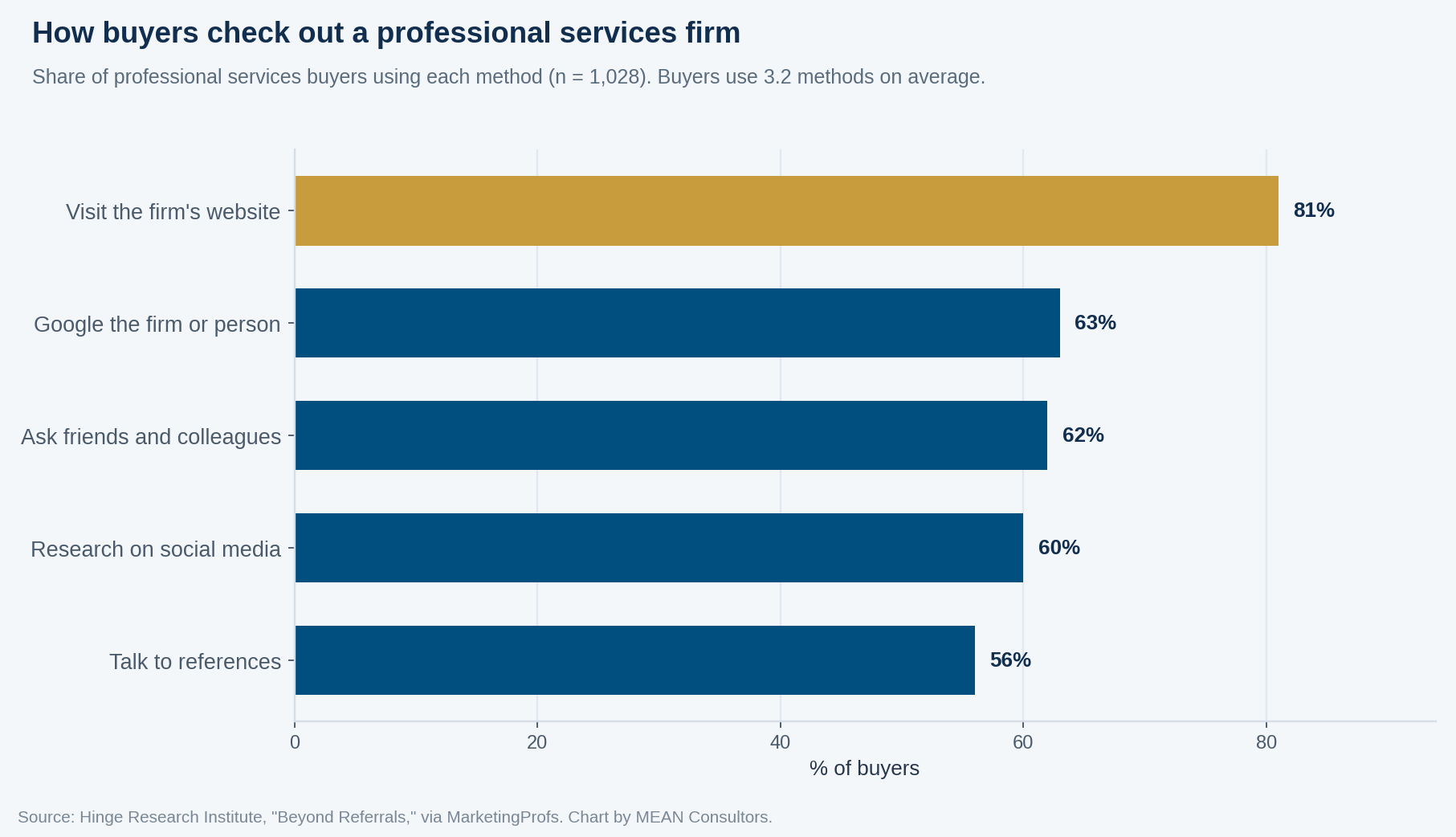
Figure 1: How buyers check out professional services providers. Data: Hinge Research Institute, “Beyond Referrals” (n = 1,028), via MarketingProfs.
The uncomfortable implication is that a weak website does not simply fail to generate leads. It actively destroys leads that other parts of the firm already earned. A partner spends two years building a relationship that produces a referral, and a 2014-era site with a stock photo of a handshake undoes it in ninety seconds. That is why I treat professional services work as a web development problem and a positioning problem at the same time — the build is straightforward, but the decisions about what goes on the page are the whole game.
- 81% of professional services buyers go to the firm’s website when evaluating a provider — more than any other single channel (Hinge, n = 1,028).
- 63% also search for the firm by name, so brand search results and the website work as a pair, not as alternatives.
- Buyers use 3.2 research methods on average, meaning the website is where a referral gets confirmed or quietly abandoned.
The four jobs a professional services site has to do
Product websites can convert on specification and price. Professional services websites cannot, because the buyer is purchasing judgment they cannot inspect in advance. Everything on the page is a proxy for “can I trust these people with something that matters?”
When I map an engagement, I lay the site out against the sequence the buyer actually moves through rather than the sequence the firm wants to talk in. It looks like this.
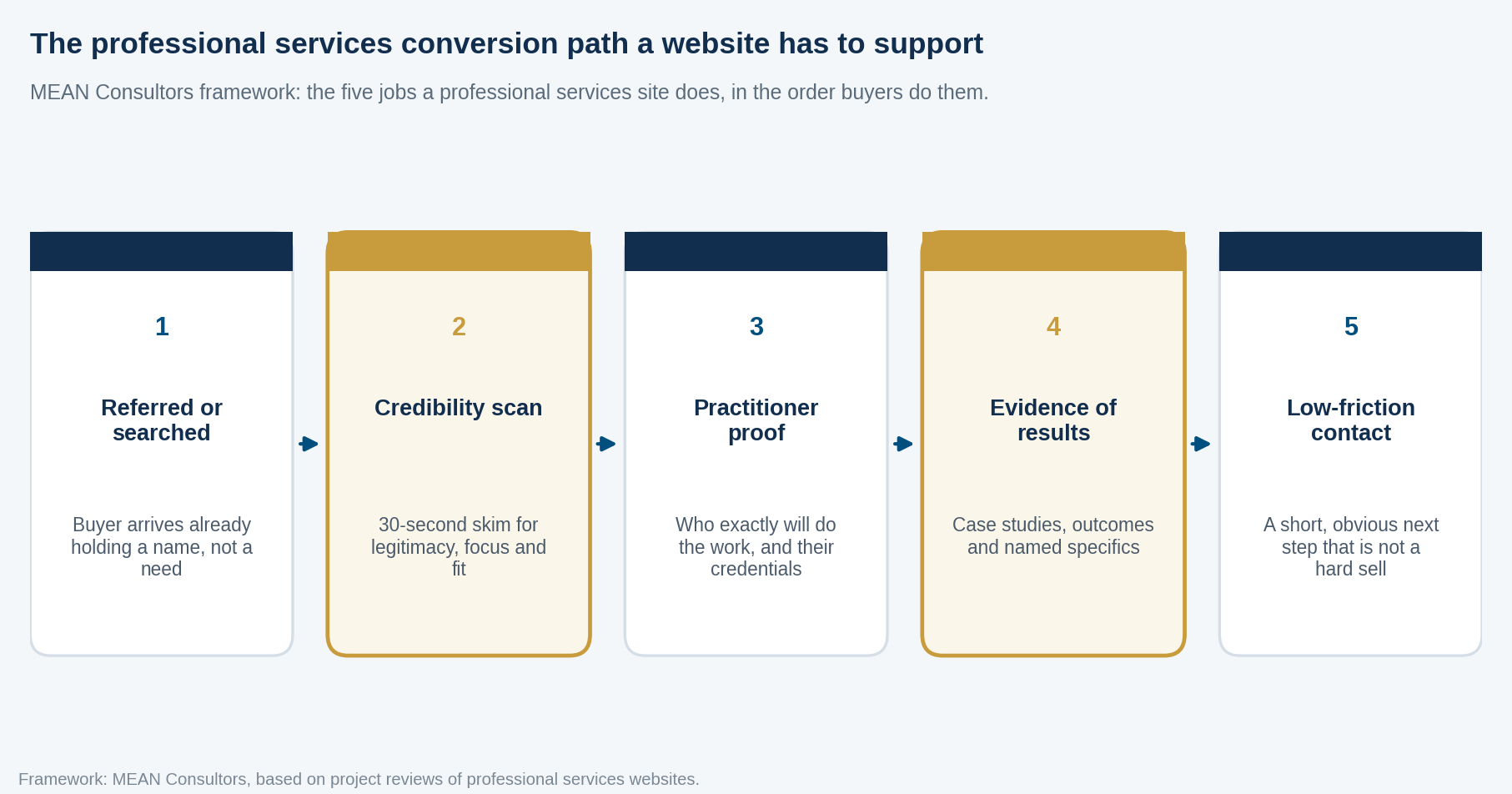
Figure 2: The five jobs a professional services website performs, in the order buyers perform them. The credibility scan and the evidence step are where most firms lose the deal.
1. Survive the credibility scan
The first pass is not reading, it is triage. The prospect is deciding whether this firm is legitimate, current, and plausibly in their league. Design carries most of this weight, which is why I resist the framing that design is decoration: a site that renders badly on a phone, loads slowly, or looks like it was last touched in 2016 fails before a single sentence gets read. The mechanics of that first impression — layout, load time, visual hierarchy — are covered in more depth in our guide to designing for trust.
2. Answer “is this for me?” in one sentence
Specificity beats breadth here, which feels wrong to most partners. A firm that says it serves “businesses of all sizes across a wide range of industries” is telling the buyer nothing. A firm that says it handles employment litigation for healthcare employers with 50 to 500 staff is telling one specific buyer that they have found their firm. You will lose some prospects to specificity. You will lose more to vagueness, and you will never know it happened.
3. Show the humans
Professional services buyers are not hiring the firm, they are hiring a person and their team. A referral usually comes attached to a name, and that prospect will look for that name. If your bios are 60-word paragraphs listing bar admissions and graduation years, you have wasted the most-visited pages on the site. Practitioner pages should show what that person actually works on, the kinds of matters or engagements they have handled, and how they think — a short piece of writing under their byline does more than a credential list.
4. Make the next step small
“Request a consultation” is a big ask for someone still deciding whether to shortlist you. Most professional services sites offer exactly one conversion path, at maximum commitment, and then wonder why the form is quiet. Offering a graduated set — a substantive guide, a short assessment, a direct email to a named person, and yes, a consultation — captures the buyers who are close but not ready. Our broader framework on conversion-centered design covers how to structure those paths without cluttering the page.
The page inventory that actually earns its keep
Firms routinely commission thirty-page sites where six pages do the work. Here is how I think about the inventory when scoping a professional services build, and what each page is responsible for.
| Page | The job it does | Where firms get it wrong |
|---|---|---|
| Homepage | Positioning, credibility, routing to the right service | Leads with firm history instead of the buyer’s problem |
| Practice / service pages | Rank for the specific service; convert the informed buyer | Thin, near-duplicate pages with no depth per service |
| Practitioner bios | Convert the referral that arrived with a name attached | Credential lists with no sense of how the person works |
| Case studies / results | Replace adjectives with evidence | Anonymised to the point of meaninglessness, or absent |
| Industry pages | Signal domain fluency to a specific vertical | Written generically, then the industry name swapped in |
| Insight / blog | Demonstrate thinking; capture non-brand search | Published for six months, then abandoned mid-2023 |
| Contact | Remove friction at the moment of intent | A generic form to an unmonitored inbox |
Two of these deserve special attention because they are where the confidentiality problem bites hardest.
Case studies when you cannot name the client
Every professional services firm tells me the same thing: we cannot publish results, our clients are confidential. That constraint is real, and it is also not the obstacle it appears to be. What buyers need is not the client’s name, it is the shape of the problem and the specificity of the response. “A regional healthcare system facing a Department of Labor audit across four states” is anonymous and completely credible. “A client in a regulated industry” is anonymous and completely useless. The detail that builds trust is the situation, not the logo. Get sign-off on the structure of the story once and you can publish for years.
Insight content that a partner will actually maintain
An abandoned blog is worse than no blog: it timestamps your firm as having stopped paying attention. Before committing to a content program, be honest about capacity. Four substantive pieces a year under a named partner’s byline will outperform a weekly cadence that dies in month five. If you want that content to compound rather than sit there, pair it with the structural work described in our guide to SEO for professional services firms.
The technical baseline that is not optional
None of the positioning work matters if the site fails the mechanical checks. This is the list I run before a professional services site goes live.
- Mobile-first, genuinely. A prospect looking you up after a meeting is on a phone. Practitioner bios and practice pages have to be as good on mobile as on desktop, not tolerable.
- Core Web Vitals inside Google’s thresholds. Google’s Search Central documentation treats page experience as part of what makes a page useful; slow professional sites are common and easy to beat.
- Accessible by default. Contrast, keyboard navigation, real headings, alt text. For firms serving public-sector or healthcare clients this is frequently a procurement requirement, not a nicety.
- Structured data on people and organizations. Person and Organization schema on bios and the firm page help search engines connect a named practitioner to the firm.
- HTTPS, a current CMS, and a real backup routine. A compromised law firm site is a client-confidence event, not an IT ticket.
- Analytics that track the right things. Form submissions, phone taps, and guide downloads — not sessions. Sessions do not pay fees.
- Redirect discipline on a rebuild. Practitioner and practice-area URLs accumulate links over a decade. Losing them in a relaunch is the most expensive avoidable mistake in this category.
What to measure once it is live
Professional services firms have long sales cycles and small lead volumes, which makes conventional web analytics misleading. Ten inquiries a month can be an outstanding result if two become engagements. Here is what I ask firms to watch instead of traffic.
Qualified inquiry rate — not total form fills, but inquiries from the kind of client you want. If volume rises and quality falls, the positioning got vaguer, not better. Practitioner page engagement — if bios are among your top-viewed pages, referrals are landing and being checked, which tells you the referral engine is working. Brand search behaviour — people searching your firm name and clicking through is the referral-verification loop made visible; watch it in Search Console. Time from first visit to inquiry — professional services buyers often visit several times over weeks. A site that only measures last-click will misattribute everything.
Set the baseline before launch. The single most common reporting failure I see is a firm that rebuilds, feels good about it, and has no idea whether it worked because nobody recorded what the old site did.
Frequently Asked Questions
How is a professional services website different from a normal business website?
A professional services website is not selling a product with a fixed spec. It is selling judgment, and the buyer cannot inspect judgment before they buy. That changes what the site has to do: instead of describing features, it has to make an intangible service feel concrete and low-risk. In practice that means naming the people who do the work, showing evidence of outcomes, being specific about who you serve, and making the first conversation easy to start. A product site can convert on price and specification. A professional services site converts on credibility.
What should be on a professional services homepage?
Four things, in this order: who you serve and what problem you solve, stated in one sentence a prospect would recognize; proof that you have done it before, ideally with named results; the people who will actually be on the engagement; and a single clear next step. Everything else — awards, history, mission statements — is secondary. If a prospect who was just referred to you cannot answer “is this firm right for my situation?” in thirty seconds, the homepage is not doing its job.
Do professional services firms still need SEO if most work comes from referrals?
Yes, and the Hinge data explains why: 81% of buyers visit the firm’s website and 63% search for the firm by name. Referrals do not remove search from the process, they change what the search is for. A referred prospect Googles you to verify the recommendation. If a competitor outranks you for your own name, or your site looks abandoned, the referral leaks. Beyond that, non-brand search reaches buyers who have no one to ask.
How long should a professional services website take to build?
For a firm with a defined practice and existing content, a well-scoped rebuild typically runs eight to fourteen weeks: discovery and positioning, information architecture, design, build, content, and launch. The variable that stretches timelines is almost never development — it is content and internal approvals. Firms that assign one decision-maker and block time for partner interviews finish near the low end. Firms that route every page through a committee do not.
Should each practice area or attorney have its own page?
Generally yes, if each one represents real demand and you can write something specific about it. Individual practice-area and practitioner pages give you pages that can rank for the specific service a buyer is searching for, and they let a referred prospect land directly on the person they were told about. The failure mode is thin duplication — ten near-identical pages with the city name swapped. If you cannot write 600 substantive words about a practice area, fold it into a parent page instead.
What is the single most common mistake on professional services websites?
Writing about the firm instead of the client’s situation. Most professional services sites open with how long the firm has been in business and how committed it is to excellence. The buyer does not have a “find a committed firm” problem; they have a specific, uncomfortable, expensive problem, and they are scanning for evidence that you have solved it before. Leading with the client’s situation, and then proving you have handled it, outperforms firm-first copy consistently.
MEAN Consultors builds professional services websites that turn a recommendation into a scheduled call — positioning, content structure, and build in one engagement.