
Local Citations That Still Matter in 2026 (And Ones You Can Skip)
Last updated: July 15, 2026 · By Joseph Olivas, Founder, MEAN Consultors · 8 min read
Local citations used to be a numbers game: the more directories you were listed in, the better. That era is over. In 2026, Google cares about whether your business information is consistent and trustworthy across sources that actually matter — not whether you paid a service to spray your name across 300 dead directories. Here is exactly which citations to invest in, which to ignore, and how to clean up the mess if you’ve already done it wrong.
What a local citation actually is in 2026
A local citation is any online mention of your business’s name, address, and phone number — the NAP. It can be a full listing in a directory or a passing mention on another site. Google uses these mentions as corroborating evidence: if dozens of trusted sources all agree on your details, Google is more confident your business is real, located where you say, and worth showing to nearby searchers. That’s why our SEO team treats citations as a trust-and-consistency exercise, not a link-building one. According to BrightLocal’s Local Search Ranking Factors research, citation consistency accounts for roughly 7% of local-pack ranking weight — modest on its own, but it’s foundational: get it wrong and everything above it wobbles.
Which citations still carry weight
Not all citations are created equal. A listing on Google’s own ecosystem is worth far more than a generic web directory nobody visits. Here’s how the sources stack up when it comes to actually influencing local rankings in 2026.
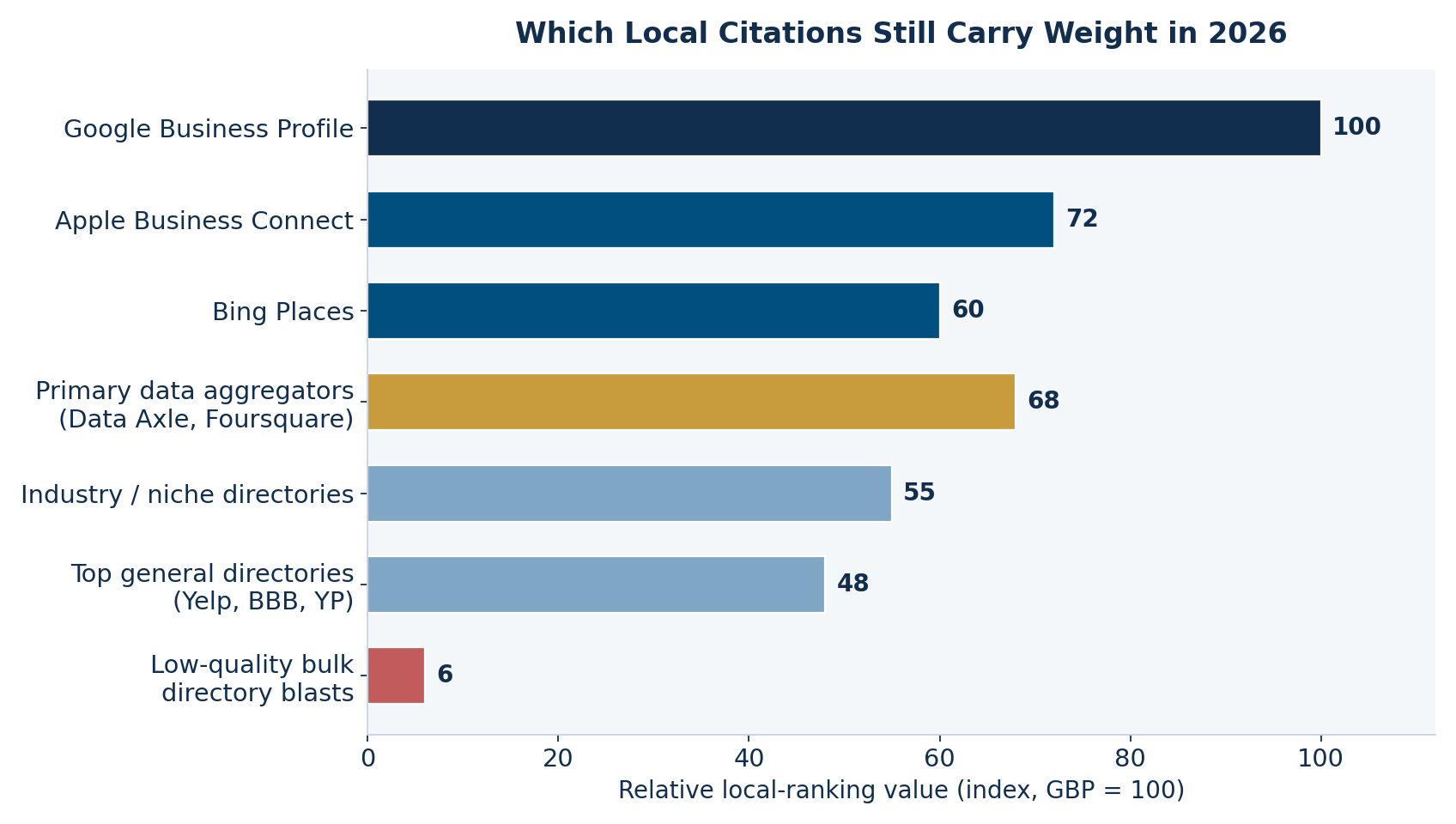
Figure 1: MEAN Consultors’ relative-value index of local citation sources for 2026 (Google Business Profile indexed at 100). Core platforms and aggregators dominate; bulk blasts barely register.
| Priority | Citation source | Why it matters in 2026 |
|---|---|---|
| Essential | Google Business Profile | The single biggest local signal — it is the listing Google shows in the map pack |
| Essential | Apple Business Connect | Powers Apple Maps and Siri; increasingly where iPhone users search locally |
| High | Bing Places | Feeds Bing and, increasingly, AI answer engines pulling from it |
| High | Primary data aggregators (Data Axle, Foursquare) | Syndicate your NAP to hundreds of downstream sites automatically |
| Medium | Industry & niche directories | Relevance signal for your specific vertical and location |
| Skip | Bulk low-quality directory blasts | Little to no ranking value; risk of introducing NAP inconsistencies |
- Your Google Business Profile is the highest-value citation by a wide margin — get it perfect first.
- Apple Business Connect and Bing Places matter more each year as search fragments across platforms and AI engines.
- Feeding the primary data aggregators cleans up dozens of downstream listings in one move.
Which citations you can safely skip
If a directory exists only to sell listings, has no real audience, and doesn’t syndicate to anywhere useful, it isn’t helping you. Worse, cheap bulk citation services often introduce small errors — an abbreviated street, an old phone number, a different business name — and those inconsistencies actively work against you. You can confidently deprioritize or ignore the following.
- “Submit to 500 directories” bulk packages from cheap services.
- Spammy directories with no organic traffic or editorial standards.
- Region-mismatched directories (a UK directory for a Jacksonville business).
- Duplicate listings you’ve accidentally created over the years.
- Any listing you can’t keep accurate and up to date over time.
How to clean up your citations the right way
If your listings are a mess — and most businesses’ are, after years of moves, rebrands, and phone changes — don’t start by adding new ones. Start by fixing what exists. Here’s the process we run for clients.
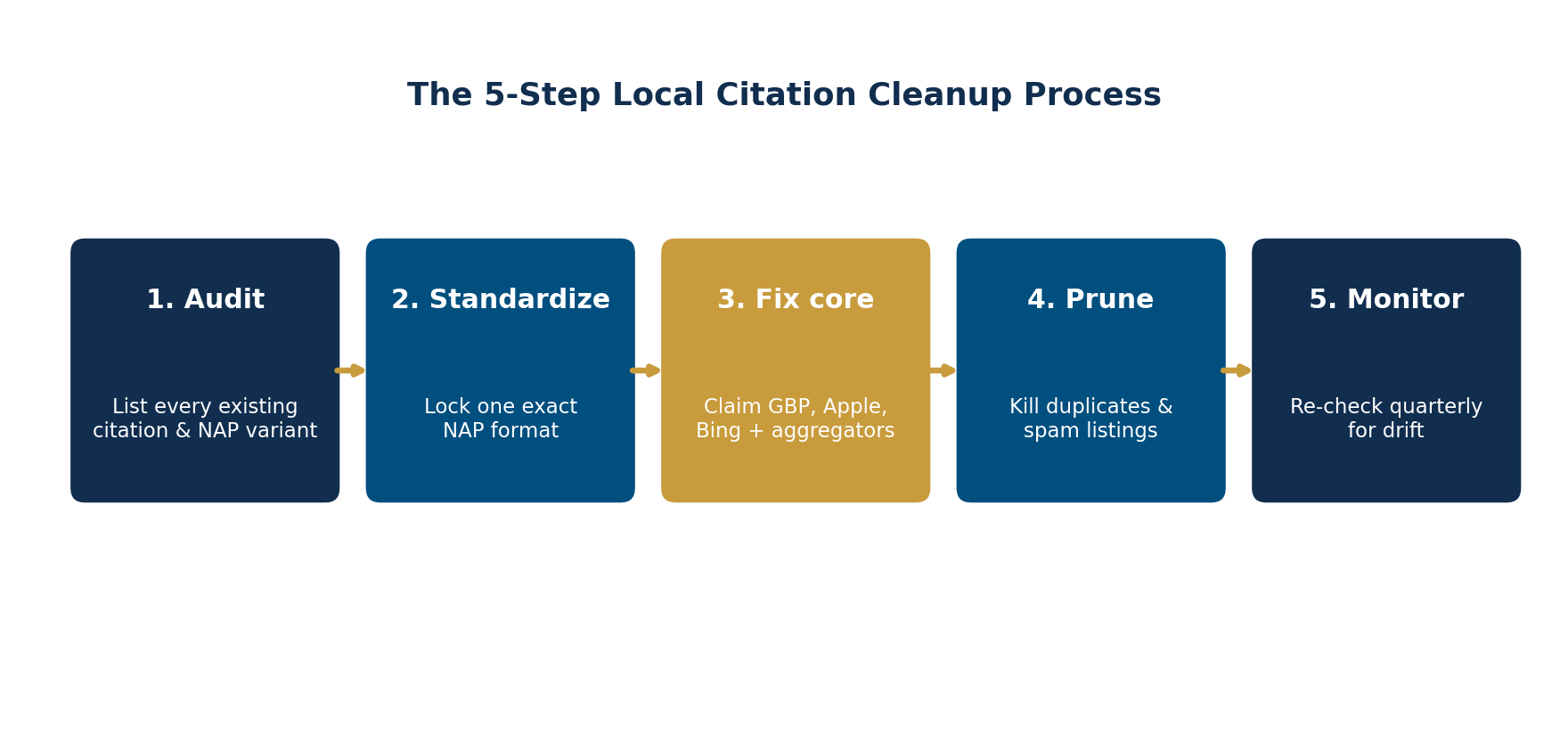
Figure 2: The five-step citation cleanup workflow MEAN Consultors uses — fix and standardize before you ever add anything new.
Once your core listings are claimed and identical, and the aggregators are fed clean data, your job shifts to maintenance. Citations drift — sites get sold, data gets overwritten, someone creates a duplicate. A quarterly check keeps small errors from quietly eroding the trust you built. If you want the full local-visibility picture beyond citations, our 2026 Local SEO Checklist covers the rest of the system.
Frequently Asked Questions
Do local citations still matter for SEO in 2026?
Yes, but their role has narrowed. Citations are no longer a volume game; they function as consistency and trust signals. A focused set of accurate, high-authority citations — led by your Google Business Profile — still supports local rankings, while low-quality bulk listings add nothing and can hurt through inconsistency.
How many citations does my business need?
Fewer than you think. A dozen or so genuinely relevant, perfectly consistent citations — the core platforms, the data aggregators, and a handful of industry or local directories — outperform hundreds of low-quality ones. Quality and consistency beat quantity.
What is NAP consistency and why does it matter?
NAP stands for name, address, and phone number. Consistency means those details are identical everywhere they appear online. It matters because Google cross-references your NAP across sources to verify your business; conflicting information undermines that trust and can suppress your local rankings.
Are paid citation-building services worth it?
Only the ones that submit to legitimate, relevant sources and keep your data consistent. Cheap “submit to hundreds of directories” services are usually a waste and often introduce the exact inconsistencies you’re trying to avoid. A careful manual or aggregator-based approach is safer.
How often should I audit my local citations?
At least quarterly. Directory sites change hands, data gets overwritten, and duplicates appear over time. A regular check catches drift early, before an incorrect address or old phone number starts costing you local visibility.
Which citation should I fix first?
Your Google Business Profile, without question. It’s the highest-value local signal and the listing Google shows in the map pack. Get it fully claimed, verified, and accurate before touching anything else.
MEAN Consultors audits, cleans, and maintains your local citations as part of a focused local SEO program built to rank you in your city.