
GEO vs. Traditional SEO: What Changes and What Stays the Same
Last updated: September 1, 2026 · By Joseph Olivas, Founder, MEAN Consultors · 10 min read
I get a version of this question every week now: do we need to throw out the SEO plan and start doing GEO instead? The honest answer is less dramatic than either side of the argument suggests. Most of what you built for search still works, and pretending otherwise is expensive. But a meaningful slice of your audience is now getting an answer without visiting anyone’s website, and the work required to be present in that answer is not identical to the work required to rank.
Start with what the data actually shows
Arguments about GEO tend to run on vibes, so it is worth anchoring on measured behaviour. In March 2025, Pew Research Center tracked the real browsing activity of 900 U.S. adults across 68,879 Google searches — not survey recall, actual clicks.
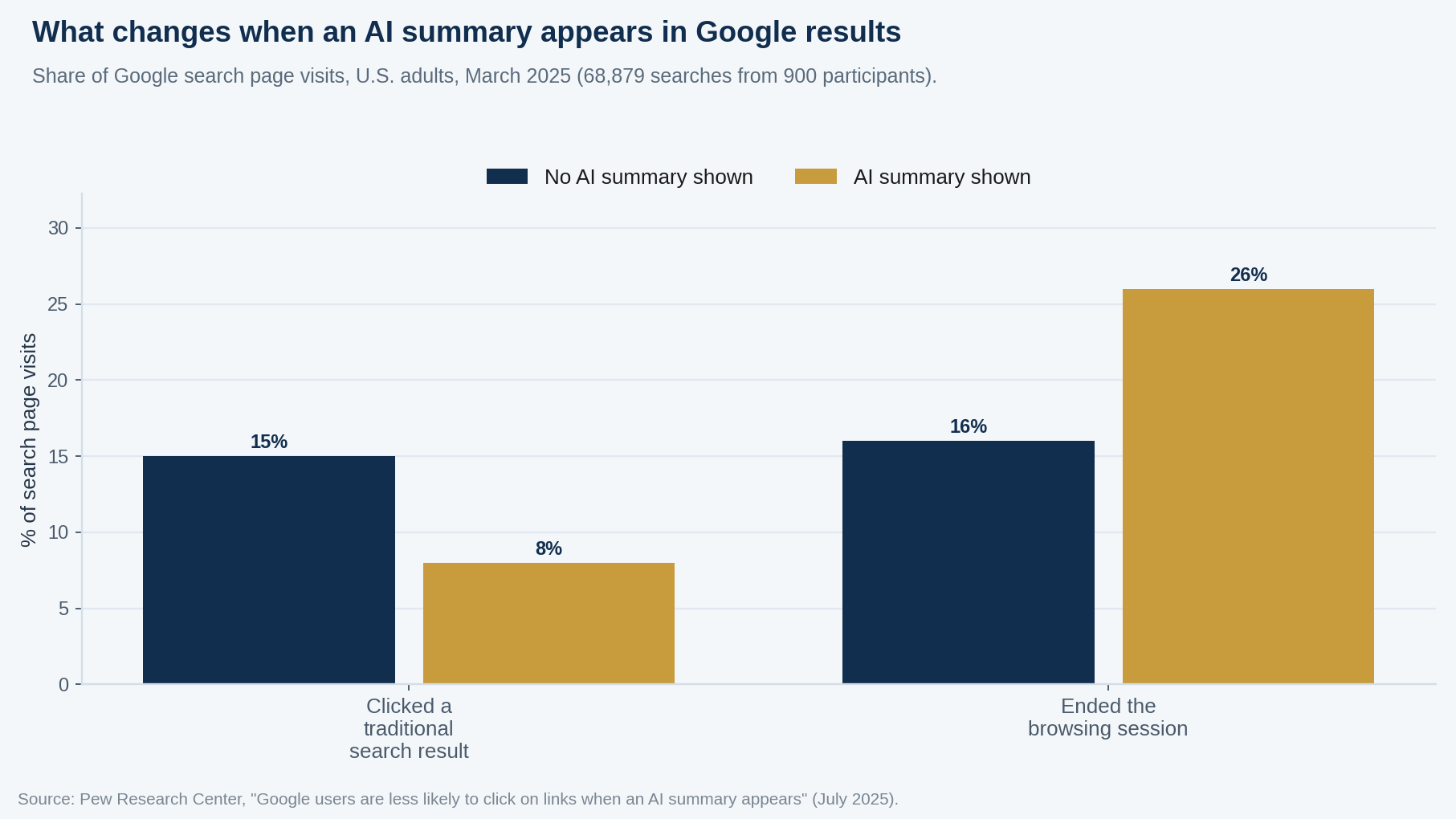
Figure 1: Click and session behaviour with and without an AI summary. Data: Pew Research Center, March 2025 browsing panel (68,879 Google searches).
Three findings matter for planning. Users clicked a traditional search result on 8% of visits where an AI summary was present, versus 15% where it was not — roughly half. Clicks on links inside the summary itself occurred on about 1% of those visits, so the summary is not quietly redistributing the traffic. And users ended the browsing session entirely on 26% of AI-summary pages versus 16% without, which is the clearest signal that the question got answered.
What that does not say is that search traffic has collapsed. AI summaries appeared on 18% of searches in that window, so the majority of queries still behaved conventionally. The correct reading is a shift in mix, not a cliff: a growing minority of queries now resolve without a visit, and those are disproportionately the informational ones. If your content strategy is built entirely on top-of-funnel explainers, that mix shift lands on you first.
- Clicks to traditional results roughly halve when an AI summary is present (8% vs. 15% of visits, Pew, March 2025).
- Links inside AI summaries are clicked on about 1% of visits, so the citation is influence, not a traffic channel.
- AI summaries appeared on 18% of searches in the study window — a significant minority, not yet the default.
Where the two disciplines actually diverge
The clearest way to see the difference is to look at how an answer engine builds a response. It is not one ranked list; it is a short pipeline, and traditional SEO addresses only part of it.
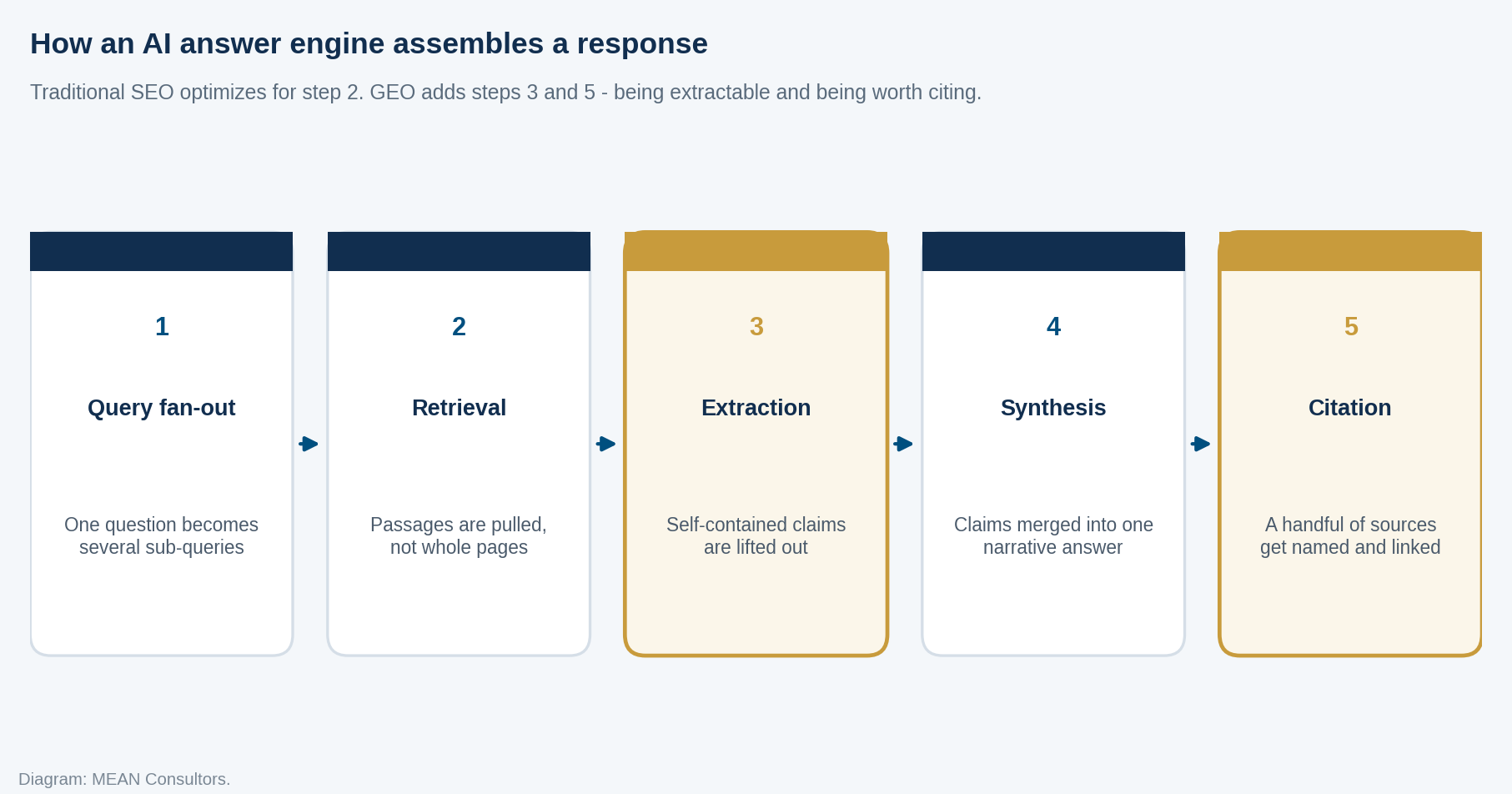
Figure 2: How an AI answer engine assembles a response. Classic SEO competes at retrieval; GEO adds extraction and citation.
Query fan-out. The engine decomposes one question into several sub-queries. This is why long-tail coverage matters more than it used to — you may be retrieved for a sub-question you never targeted.
Retrieval. Candidate passages are pulled from an index. This step is pure traditional SEO: crawlability, indexation, site architecture, internal links, authority. Nothing here is new, and nothing here is optional.
Extraction. Self-contained claims are lifted out of those passages. This is the first genuinely new competitive surface. A paragraph that only makes sense after three paragraphs of setup is a poor extraction candidate no matter how good the article is.
Synthesis. Claims from multiple sources get merged into one narrative. You do not control this, but you influence it: consistent, unambiguous phrasing across your own pages makes your version of a claim easier to reconcile.
Citation. A handful of sources get named. Models favour sources that look attributable — identifiable authors, dates, named organizations, original data. If your best statistic is uncited, someone else’s cited version gets the mention.
Read against that pipeline, the whole GEO-versus-SEO argument resolves. Retrieval is table stakes you already know how to earn. Extraction and citation are the new work. If you want the fuller foundation, our pillar guide on what generative engine optimization actually is covers the mechanics in depth, and the companion piece on how to get cited by ChatGPT, Perplexity, and Google AI Overviews covers the tactics.
Side by side: what carries over and what does not
| Dimension | Traditional SEO | GEO |
|---|---|---|
| Unit of competition | The page | The passage |
| Success metric | Ranking position, clicks | Citation presence, share of answers |
| Result surface | A ranked list the user chooses from | A synthesized answer the user reads |
| Payoff | A session on your site | Often influence without a session |
| Content shape | Comprehensive, keyword-anchored | Modular, self-contained, directly answered |
| Authority signal | Links and domain history | Links, plus attributable expertise and original data |
| Freshness | Matters for some queries | Matters more — dated pages get skipped |
| Technical baseline | Crawl, index, speed, structure | Identical, plus AI crawler access |
Notice how much of the left column survives intact. Site architecture, internal linking, page speed, and schema all carry over unchanged — if anything they matter more, because a badly structured site produces badly bounded passages. What genuinely changes is the shape of the writing and the definition of a win.
The practical adjustment list
This is what I actually change on a client site when we add GEO to an existing SEO program. It is shorter than most people expect.
- Answer the title question in the first sixty words of every commercial page, then prove it underneath. This one change does more than everything else combined.
- Make each H2 section stand alone. If a section cannot be understood when lifted out of the page, rewrite its opening sentence to restate its subject.
- Attribute every number to a named source with a date, inline. Unattributed statistics are a liability in an extraction pipeline.
- Publish at least one thing only you can publish — your own data, your own benchmark, your own documented process. Synthesis rewards uniqueness; there is no reason to cite the fourth restatement of a common claim.
- Add FAQPage and Article schema that matches the visible content exactly, and keep author and date metadata accurate.
- Check robots.txt for accidental AI crawler blocks and decide deliberately, per bot, rather than inheriting a default.
- Keep pages current and say so. A visible “last updated” date, honestly maintained, is both a trust signal and a freshness signal.
- Build the internal link graph properly. Pillar-and-cluster structure helps retrieval understand which page is authoritative on a topic. Our guide to internal linking strategy covers the mechanics.
How to measure a channel that does not send clicks
The hardest part of GEO is not the optimization, it is the reporting. A discipline whose main output is a mention inside somebody else’s answer does not fit a sessions-and-conversions dashboard, and if you force it into one, you will conclude that content stopped working.
Build a simple citation baseline first. Take the twenty questions your buyers genuinely ask, run them through the major assistants once a month, and log whether you appear, who appears instead, and how you are characterized. It is manual and it is unglamorous, and it is the only measurement most small businesses actually need. Layer on server logs for AI crawler activity, referral traffic from assistant domains, and branded search volume in Search Console — a rise in people searching your name with no campaign behind it is often the first visible trace of citations working. Our guide to setting SEO KPIs that connect to revenue covers how to fold this into a report an owner will actually read.
The strategic point underneath all of this: the firms doing well in AI answers are, overwhelmingly, the firms that were already doing SEO properly and then made their writing clearer and their evidence original. There is no shortcut hiding in the new acronym. There is a real shift in emphasis, and it rewards the same thing it always did — being genuinely worth citing — just more literally than before. Our SEO services now treat the two as one program for exactly that reason.
Frequently Asked Questions
Is GEO replacing SEO?
No. GEO is a layer on top of SEO, not a replacement for it. Every major AI answer engine retrieves from an index built by crawling the web, so a page that cannot be crawled, is not indexed, or carries no authority signals does not enter the candidate set in the first place. What GEO adds is a second question: once your page has been retrieved, is the passage clear enough to be extracted and credible enough to be cited? Firms that abandon technical SEO to chase GEO end up optimizing for a pipeline they have been disqualified from.
What actually changes between SEO and GEO?
Three things. The unit of competition moves from the page to the passage, because answer engines pull self-contained chunks rather than whole documents. The success metric moves from ranking position to citation presence, because there is no position one in a generated answer. And the traffic economics change — Pew found users clicked a traditional result on 8% of visits where an AI summary appeared versus 15% where none did, so a citation may deliver influence without a session.
How do I know if AI engines are citing my site?
Start manually: run the twenty questions your buyers actually ask through ChatGPT, Perplexity, Google AI Mode, and Copilot, and record whether you appear and in what framing. That baseline takes an afternoon and tells you more than most tools. Then add server-side signals — AI crawler user agents in your logs (GPTBot, PerplexityBot, ClaudeBot, Google-Extended), referral traffic from AI assistant domains in analytics, and direct or branded-search lifts that follow no obvious campaign.
Does schema markup help with GEO?
It helps, but not as the magic switch it is often sold as. Structured data does not force a model to cite you. What it does is remove ambiguity about what a page is, who wrote it, when it was updated, and how its questions and answers pair up — which makes clean extraction more likely. FAQPage, Article or BlogPosting, Organization, and Person markup are the practical set. Treat schema as reducing friction, not as a ranking lever.
Should I write differently for AI engines than for people?
You should write more clearly, which serves both. The specific habits that help extraction — answering the question in the first two sentences, keeping each section self-contained, defining terms on first use, attributing data to a named source with a date, avoiding pronouns that depend on three paragraphs of prior context — are the same habits that help a rushed human reader. What does not work is writing for machines at the expense of people; Google’s scaled content abuse policy targets exactly that, regardless of whether the text was written by a person or generated.
If AI summaries reduce clicks, is content marketing still worth it?
Yes, but the measurement has to change with it. If you judge content solely on organic sessions, a rising share of your influence becomes invisible and you will cut budgets that are working. The realistic model is that content now does two jobs: it earns clicks from the searches that still send them, and it earns mentions inside answers that shape a buyer’s shortlist before they ever visit. Track branded search volume, direct traffic quality, and how often prospects arrive already familiar with your framing.
What should a small business do first?
Fix retrieval before you worry about citation. Confirm your key pages are indexed, fast, and crawlable by AI user agents rather than blocked in robots.txt by accident. Then take your ten highest-intent pages and restructure the opening of each one so it answers its own title question in under sixty words, with the supporting evidence attributed underneath. That single change — a direct answer near the top of every commercial page — is the highest-leverage GEO work available to most small businesses.
MEAN Consultors audits what AI engines currently say about your business, then fixes the retrieval and extraction problems keeping you out of the answer.