
Agile vs. Waterfall Software Development: What Actually Fits Your Custom Project
Last updated: July 21, 2026 · By Joseph Olivas, Founder, MEAN Consultors · 8 min read
Choosing between Agile and Waterfall is one of the first real decisions on any custom software project, and it is usually made for the wrong reasons — habit, whichever the last vendor used, or whichever sounds more modern. After delivering custom software for U.S. businesses for years, I have learned the choice is less about ideology and more about how much you actually know at the start, how likely requirements are to change, and how you have structured the contract. Here is how I help clients decide.
The Core Difference in One Paragraph
Waterfall is sequential: you define all requirements up front, then design, build, test, and release in distinct phases. Agile is iterative: you build in short cycles (usually one to four weeks), ship working software frequently, and adjust the plan as you learn. Waterfall optimizes for predictability against a fixed plan; Agile optimizes for adaptability when the plan is uncertain. If you want to go deeper on scoping the work itself, our custom software development process is built around picking the right cadence for each project rather than forcing one method on every client.
What the Data Actually Says About Success Rates
The most-cited numbers come from The Standish Group’s CHAOS research, which defines a project as “successful” only when it is delivered on time, on budget, and with the planned features. By that strict bar, Agile projects succeed roughly three times more often than Waterfall projects — and, just as importantly, they fail far less often.
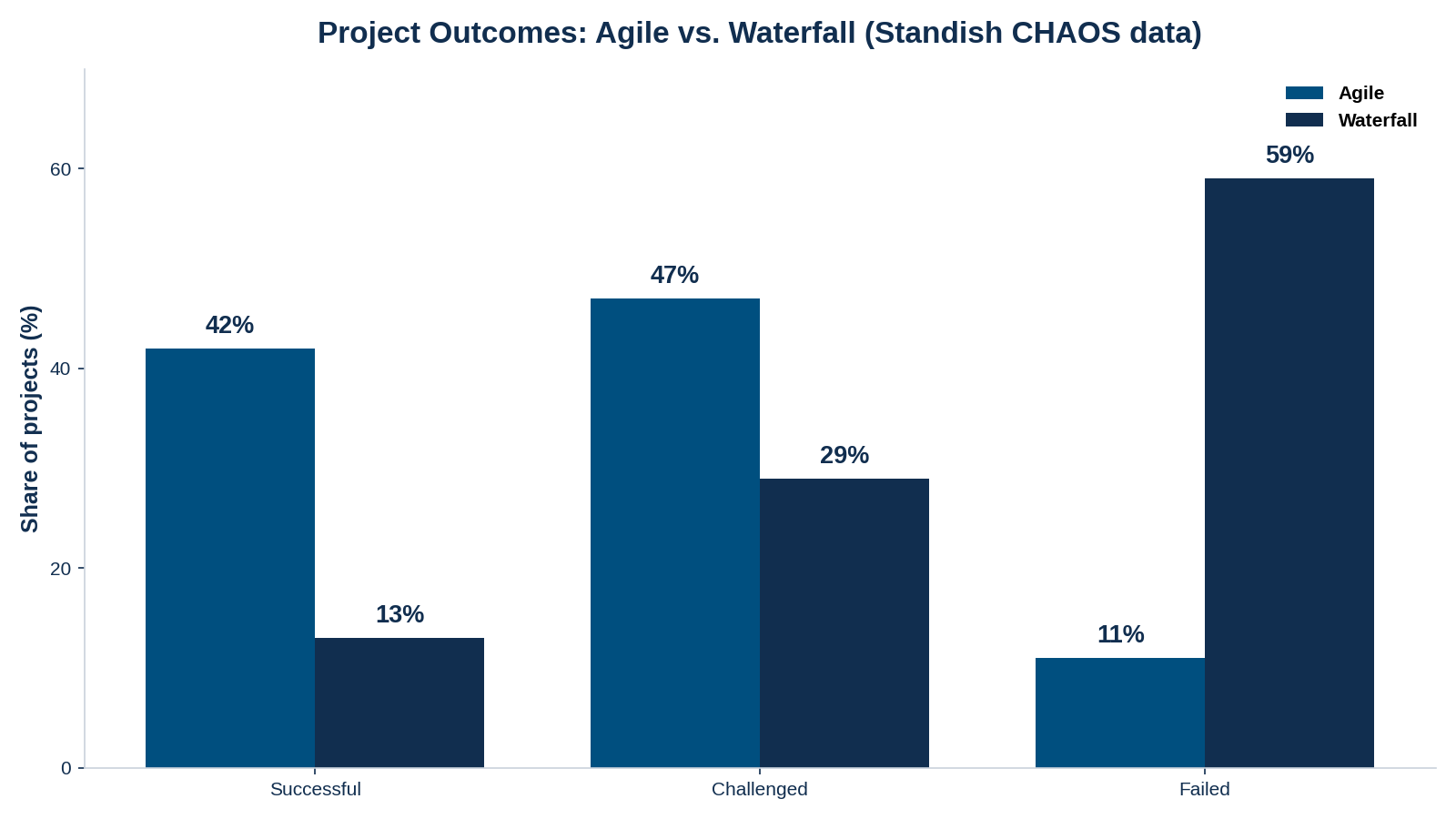
Figure 1: Project outcomes for Agile vs. Waterfall, based on The Standish Group CHAOS report.
| Outcome | Agile | Waterfall |
|---|---|---|
| Successful (on time, on budget, full scope) | 42% | 13% |
| Challenged (late, over budget, or reduced scope) | 47% | 29% |
| Failed (cancelled or never used) | 11% | 59% |
- Agile projects are about 3x more likely to be delivered fully successfully than Waterfall projects (42% vs. 13%).
- The gap widens with project size — Standish found the Agile advantage is most pronounced on medium and large efforts.
- Waterfall’s biggest risk is outright failure: 59% of Waterfall projects were cancelled or never used, versus 11% for Agile.
Two caveats keep this honest. First, “Agile” in these studies often means teams that are genuinely disciplined about iteration, not teams that simply hold stand-ups. Second, success rate is not the only variable — a small, fully specified project can be delivered predictably with Waterfall at lower coordination cost.
The Industry Is Quietly Moving to Hybrid
The clean Agile-versus-Waterfall debate is increasingly outdated. In the Project Management Institute’s 2024 Pulse of the Profession research, roughly 71% of organizations reported using Agile to at least some degree — but the fastest-growing category is neither pure Agile nor pure Waterfall. Hybrid approaches (a predictive plan for the parts you understand, iterative cycles for the parts you don’t) climbed from about 20% of organizations in 2020 to 31% in 2023, while purely predictive/Waterfall use declined.
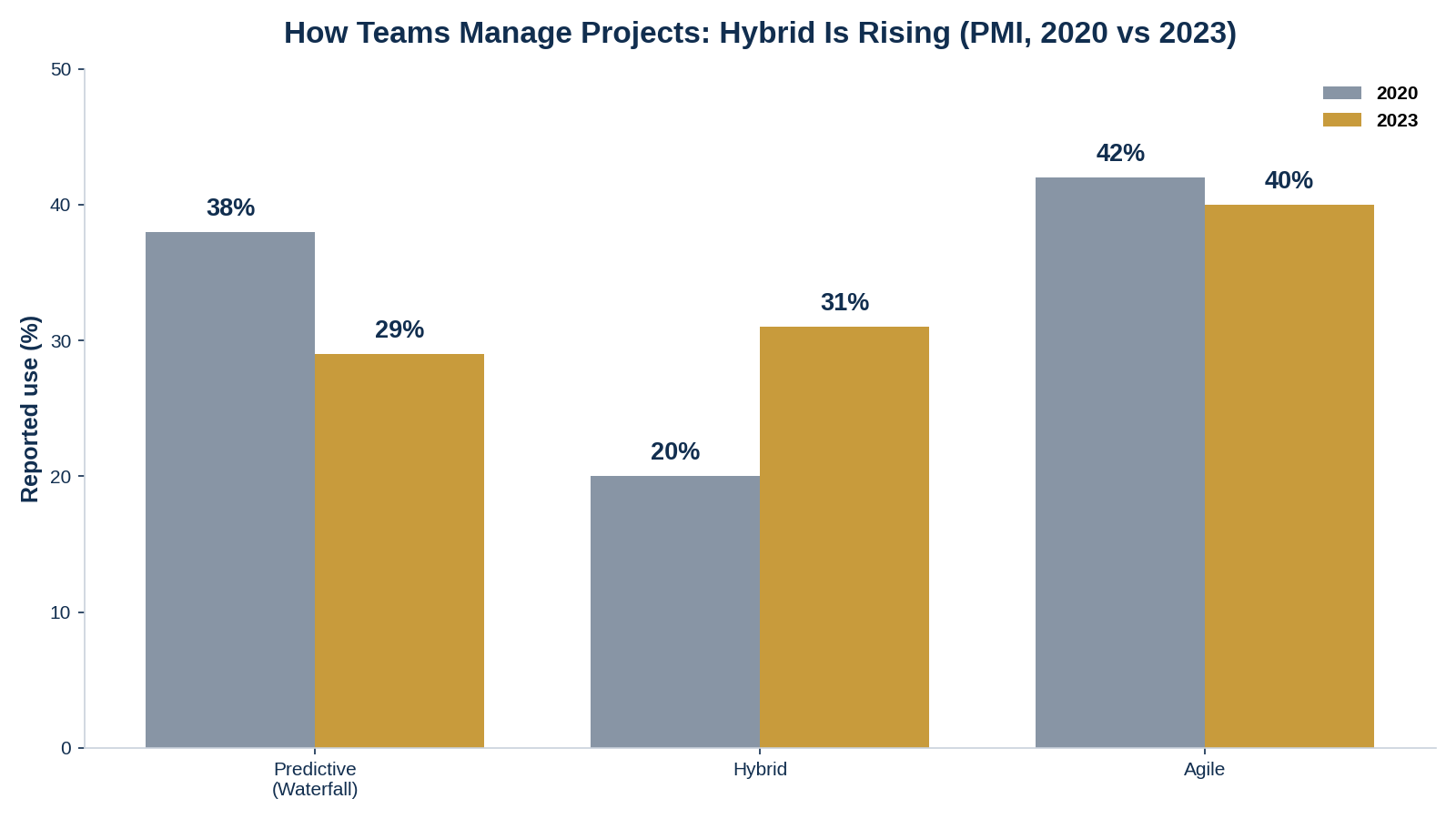
Figure 2: The shift toward hybrid delivery, 2020 vs. 2023 (directional, based on PMI Pulse of the Profession).
This matches what I see in the field. Very few real custom projects are 100% uncertain or 100% fixed. A payments integration with a hard compliance deadline benefits from Waterfall-style up-front design; the customer-facing dashboard bolted onto it benefits from Agile iteration. Treating “method” as a single global choice is the mistake — you can and should vary it by workstream.
A Practical Decision Framework
Instead of asking “which method is better,” ask “how much is likely to change, and how is risk allocated in the contract?” The table below is the same rubric I walk clients through.
| If your project has… | Lean toward | Why |
|---|---|---|
| Clear, stable, fully documented requirements | Waterfall | Little to gain from iteration; up-front planning reduces coordination overhead |
| Evolving requirements or an unproven concept | Agile | Frequent feedback prevents building the wrong thing for months |
| A hard regulatory or audit sign-off | Waterfall / Hybrid | Phase gates and documentation map cleanly to compliance needs |
| A fixed-bid contract | Waterfall | Fixed price needs fixed scope; Agile pairs better with time-and-materials |
| Mixed certainty across modules | Hybrid | Plan the known parts, iterate the unknown parts |
A Five-Question Checklist Before You Commit
- Can we write down complete, unambiguous requirements today — and are we confident they won’t change?
- How costly is it to discover a wrong assumption late rather than early?
- Does a regulator, auditor, or enterprise client require formal phase documentation?
- Is the budget structured as fixed-bid, or as time-and-materials with a cap?
- Is a stakeholder available to review working software every two to four weeks?
If you answered “requirements will change,” “late discovery is expensive,” and “yes, a reviewer is available,” Agile is almost always the right call. If you answered “requirements are locked,” “fixed-bid,” and “no reviewer available,” Waterfall or a hybrid with a strong planning phase will serve you better. When you are also weighing whether to build at all versus buy something off the shelf, that decision interacts with method choice — a topic we cover in depth in our guide to custom software strategy.
What the Choice Means for You as the Client
Method choice is not just an internal engineering preference — it changes how you experience the project as the person paying for it. Under Waterfall, most of your involvement is front-loaded: you spend heavily on requirements and sign-off early, then wait, often for months, before you see anything running. That is comfortable if your requirements are genuinely settled, and nerve-wracking if they are not, because the first time you touch the software is also the last chance to change it cheaply.
Under Agile, your involvement is spread across the whole engagement. You review working software every couple of weeks, which means you catch misunderstandings while they are still cheap to fix and you can reprioritize as the market or your business shifts. The trade-off is that you have to stay engaged — an Agile project with an absentee client tends to drift. I tell clients plainly: if you cannot commit to a short, regular review, Agile loses much of its advantage and a planning-heavy hybrid may serve you better.
The most expensive pattern I see is a Waterfall contract with Agile expectations — a fixed scope and price signed on day one, followed by a stream of “small” change requests that were never budgeted. Aligning the delivery method with the contract structure up front prevents that friction and keeps the relationship healthy through delivery.
Frequently Asked Questions
Is Agile always better than Waterfall for custom software?
No. Agile wins on average and especially on projects with changing requirements, but Waterfall can be more efficient for small, fully specified projects, fixed-bid contracts, and work with hard regulatory phase gates. The best predictor is how much your requirements are likely to change once you see the software working.
What is a hybrid Agile-Waterfall approach?
A hybrid approach uses up-front, Waterfall-style planning for the parts of a system that are well understood or compliance-driven, while running iterative Agile cycles for parts that are uncertain or user-facing. PMI data shows hybrid is the fastest-growing delivery model, rising from roughly 20% of organizations in 2020 to 31% in 2023.
Does Waterfall cost less than Agile?
Sometimes, on paper. For a small, fully specified project, Waterfall carries less ceremony and coordination overhead. But when requirements shift — which they usually do — Waterfall’s rework and late-discovery costs often exceed Agile’s, which is why Agile shows dramatically lower failure rates in the Standish data.
Can I use a fixed-price contract with Agile?
You can, but it requires care. Fixed price assumes fixed scope, and Agile deliberately keeps scope flexible. Most teams pair Agile with time-and-materials (often with a not-to-exceed cap) or fix the budget and timeline while keeping the feature list negotiable — delivering the highest-value features first.
How do I know if my software partner is truly Agile?
Ask how often you will see working software, how change requests are handled mid-project, and whether you will have a standing review cadence. Real Agile means shippable increments every one to four weeks and a documented way to reprioritize — not just daily meetings on top of a Waterfall plan.
MEAN Consultors scopes each custom software project to the right delivery method — Agile, Waterfall, or a hybrid tailored to your requirements and contract.