
Build vs. Buy Software: A Framework for Smarter Investment Decisions
Last updated: July 16, 2026 · By Joseph Olivas, Founder, MEAN Consultors · 8 min read
Nearly every growing business hits the same fork in the road: pay for off-the-shelf software, or invest in building something custom. Get it wrong and you either bolt your operations onto a tool that never quite fits, or you sink budget into building something you could have licensed for a fraction of the cost. This is the exact framework I walk clients through at MEAN Consultors so the decision comes down to evidence, not gut feel.
What “build vs. buy” actually means
“Buy” means licensing existing software — usually a SaaS subscription — and adapting your process to how the tool works. “Build” means commissioning custom software development tailored to your exact workflow, which you then own and maintain. There is also a middle path most owners overlook: a hybrid, where you buy proven commodity pieces (payments, email, accounting) and build only the layer that makes you different. The goal of a build vs buy software framework is not to crown one winner — it is to match each part of your operation to the right approach.
The six factors that should drive the decision
Most build-vs-buy debates go in circles because people argue about price alone. Price matters, but it is one input among several. I weight the decision across six factors, giving the most influence to the ones that are hardest to reverse later.
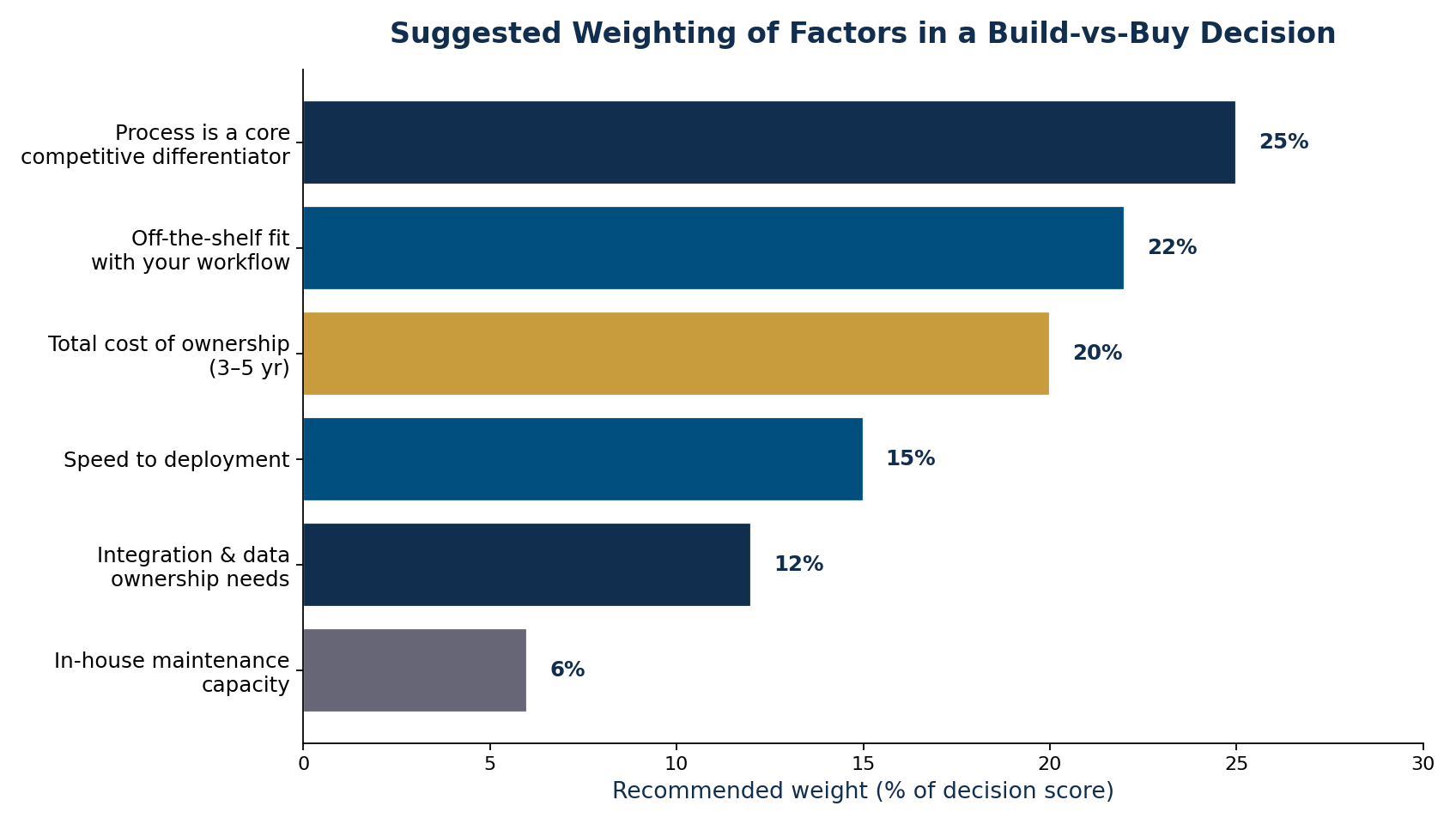
Figure 1: A suggested weighting of the factors that should drive a build-vs-buy decision.
| Factor | Weight | Leans “buy” when… | Leans “build” when… |
|---|---|---|---|
| Strategic differentiation | 25% | The process is generic (payroll, email) | The workflow is your competitive edge |
| Off-the-shelf fit | 22% | A tool covers 80%+ of needs | You’d need heavy workarounds |
| 3–5 yr total cost | 20% | Subscriptions stay modest at your scale | Per-seat costs balloon as you grow |
| Speed to deploy | 15% | You need it live in weeks | You can invest in a longer build |
| Integration & data ownership | 12% | Standard integrations suffice | You need full control of your data |
| Maintenance capacity | 6% | You have no one to maintain code | You have or will hire technical support |
- The two factors that should dominate the decision — strategic differentiation (25%) and off-the-shelf fit (22%) — are about strategy, not price.
- Cost still carries real weight (20%), but only over a three-to-five-year horizon, not month one.
- Maintenance capacity is weighted lowest but sinks more custom projects than any other factor when ignored.
Run the numbers: total cost of ownership over 3–5 years
The single most common mistake I see is comparing a SaaS monthly fee against a one-time build quote. That is not a fair comparison. Buying looks cheap up front because the cost is spread thin, but subscriptions compound every month and climb as you add users. Building costs more on day one, then settles into predictable maintenance. According to a widely cited McKinsey and University of Oxford study, large software projects ran on average 45% over budget while delivering 56% less value than predicted — which is exactly why the build side of the ledger has to be estimated honestly, with contingency built in.
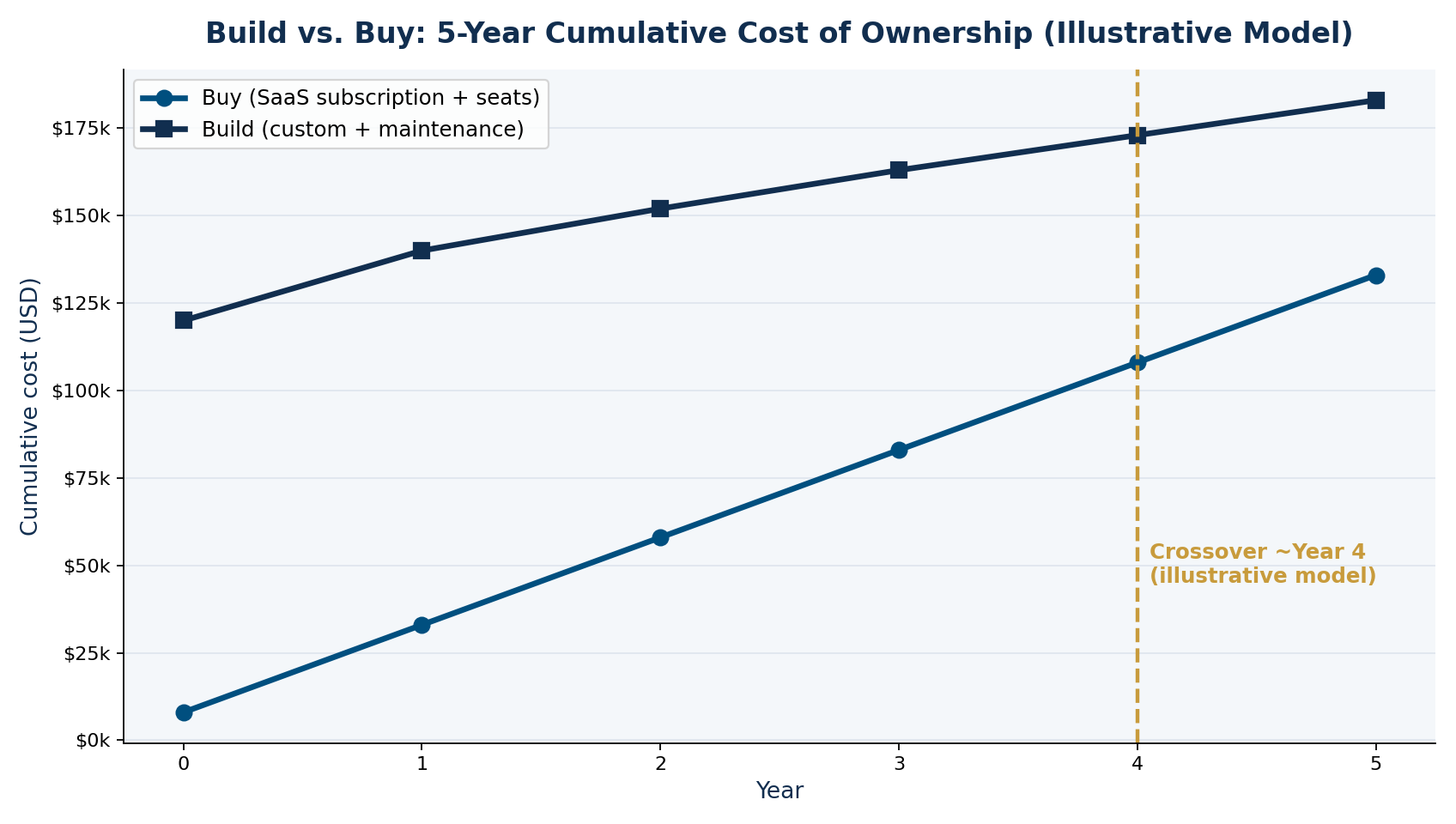
Figure 2: An illustrative five-year cost model — the “buy” line often overtakes “build” once seat counts and subscriptions compound.
The illustrative model above shows why the answer changes with time horizon. In the first year, buying almost always wins on cash. But once seat counts grow and annual subscription increases stack up, the cumulative “buy” line frequently crosses the “build” line somewhere between years three and five. If you plan to run the process for a decade, the total cost of ownership math often favors owning your software outright. If you might pivot away from the process in 18 months, buying protects you from sinking capital into an asset you’ll abandon.
A simple scoring method you can run in an afternoon
You don’t need a consultant to get 80% of the value from this framework. Here is the exact sequence I use with clients before a single line of code is scoped:
- Score each of the six factors from 1 (strongly favors buy) to 5 (strongly favors build).
- Multiply each score by its weight from the table above, then total the weighted scores.
- A weighted total under 2.5 points toward buying; above 3.5 points toward building; in between signals a hybrid.
- Pressure-test the two heaviest factors — differentiation and fit — with the people who actually do the work.
- Get a real build estimate and a real three-year subscription quote before committing to either path.
When buying wins, and when building wins
Buying is the right call more often than founders expect. If the process is a solved commodity — accounting, email marketing, help-desk ticketing — a mature tool will almost always beat anything custom on cost, reliability, and time to value. Reserve your build budget for the workflows that competitors can’t easily copy.
Building wins when the software is the differentiator: a proprietary pricing engine, a client portal no vendor sells, or an operational workflow so specific that every tool forces painful compromises. It also wins when integration and data ownership are non-negotiable, or when per-seat subscription costs have quietly grown into one of your largest line items. If you’re weighing this against a packaged tool, our deeper comparison of custom software versus off-the-shelf breaks down the trade-offs side by side. And if you’re not sure whether you’ve outgrown your current tools at all, the framework pairs well with our guide to the signals that it’s time for custom software.
Frequently Asked Questions
What is a build vs buy software framework?
It is a structured way to decide whether to license existing software or commission custom software, by scoring weighted factors — strategic differentiation, off-the-shelf fit, total cost of ownership, speed, integration and data needs, and maintenance capacity — instead of arguing about price alone.
Is it cheaper to build or buy software?
Buying is almost always cheaper in year one. Over three to five years, the math often flips: compounding subscriptions and per-seat increases can push the cumulative cost of buying past the cost of owning custom software. Always compare total cost of ownership over your real time horizon, not month-one price.
When should a small business build custom software?
When the process is a genuine competitive differentiator, when no off-the-shelf tool fits without heavy workarounds, when you need full ownership of your data and integrations, or when subscription costs have grown into a major expense. Otherwise, buying usually wins.
What is the hybrid build-vs-buy approach?
You buy proven commodity components — payments, email, accounting — and build only the differentiating layer on top. Most growing businesses land here, because it concentrates custom investment where it creates an edge and avoids reinventing solved problems.
How long does custom software take to build?
It varies with scope, but a focused first version typically takes weeks to a few months. That timeline is exactly why “speed to deploy” is a factor in the framework: if you need something live in days, buying wins by default.
MEAN Consultors scopes custom software only when the numbers justify it — and tells you honestly when an off-the-shelf tool is the smarter buy.