
AI-Assisted Content Workflows: What to Automate and What to Keep Human
Last updated: September 1, 2026 · By Joseph Olivas, Founder, MEAN Consultors · 10 min read
Most teams I talk to have already tried putting AI into their content process, and most describe the same disappointment: it saved less time than expected and the output needed more rewriting than expected. Almost always, the cause is the same design error. They automated the wrong step. They asked the model to decide what to say, and then spent their human hours fixing the consequences, when the leverage was in having a human decide what to say and letting the model handle getting it onto the page.
The research that should shape your workflow design
The most useful study on this is not about content marketing at all. In 2023, researchers from Harvard Business School, MIT, Wharton, and Warwick ran a field experiment with 758 consultants at Boston Consulting Group — about 7% of the firm’s individual contributors — comparing performance with and without GPT-4 on realistic knowledge work.
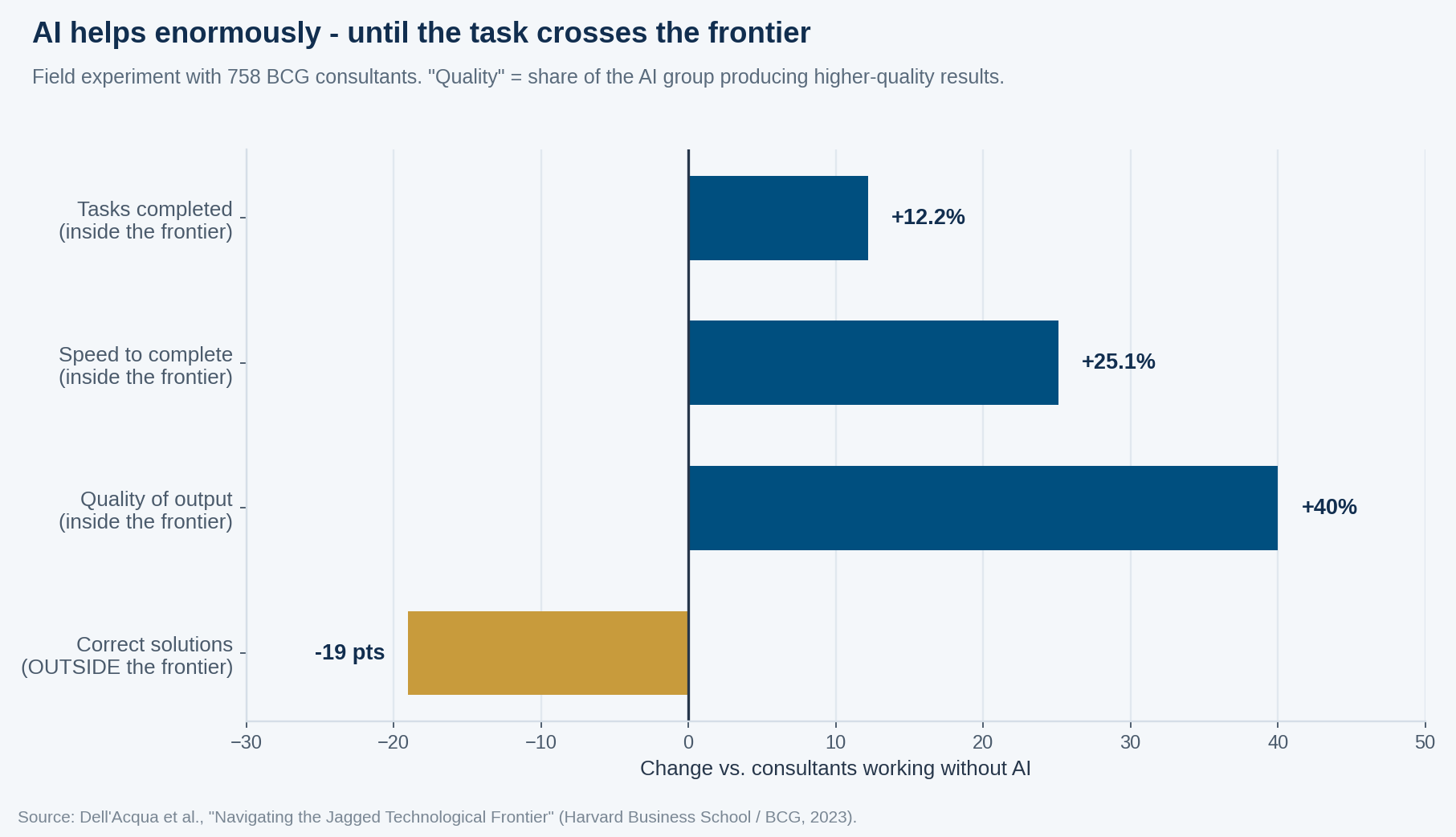
Figure 1: Results from Dell’Acqua et al., “Navigating the Jagged Technological Frontier” (HBS / BCG, 2023), n = 758 consultants.
On eighteen tasks inside AI’s capability, the assisted group completed 12.2% more tasks, 25.1% faster, with 40% of them producing higher-quality output. Those are large effects for a knowledge-work intervention. But the researchers also included one task deliberately chosen to sit outside the model’s competence, and there the assisted group was 19 percentage points less likely to reach the correct answer than the group working without AI.
The concept they named for this is the one worth carrying into your process: a “jagged technological frontier.” The boundary between what AI does brilliantly and what it does badly is irregular, and — critically — the two categories look equally easy from the outside. The model gives no signal when it crosses over. It produces the wrong answer with exactly the same fluency as the right one.
That single property determines everything about how a content workflow should be built. You cannot design a process that trusts the output and inspects it when it looks doubtful, because it never looks doubtful. You have to design a process where verification is unconditional.
- Inside AI’s capability: 12.2% more tasks completed, 25.1% faster, 40% of the AI group higher quality (BCG/HBS, n = 758).
- Outside it: 19 percentage points less likely to be correct — worse than working with no AI at all.
- The model gives no signal when it crosses the boundary, so verification cannot be conditional on output looking wrong.
The workflow, with the gates in the right places
Here is the shape I recommend, and the reasoning behind which steps stay human. It is deliberately unexciting: the value is in the boundaries, not the sophistication.
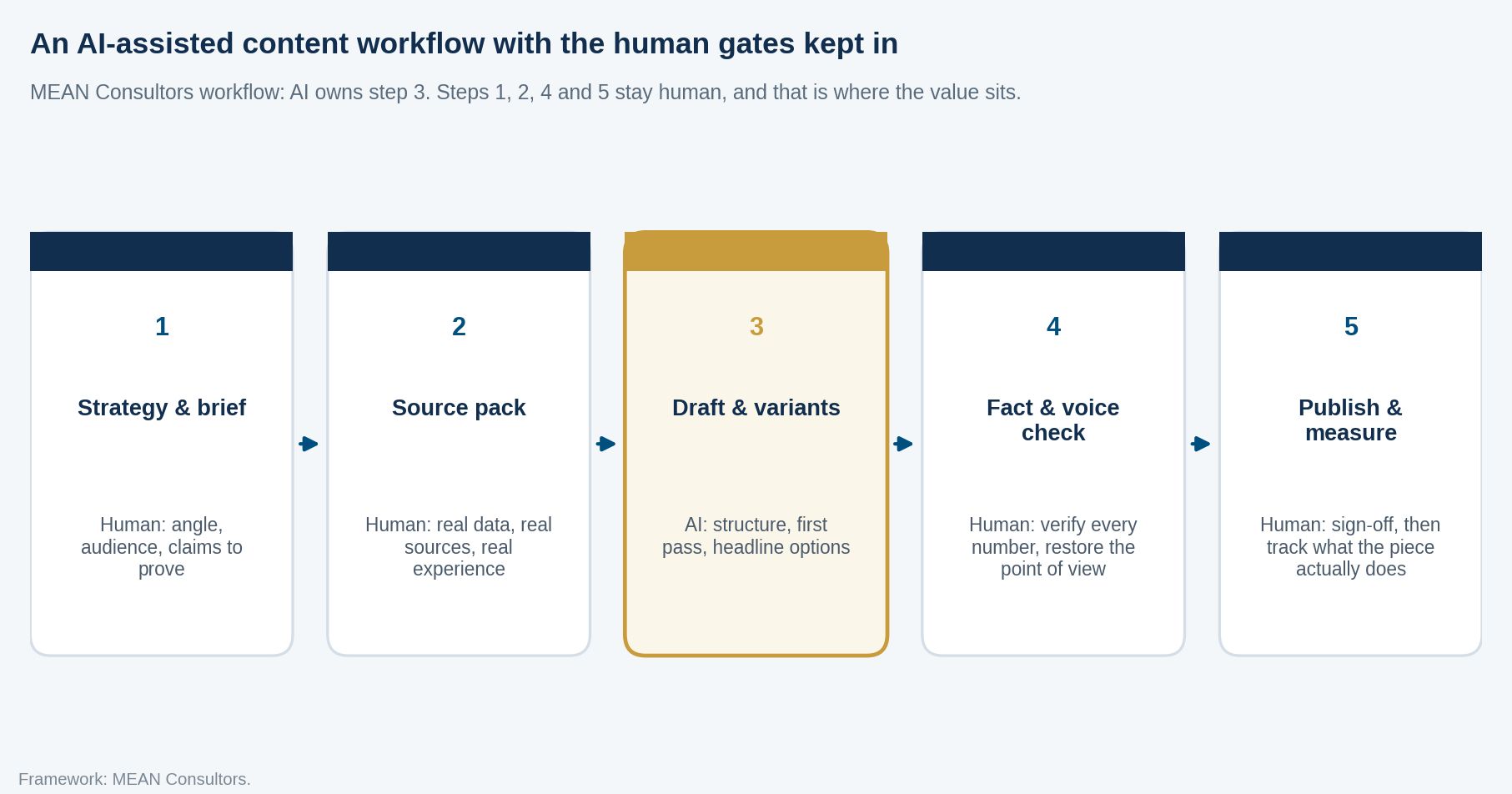
Figure 2: An AI-assisted content workflow. AI owns step three. Everything that determines whether the piece is worth publishing stays human.
Step 1 — Strategy and brief (human)
What is this piece arguing, for whom, and what claim are we willing to stand behind? A model can generate a hundred topic ideas, and they will regress toward what everyone else has already published, because that is what the training data contains. The angle is where differentiation lives, and it is the cheapest step to do well — twenty minutes of human thinking here saves hours downstream.
Step 2 — Source pack (human)
Assemble the actual inputs before drafting: the real statistics with their real sources, the internal data, the project experience, the customer quote. This is the step teams skip, and skipping it is what produces content indistinguishable from a competitor’s. It is also the single best defense against fabricated citations — a model working from a supplied source pack has far less occasion to invent one. If assembling this pack is your bottleneck, that is the signal to consider a retrieval layer over your own documents; our overview of retrieval-augmented generation explains how that works in practice.
Step 3 — Draft and variants (AI)
This is the step to automate, wholeheartedly. Given a real brief and a real source pack, a model produces a structured first draft quickly and generates alternatives — five headlines, three openings, two structures — at effectively zero marginal cost. Variant generation is genuinely underused; the value is not the first draft but the ability to see four framings of the same argument and pick the one that lands.
Step 4 — Fact and voice check (human)
Two distinct passes that get collapsed into one and should not be. The fact pass verifies every number, name, date, quote, and link against the source pack — unconditionally, including the claims that came from your own brief and look obviously right. The voice pass puts back what the model averaged out: the specific opinion, the concrete example, the sentence a competitor would not write. This is where keeping a human in the loop stops being a principle and becomes the actual work.
Step 5 — Publish and measure (human)
A named person signs off and owns the result. Then measure whether the piece did anything, because volume is the easiest thing to increase with AI and the least likely to matter on its own.
The automate / keep-human split, task by task
| Task | Automate? | Why |
|---|---|---|
| Topic and angle selection | No | Regresses to the average of what already exists; this is your differentiation |
| Outline from an approved brief | Yes, with review | Structural transformation of a decision you already made |
| First draft from brief + sources | Yes | Highest time saving, lowest judgment content |
| Statistics and citations | No | The one place fabrication is both most likely and most damaging |
| First-person experience and opinion | No | Cannot be generated; it is the only thing a competitor cannot copy |
| Headline and subject-line variants | Yes | Cheap volume, human picks the winner |
| Repurposing into other channels | Yes, with review | Format transformation of already-approved content |
| Meta descriptions and alt text | Yes | Bounded, mechanical, low risk |
| Fact-checking | No | Asking a model to check itself inherits the same blind spot |
| Final approval | No | Accountability cannot be delegated to a tool |
Read the “No” column and a pattern emerges: everything you keep is either a judgment call or an accountability point. That is not a coincidence, and it is a reasonable heuristic for any automation decision, not just content. We use the same test when scoping AI automation engagements generally.
Where Google actually draws the line
The compliance question comes up in every one of these conversations, and the answer is more permissive and more demanding than most people expect. Google’s Search Central guidance on AI-generated content states that its focus is content quality rather than production method, and that using automation to generate content primarily for ranking manipulation violates its spam policies.
The operative policy is scaled content abuse: creating many pages primarily to manipulate rankings, with little value to users. Note what that definition does not mention — whether a human or a model produced the text. It is method-agnostic by design. Google’s helpful content guidance and its quality rater framework push in the same direction, emphasizing experience, expertise, authoritativeness, and trustworthiness.
Translated into workflow terms, the line is roughly this: content that a knowledgeable person shaped, verified, and put their name on is inside policy regardless of what drafted it. Content mass-produced to occupy keyword space is outside it regardless of who typed it. The workflow above is not primarily a compliance exercise — but it happens to keep you comfortably on the right side of that line, which is a useful property.
How to roll this out without a six-month project
Pick one content type. Not your whole program — one type, ideally a repeatable one where the brief is already well-understood: case studies, product update posts, monthly newsletters. Document the five steps above for that single type, including who owns each gate by name. Run it for four pieces.
Then measure two things that are easy to overlook. First, actual hours per piece before and after, tracked honestly — teams routinely feel faster while spending the same total time in a different distribution. Second, the error catch rate at step four: how many factual problems did verification actually find? If the answer is zero across four pieces, your verification step is not real and you should be worried rather than reassured.
Only after that loop is stable should you expand to a second content type or invest in tooling. The temptation to start with tooling is strong and almost always wrong; the process is the product here, and a documented process with generic tools beats sophisticated tools with no process every time. For a broader view of where generative AI earns its keep across a business rather than just in marketing, see our overview of generative AI for business operations.
Frequently Asked Questions
What parts of content production should I actually automate?
Automate the parts where the answer is already determined and the work is transformation: turning an approved outline into a first draft, generating headline and subject-line variants, reformatting one asset into another channel, drafting alt text, producing meta descriptions, and summarizing source material you have already vetted. Keep human the parts where judgment creates the value: choosing the angle, deciding which claim you are willing to stand behind, supplying the experience nobody else has, verifying every number, and the final sign-off.
Does Google penalize AI-generated content?
Google’s stated position is that it rewards high-quality content regardless of how it is produced, and that its spam policies target scaled content abuse — generating many pages primarily to manipulate rankings with little value to users. The method is not the trigger; the intent and the outcome are. In practice this means AI-assisted content with genuine human oversight, original substance, and accurate information is inside policy, and mass-produced thin pages are outside it whether a person or a model wrote them.
How much time does an AI-assisted workflow actually save?
The best available evidence is a field experiment with 758 BCG consultants, which found that on tasks inside AI’s current capability, participants completed 12.2% more tasks and worked 25.1% faster, with 40% of the AI group producing higher-quality results. Content drafting is squarely inside that zone. But the same study found a 19-percentage-point drop in correct solutions on a task outside the model’s competence, which is why the savings only materialize when you also keep the verification step.
What is the biggest risk in an AI content workflow?
Fluent wrongness. A model produces text with uniform confidence whether the underlying claim is verified, misremembered, or invented, and it gives no signal about which. The failure mode is not obviously bad output that gets caught — it is plausible output that reads well, cites a statistic that does not exist, and gets published under your name. Every workflow control worth having exists to catch that specific problem, which is why the verification gate is non-negotiable.
Should we disclose that content was AI-assisted?
There is no universal rule, and it depends on the medium and your audience. My practical position: disclosure matters most where the reader is entitled to assume a human’s direct experience — a first-person case study, a client testimonial, a clinical or legal opinion. For informational content that a named person has researched, verified, and signed, the byline is already the accountability claim, and the tool used is comparable to the word processor. Where regulated industries have specific rules, follow those first.
How do we keep our brand voice from flattening out?
Assume the model will flatten it and plan a step to put it back. The failure is not that AI drafts sound bad; it is that they sound like everyone else’s AI drafts — competent, hedged, structurally identical. Two things help: give the model a substantial style reference from your own best work rather than adjectives like “professional,” and treat the human editing pass as a voice restoration pass, not just a fact-check. Specific opinions, real examples, and the willingness to say something a competitor would not are what survive.
Do we need custom tooling or are off-the-shelf tools enough?
For most teams producing under a few dozen pieces a month, off-the-shelf tools plus a documented process are enough, and building anything is premature. Custom tooling starts to pay when you have volume, a proprietary source corpus the model needs grounded access to, or compliance requirements that dictate where data goes. The trigger is usually the source-pack step: when assembling verified inputs becomes the bottleneck, a retrieval layer over your own documents earns its keep.
- Dell’Acqua et al., “Navigating the Jagged Technological Frontier: Field Experimental Evidence of the Effects of AI on Knowledge Worker Productivity and Quality” (Harvard Business School Working Paper 24-013, 2023)
- Google Search Central, “Google Search’s guidance about AI-generated content”
- Google Search Central, “Spam policies for Google web search” (scaled content abuse)
MEAN Consultors designs AI-assisted workflows — and the retrieval and review tooling behind them — around the steps that should stay human.